
Falls are the leading cause of injury among older adults, with nearly 43,000 hospitalizations recorded in nursing homes and assisted living settings in just one year, costing Medicare over $800 million. For families in New York, New Jersey, and Connecticut searching for the right community for a parent or spouse, that number hits close to home. But safety in assisted living is far more than preventing falls. It covers medication management, infection control, emergency preparedness, and cognitive support, all of which vary significantly from one facility to the next. This guide breaks down what safety really means, how tri-state regulations shape it, and what you can do to protect your loved one.
Table of Contents
- What safety really means in assisted living communities
- State regulations and standards in the tri-state area
- How facilities build a culture of safety: Practices, people, and technology
- The real impact: Risks, outcomes, and what families can do
- Safety is about culture, not just compliance: A tri-state family advisor’s view
- Find a safe assisted living community in the tri-state area
- Frequently asked questions
Key Takeaways
| Point | Details |
|---|---|
| Comprehensive safety is essential | You should look for multifaceted safety protocols covering physical, medical, cognitive, and emergency risks. |
| Regulations vary by state | Tri-state facilities must meet different safety standards depending on local rules in NY, NJ, or CT. |
| Proactive culture matters most | A safety-minded staff and leadership go beyond compliance to truly protect residents every day. |
| Tech adds value—but isn’t everything | Wearables and smart alerts help, but personal oversight and advocacy remain crucial. |
| Families play a key role | You can advocate for loved ones by checking compliance, asking tough questions, and choosing wisely. |
What safety really means in assisted living communities
Most families picture safety as grab bars in the bathroom and a call button by the bed. Those features matter, but they only scratch the surface. Safety in assisted living actually spans five distinct domains: physical safety, emergency preparedness, infection control, medication management, and cognitive or behavioral safety. Each one affects your loved one’s daily experience in a real and measurable way.
Physical safety covers the obvious things: fall prevention, secure flooring, adequate lighting, and outdoor spaces that reduce wandering risks. Emergency preparedness means the facility has practiced, documented plans for fires, severe weather, and medical crises. Infection control became a household term during the pandemic, but it was already a critical standard long before that, covering hand hygiene protocols, isolation procedures, and outbreak response. Medication management is often overlooked by families during tours, yet medication errors are among the most common adverse events in senior care settings. Cognitive and behavioral safety refers to how staff are trained to support residents with dementia, anxiety, or other conditions that affect behavior and judgment.
Here is a quick comparison of these safety domains and who is responsible for each:
| Safety domain | Primary responsibility | What families should look for |
|---|---|---|
| Physical safety | Facility maintenance and design | Handrails, non-slip floors, lighting, secured exits |
| Emergency preparedness | Administration and all staff | Posted plans, regular drills, backup power |
| Infection control | Nursing and care staff | Hand hygiene stations, visitor protocols, outbreak logs |
| Medication management | Licensed nursing staff | Locked medication carts, double-check protocols, reconciliation records |
| Cognitive/behavioral safety | Direct care staff and social workers | Dementia training, de-escalation skills, secure memory care units |
A safer environment for seniors is one where all five of these domains are actively managed, not just checked off a list during a state inspection. The best communities treat safety as an ongoing practice, not a one-time achievement.
“Nearly one in three adverse events in senior care settings involves an infection, and falls remain the top cause of injury-related hospitalizations. No single safety measure is enough on its own.”
Understanding the role of assisted living communities in supporting resident independence makes this even clearer. Safety and dignity are not opposites. When a community gets safety right, residents feel more confident and free, not more restricted.
State regulations and standards in the tri-state area
Understanding these core safety concepts, it’s important to know how regulations shape what assisted living facilities must provide, especially in the tri-state area. New York, New Jersey, and Connecticut each have their own licensing agencies, inspection schedules, and required safety standards. These differences matter when you are comparing facilities across state lines.
New York assisted living rules fall under the New York State Department of Health (NYSDOH), specifically Section 4662 of the Public Health Law. New York requires facilities to maintain detailed incident reporting, conduct regular fire drills, and meet specific staffing ratios for personal care. The NYSDOH also maintains a “Do Not Refer” list, which families can search to identify facilities with serious compliance violations.
New Jersey operates under N.J.A.C. 8:36, Subchapter 17, administered by the New Jersey Department of Health. NJ rules require facilities to conduct criminal background checks on all staff, maintain emergency evacuation plans, and provide documented medication management protocols. Connecticut licenses Assisted Living Services Agencies through the Department of Public Health (DPH), with specific requirements around service agreements, care plans, and staff training in resident rights.
Here is how the three states compare on key safety requirements:
| Requirement | New York | New Jersey | Connecticut |
|---|---|---|---|
| Staff background checks | Required | Required | Required |
| Incident reporting to state | Within 24 hours | Within 24 hours | Within 5 days |
| Fire and emergency drills | Quarterly | Twice yearly | Twice yearly |
| Medication management oversight | Licensed nurse required | Licensed nurse required | Nurse or trained aide |
| Dementia-specific training | Required for memory care | Required for memory care | Required for memory care |
| State inspection frequency | Annual | Annual | Every 2 years |
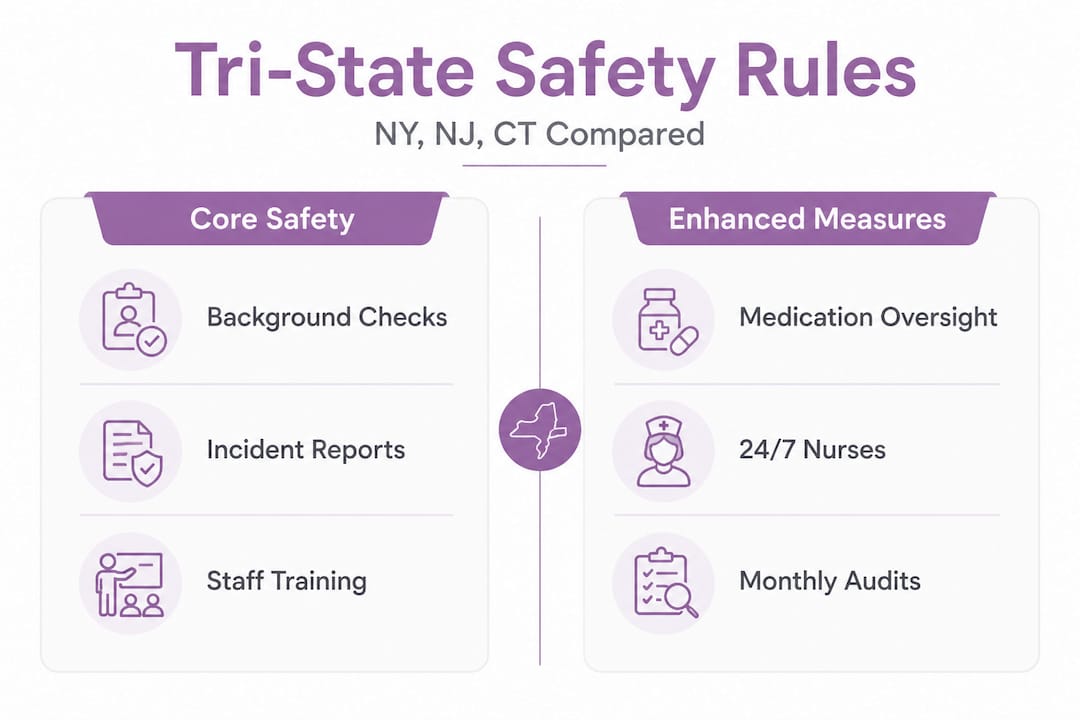
New Jersey safety standards are particularly detailed around medication oversight, which is worth noting if your loved one takes multiple prescriptions. Connecticut’s longer inspection cycle means families may need to be more proactive in requesting recent inspection reports.
Some protections are mandated by law. Others, like monthly safety audits or 24/7 nursing coverage, are simply markers of a high-quality facility. Knowing the difference helps you ask better questions.
Pro Tip: Before touring any facility, pull its most recent state inspection report. In New York, these are available through the NYSDOH website. In New Jersey, search the NJ DOH licensing portal. In Connecticut, contact the DPH directly. Look for patterns, not just isolated incidents. One complaint in five years tells a different story than three complaints in one year.
How facilities build a culture of safety: Practices, people, and technology
State rules set the foundation, but it’s the day-to-day actions, values, and innovations at each facility that bring safety to life. A community can pass every inspection and still have a weak safety culture. The difference shows up in small, observable details during your visit.
Here is what families should look for when evaluating how a facility practices safety:
- Visible safety features: Non-slip flooring, handrails in all hallways, call systems in every room and bathroom, secured exits in memory care units, and adequate lighting throughout common areas and bedrooms.
- Emergency preparedness documentation: Ask to see the facility’s emergency plan. It should be current, posted in visible locations, and reviewed with staff at least twice a year. Emergency preparedness checklists from accrediting bodies like The Joint Commission provide a useful benchmark.
- Staff training records: Ask how often staff receive safety training and whether it covers fall prevention, dementia care, and emergency response. Facilities with strong cultures train beyond the minimum required hours.
- Technology integration: Leading communities now use wearable alert devices, motion sensors, and smart monitoring systems. Research shows wearables reduce falls by 46% and smart home technology cuts emergency response times by 67%. These are meaningful numbers when seconds count.
- Incident reporting transparency: Ask how the facility reports and reviews safety incidents internally. A good facility will have a clear process and will be willing to share summary data with families.
Technology adoption is accelerating across the tri-state area, and the results are worth noting. Wearable devices that detect sudden movement changes can alert staff before a fall becomes a hospitalization. Smart sensors in rooms can identify unusual patterns, like a resident who hasn’t moved in several hours, without requiring constant visual monitoring. These tools support better outcomes for seniors when they are implemented thoughtfully.
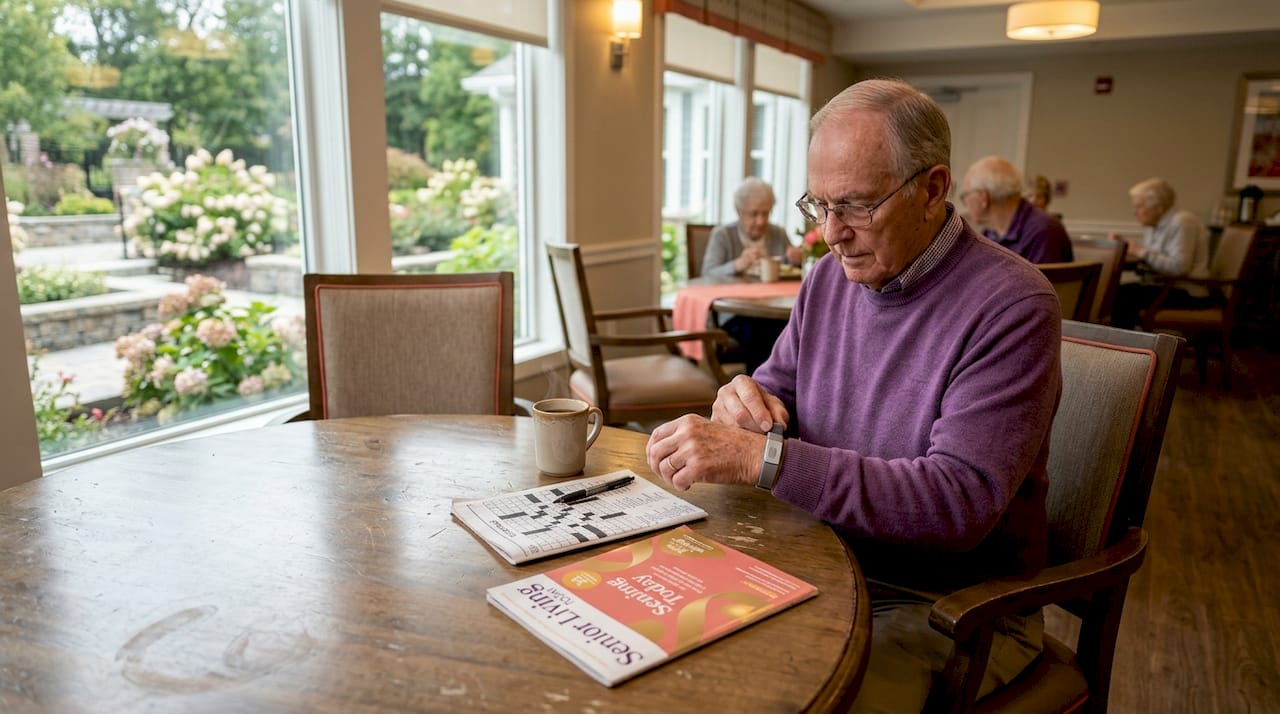
That said, technology has real limits. Wearables only work if residents wear them consistently. Sensors can generate false alarms that lead to alert fatigue among staff. Privacy is a genuine concern for residents who value their independence. The best facilities balance innovation with usability and always keep the human element central. The industry is evolving to better suit seniors, and families benefit from knowing what good technology adoption looks like versus what is just a marketing feature.
Pro Tip: During your facility tour, ask specifically about staffing ratios on overnight shifts. Safety incidents are more likely to occur when staffing is thin. A ratio of one caregiver to eight or fewer residents overnight is a strong indicator of genuine commitment to safety.
The real impact: Risks, outcomes, and what families can do
With an understanding of standards and best practices, it’s important to grasp what these measures mean for real families and outcomes. The data is sobering. Falls account for 3 million emergency department visits among older adults every year in the United States, and nearly one in three adverse events in senior care involves an infection. Facilities with lower staffing levels consistently show higher rates of both.
The gap between high-safety and low-safety communities is not small. Residents in well-staffed, well-trained environments experience fewer hospitalizations, shorter recovery times, and measurably better quality of life. For families, this translates to fewer emergency calls, less disruption, and greater peace of mind.
Here are warning signs that a facility may have weak safety practices:
- Staff seem rushed or unable to answer basic questions about safety protocols
- The facility cannot produce a current emergency evacuation plan
- Inspection reports show repeated citations for the same violations
- There is no visible system for tracking medication administration
- Common areas have poor lighting or obvious fall hazards like loose rugs or cluttered hallways
- Staff turnover is high, which disrupts continuity of care and safety monitoring
And here are concrete steps families can take, both during the search and after move-in:
- Request and read the last two state inspection reports before signing any agreement
- Ask the admissions director how safety incidents are communicated to family members
- Schedule an unannounced visit after move-in to observe the facility during a regular shift
- Attend family council meetings, which most facilities are required to hold, to hear from other families
- Establish a direct relationship with the charge nurse or care coordinator for your loved one
- Know your loved one’s rights under state law, including the right to file a complaint without retaliation
Communities that help residents thrive do so because families stay engaged. Your involvement is not a burden to the facility. It is a protective factor for your loved one.
“Facilities with adequate staffing ratios and documented safety training programs show significantly lower rates of fall-related hospitalizations and infection outbreaks. Staffing is not a luxury. It is a safety variable.”
The connection between safety and mental and physical health improvement is well established. When residents feel secure, they participate more, eat better, sleep better, and maintain stronger social connections, all of which support long-term health.
Safety is about culture, not just compliance: A tri-state family advisor’s view
Here is something we have learned from working with hundreds of families across New York, New Jersey, and Connecticut: inspection scores tell you the floor, not the ceiling. A facility can score well on every state checklist and still have a culture where staff cut corners when no one is watching, where leadership avoids difficult conversations, and where safety is treated as a compliance exercise rather than a genuine value.
The families who find the best outcomes are the ones who look past the brochure. They ask the hard questions. They notice whether the administrator knows residents by name. They pay attention to how staff interact with each other, not just with residents. A team that respects and supports one another tends to provide safer, more attentive care.
We also want to challenge the idea that a perfect inspection record means a facility is the right fit. Some facilities with spotless records are deeply risk-averse in ways that limit resident independence. Others with a minor citation in their history have genuinely learned from it and built stronger systems as a result. Context matters enormously.
The real differentiator is leadership. When a facility director actively participates in safety drills, reviews incident reports personally, and creates an environment where staff feel safe reporting concerns without fear of blame, residents benefit directly. That kind of culture is visible during a thoughtful tour. It shows up in how staff answer your questions, whether they seem proud of their work, and whether they can describe specific improvements the facility has made in the past year.
Competition among assisted living communities in the tri-state area is actually driving meaningful improvements in safety standards. Facilities know that informed families ask better questions, and the best communities welcome that scrutiny. Use it to your advantage.
Find a safe assisted living community in the tri-state area
If you’re now ready to apply these insights in your own search, you don’t have to navigate it on your own. Choosing a community that meets both safety standards and your loved one’s personal needs is a process that takes time, local knowledge, and the right questions.
At Assisted Living Advisers, we specialize in helping tri-state families identify vetted communities that prioritize genuine safety cultures, not just compliance checkboxes. Our advisers know the facilities in New York, New Jersey, and Connecticut firsthand. We can help you find assisted living near me with confidence, matching your loved one’s specific care needs, preferences, and budget to communities that have demonstrated strong safety practices. We also walk you through every step, from the first tour to move-in day, at no cost to your family. If this guide raised questions you want to talk through, we are here to help you get real answers about what a safer environment for seniors actually looks like in practice.
Frequently asked questions
What are the most important safety features to look for in assisted living?
Focus on fall prevention protocols, emergency preparedness, infection control, medication management, and cognitive-behavioral safety, as these five domains together define a genuinely safe community. No single feature is enough on its own.
How do New York, New Jersey, and Connecticut differ in assisted living safety laws?
Each state has its own licensing and reporting requirements: NYSDOH Section 4662 governs New York, N.J.A.C. 8:36 Subchapter 17 covers New Jersey, and Connecticut’s DPH oversees Assisted Living Services Agencies, with key differences in inspection frequency and incident reporting timelines.
Does technology like wearables really make a difference in assisted living safety?
Research shows wearables reduce falls by 46% and smart home technology cuts emergency response times by 67%, though effective implementation requires attention to resident privacy and consistent device use.
Why is staff training so important for safety?
Facilities with well-trained and properly staffed teams see lower rates of falls and serious adverse events, because consistent training builds the habits and judgment that prevent incidents before they happen.
How can families check a facility’s safety record before moving in?
Review state inspection reports through the NYSDOH, NJ DOH, or CT DPH portals, search for the facility on state compliance lists, and ask staff directly about incident reporting processes and recent safety improvements.
Recommended
Let’s Work Together To Find The Ideal Senior Living Community For Your Loved One.
Assisted Living Advisers is a FREE, personalized service offering expert guidance in determining the ideal community for your loved one based on physical needs, location preferences and finances.