
Most families assume senior living works like renting an apartment: one monthly number, one check. That assumption costs them dearly. Explaining senior living costs in the New York City tri-state area means unpacking a pricing system with multiple layers, including base rent, tiered care charges, and separate fees for services that many families never expect. New York, New Jersey, and Connecticut consistently rank among the most expensive regions in the country for elder care. This guide walks you through every layer of that pricing, the hidden costs that catch families off guard, and the financial strategies that actually help.
Table of Contents
- How senior living costs are structured in the NYC tri-state area
- Comparing costs: assisted living, independent living, and memory care in NYC
- Nuances and hidden costs: what families often miss when budgeting
- Planning ahead: financial strategies and paying for senior living
- Why understanding senior living costs requires looking beyond the sticker price
- How Assisted Living Advisers can help navigate senior living costs in NYC
- Frequently asked questions
How senior living costs are structured in the NYC tri-state area
Understanding how senior living expenses are explained to families starts with one truth: there is no single monthly fee. Instead, pricing is built in layers, and each layer adds to the total. The cost of assisted living in NYC is one of the clearest examples of how complex this structure gets.
Here is how the typical pricing model breaks down:
- Base rent: This covers housing, meals, utilities, housekeeping, laundry, and access to community amenities. It varies by unit size, so a studio will cost less than a one-bedroom, and a one-bedroom will cost less than a two-bedroom.
- Care tiers: These are monthly surcharges added on top of base rent, calculated by assessing a resident’s ability to perform Activities of Daily Living (ADLs) such as bathing, dressing, and mobility. The more assistance someone needs, the higher the care tier and the higher the monthly bill.
- À la carte services: Many communities bill certain services separately, including medication administration, incontinence care, and escort services to appointments. These charges can add hundreds of dollars per month and often catch families off guard.
- Move-in and community fees: Move-in fees range from $2,000 to $5,000 and are typically a one-time upfront cost when entering a community. Some facilities also charge a recurring community fee or an annual reassessment fee.
The important thing to recognize is that the advertised monthly rate you see on a website or brochure almost never reflects what a resident will actually pay. You need to ask specifically about care tiers, service packages, and any fees beyond base rent before comparing communities. Visiting an introduction to assisted living communities resource can help you know what questions to ask before your first tour.
Now that we understand the layered pricing approach, let’s explore how costs differ among senior living types.

Comparing costs: assisted living, independent living, and memory care in NYC
Not every senior needs the same level of support, and senior housing types explained properly show a wide range of both care and cost. The three main options are independent living, assisted living, and memory care, each with a distinct price point and purpose.
Independent living is designed for active seniors who need little or no personal care. Monthly fees cover housing, meals, and social programming. Because personal care is minimal, fees tend to be flat and predictable. In New York, independent living averages $3,919 to $5,090 monthly. Browse New York independent living communities to get a feel for what is available at that range.
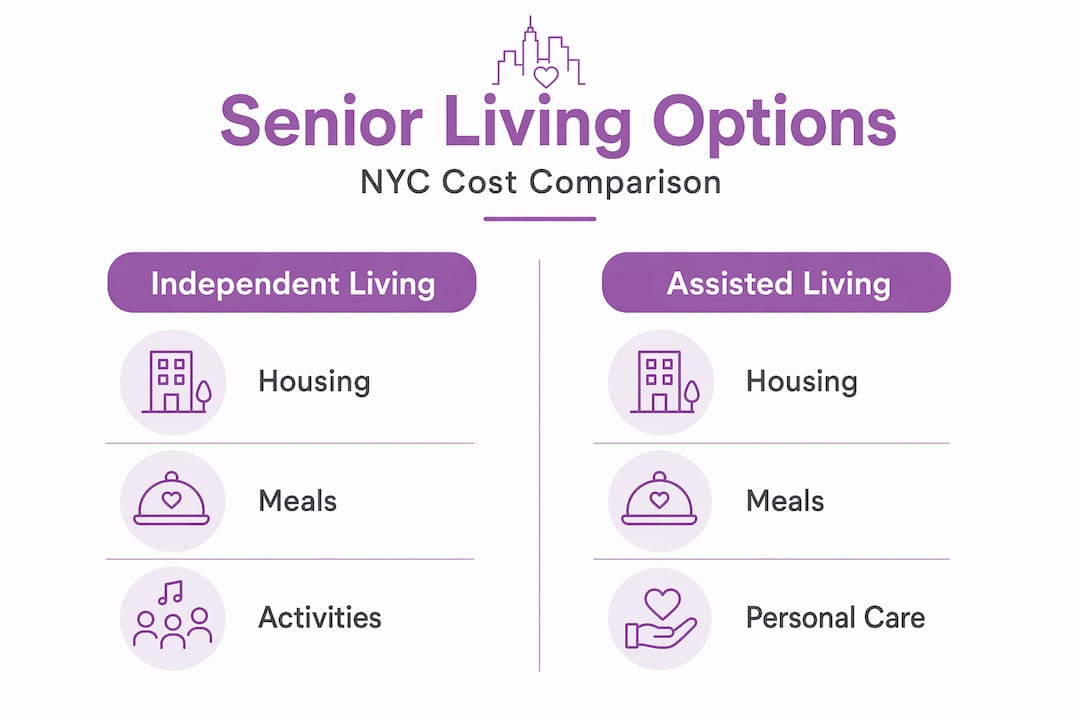
Assisted living adds personal care support on top of housing and meals. Because of the tiered care model described above, costs are both higher and more variable. The median monthly cost for assisted living in NYC sits at $6,800, though the actual amount depends heavily on care needs and unit size.
Memory care is purpose-built for residents living with Alzheimer’s or other forms of dementia. These communities require specially trained staff, secured environments, structured programming, and higher staff-to-resident ratios. That specialized infrastructure is why memory care ranges $8,250 to $12,000 monthly in the NYC area, a 25 to 35 percent premium over standard assisted living. You can explore memory care communities in New York to compare specific options.
| Care type | NYC monthly cost range | Best for |
|---|---|---|
| Independent living | $3,919 to $5,090 | Active seniors, minimal care needs |
| Assisted living | $5,500 to $8,500+ | Seniors needing help with daily tasks |
| Memory care | $8,250 to $12,000 | Dementia or Alzheimer’s diagnoses |
A few additional variables that shift costs within each category:
- Studio apartments typically cost $500 to $1,500 less per month than a one-bedroom in the same community.
- Location within the tri-state area matters significantly. Manhattan and Westchester communities tend to run higher than those in New Jersey or Connecticut.
- Newer buildings with more modern amenities charge a premium over older facilities with comparable care quality.
Having clarified the cost ranges, let’s look at the complexities families often overlook when budgeting.
Nuances and hidden costs: what families often miss when budgeting
Senior care pricing breakdowns from most brochures stop at the base rate and maybe one care tier example. That is not enough. There are several cost factors that routinely surprise families, and knowing them now protects you later.
Here are the most common ones to watch for:
- Acuity creep. This is the gradual increase in care needs as a senior’s health declines over time. Because care tiers are reassessed periodically, a resident can move from a Level 2 to a Level 4 care tier without ever changing rooms. Acuity creep can cause 40 to 80 percent cost increases over three to five years. A family budgeting around a starting rate of $6,000 per month may be paying $9,000 or more within a few years.
- Separately billed care services. Medication management, wound care, and incontinence support are often billed as add-ons rather than included in care tiers. Always request a complete list of what is and is not included in each tier before signing a contract.
- Medicaid limitations in New York. Many families plan to rely on Medicaid to cover assisted living, and this is where serious financial miscalculations happen. Medicaid in New York covers assisted living only via the ALP waiver in certified facilities. Standard Medicaid does not pay for room and board in typical assisted living communities. Not every community participates in the ALP program, which significantly limits options for Medicaid-eligible residents.
- Contract review gaps. Many families sign residency agreements without fully reading the sections on care reassessments, fee escalation clauses, and discharge policies. These sections determine whether and how much your bill can increase.
Pro Tip: Before touring any community, ask for a sample resident contract and a complete fee schedule. Read the section on care tier reassessments carefully. The frequency and trigger points for reassessments vary widely and directly affect your long-term budget.
Understanding these costs upfront helps when planning how to pay for assisted living and can also shape decisions about relocating to assisted living in Manhattan, where fee structures can be especially layered.
Understanding hidden costs prepares you better for the financial planning steps we cover next.
Planning ahead: financial strategies and paying for senior living
Budgeting for elderly care in the tri-state area requires more than calculating whether Social Security covers the monthly rate. It almost never does. Financial planners recommend aggregating all income sources and identifying the monthly “gap” between that income and the projected care cost before you ever start touring communities. That gap tells you how much you need to draw from savings, insurance, or other funding sources each month.
Here is a practical checklist for building your financial picture:
- Income sources: Social Security, pensions, retirement account distributions, investment income, and rental income all count.
- Insurance assets: Long-term care insurance policies often cover a portion of assisted living or memory care costs. Review the policy’s daily benefit, benefit period, and inflation protection provisions.
- VA benefits: Veterans and their spouses may qualify for the Aid and Attendance benefit, which provides a monthly cash benefit specifically for care costs. This is underutilized and often overlooked.
- Life settlements or life insurance conversions: Some families pay for assisted living using life insurance by converting a policy into a benefit that funds care directly.
- Medicaid ALP planning: If Medicaid may eventually be needed, plan for it now rather than in a crisis. Medicaid has a five-year look-back period for asset transfers, so early planning with an elder law attorney matters.
One comparison that often surprises families involves aging at home. Many assume it is less expensive than a community. Home care hidden costs frequently exceed estimates when you factor in home modifications such as ramp installations and grab bars, professional in-home care at $25 to $35 per hour, and the lost income of a family member who reduces work hours to provide care. When full-time support is needed, a care community often costs less than people think by comparison.
Pro Tip: When evaluating memory care affordability, work backward from the highest projected cost (the $12,000 ceiling) rather than the average. If you can fund that level, everything below it is manageable. Learn more about paying for memory care with specific strategies for that cost range.
With financial strategies in place, let’s look at the bigger picture of what good planning actually requires.
Why understanding senior living costs requires looking beyond the sticker price
Here is something we see repeatedly when working with families across the NYC tri-state area: the sticker price is not the problem. The problem is that families evaluate costs at a single point in time rather than across a trajectory.
A senior moving into assisted living today at $6,500 per month may be at $9,500 in four years due to acuity creep. If the family planned only for the entry rate, they are in financial crisis without warning. This is not hypothetical. It happens regularly. The only protection is stress-testing your budget against a higher cost scenario from the very beginning.
The second major blind spot is Medicaid. Medicaid does not cover room and board in standard assisted living except through the ALP waiver in a narrow set of certified facilities. Families who assume their loved one will “eventually go on Medicaid” at any community of their choosing may find that no ALP-certified community has availability, or that the communities that do participate are not the right fit. That realization mid-placement is avoidable with early planning.
The third blind spot is aging at home. Many families believe that keeping a loved one at home is both cheaper and better. Sometimes it is. But aging in place often incurs hidden costs, including structural home modifications, round-the-clock professional care, and the career impact on family members who become informal caregivers. When a senior needs help with multiple ADLs around the clock, a well-run community frequently offers better care for a comparable or lower total cost.
Working with an elder care advisor does not just help you find a good community. It helps you avoid the planning errors that result in financial strain or the wrong placement entirely. The families who navigate this process most successfully are the ones who started planning early and got professional guidance before a health crisis forced a rushed decision.
How Assisted Living Advisers can help navigate senior living costs in NYC
Knowing the cost structures is one thing. Applying that knowledge while also managing a parent’s health, your own schedule, and the emotional weight of this decision is another entirely.

Assisted Living Advisers provides free, personalized consultations for families in New York, New Jersey, and Connecticut. We match your loved one’s care needs, preferences, and budget with vetted communities, guide you through the cost structures at each facility, and help you understand financing options from Medicaid ALP to long-term care insurance. Whether you are exploring assisted living near you, comparing memory care communities, or trying to understand how to pay for an assisted living community, we walk alongside you through every step. Schedule a free consultation today and get clarity without the guesswork.
Frequently asked questions
What costs does the base monthly fee usually cover in assisted living?
The base fee typically covers housing, utilities, meals, housekeeping, laundry, and community activities, but base room and board excludes personal care services, which are billed separately through care tiers or à la carte charges.
Does Medicaid pay for assisted living in New York?
Medicaid pays for assisted living care only through the ALP waiver in certified facilities; standard Medicaid does not cover room and board in regular assisted living communities, so placement options are limited for Medicaid-eligible residents.
How much can care requirements increase senior living costs over time?
Care needs typically intensify over three to five years, and acuity creep causes 40 to 80 percent cost increases as residents move into higher care tiers, even without changing rooms.
Are independent living communities less expensive than assisted living?
Yes. Independent living is the most affordable option because it includes housing with minimal or no personal care, while assisted living stacks tiered care charges on top of the base rate, significantly raising the monthly total.
What should families consider when budgeting for aging in place at home?
Families should account for home modifications, professional in-home care costs, caregiver lost income, and transportation expenses, because aging in place’s hidden costs frequently add up to more than the cost of a care community when full-time support is needed.
Recommended
Let’s Work Together To Find The Ideal Senior Living Community For Your Loved One.
Assisted Living Advisers is a FREE, personalized service offering expert guidance in determining the ideal community for your loved one based on physical needs, location preferences and finances.