
When your family starts exploring senior living options, the conversation usually centers on medical care, room quality, and safety. Social life tends to come up later, almost as an afterthought. But the role of social activities in senior living is far more than a perk on a brochure. It is a measurable health factor with documented effects on longevity, cognitive health, and emotional well-being. Understanding what strong social programming looks like, and how to evaluate it, may be one of the most consequential things you do during this process.
Table of Contents
- Key Takeaways
- The real health stakes of social connection
- What social activities actually look like in communities
- What separates good programs from great ones
- How to evaluate a community’s social program
- My perspective after years of advising families
- Find a community where your loved one will truly connect
- FAQ
Key Takeaways
| Point | Details |
|---|---|
| Social isolation is a health risk | Loneliness and isolation increase mortality risk and contribute to heart disease, depression, and cognitive decline. |
| Activity quality beats quantity | A few well-run, accessible programs drive real engagement better than a packed calendar nobody attends. |
| Objective vs. subjective loneliness | Just being around people does not automatically reduce loneliness if social fit and belonging are absent. |
| Families should ask the right questions | Go beyond the activity calendar and ask about staff support, accessibility accommodations, and how resistant residents are engaged. |
| Social fit belongs in your decision | Matching your loved one’s preferences and personality to a community’s social culture is as important as matching care levels. |
The real health stakes of social connection
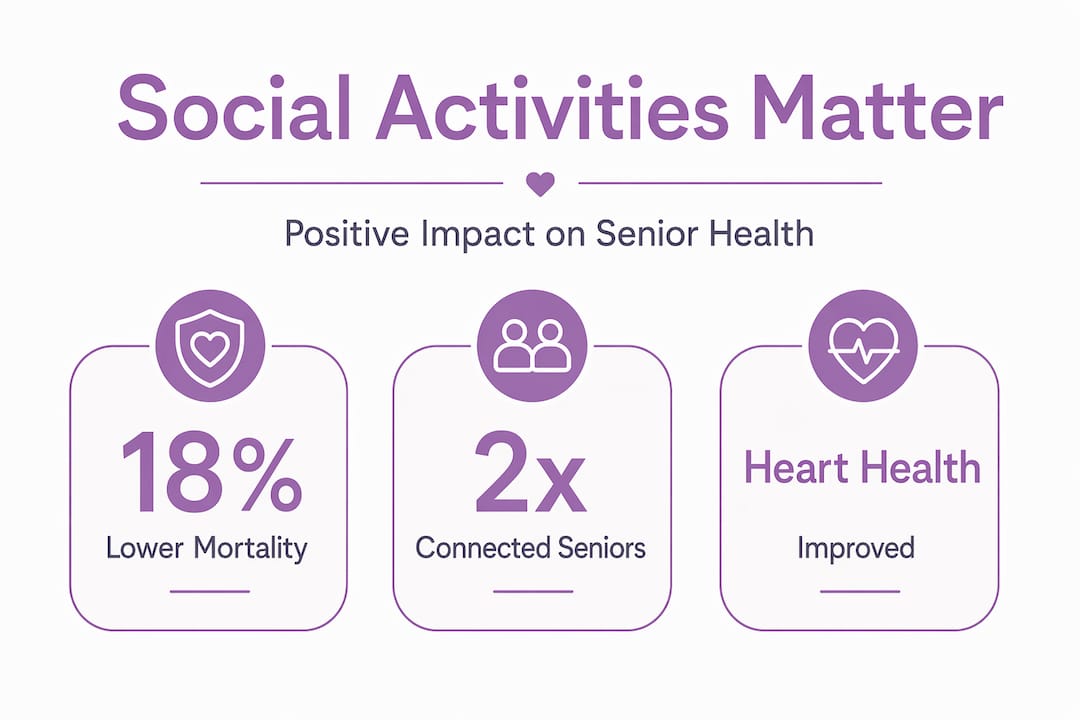
Most families think of loneliness as a feelings problem. The research says otherwise. Social disconnection causes approximately 871,000 deaths per year globally and raises the risk of heart disease, stroke, high blood pressure, and diabetes. The World Health Organization frames social connection as foundational health infrastructure, not a lifestyle preference.
For older adults specifically, the numbers are sobering. A review published in Frontiers in Public Health found that living alone with social isolation carries a mortality hazard ratio of 2.08, meaning those individuals face roughly double the risk of death compared to socially connected peers. That figure sits alongside a broader picture: 26% of U.S. adults 65 and older lived alone in 2023, and 40% of U.S. adults 45 and older reported feeling lonely in 2025.
There is also an important distinction your family should understand before evaluating any community. Objective isolation, meaning physically limited social contact, and subjective loneliness, meaning the personal feeling of being disconnected, are not the same thing. Someone can live in a building full of people and still feel profoundly alone. Poor social fit between a resident and their social environment can preserve loneliness even when activities are abundant. This distinction matters enormously when choosing a community.
“Social connection is not a luxury or a wellness add-on. It is a health determinant with the same clinical weight as diet, sleep, and physical activity.”
The practical takeaway for your family: a senior living community that takes social engagement seriously is not offering extras. It is managing a genuine health risk for your loved one, with the same seriousness as medication management or fall prevention.
What social activities actually look like in communities
Senior living communities vary widely in what they offer, but the best programs cover multiple dimensions of engagement. Physical, intellectual, creative, and purely social activities each serve different needs, and the mix matters more than the volume.
Common examples you will find across many communities include:
- Group fitness classes such as chair yoga, water aerobics, and walking clubs
- Cognitive and intellectual programs including trivia nights, book clubs, and current events discussions
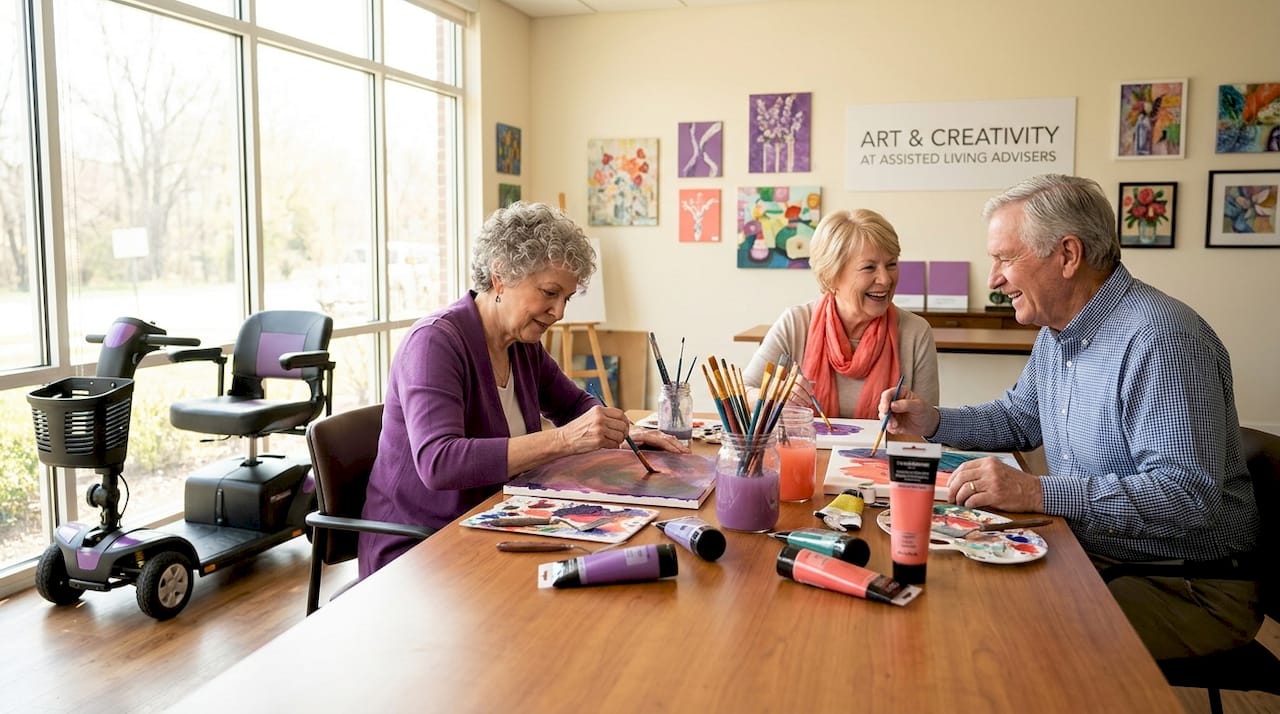
- Creative workshops like painting, music groups, journaling, and crafts
- Social gatherings such as game nights, movie screenings, birthday celebrations, and seasonal parties
- Community outings to local restaurants, cultural venues, gardens, and shopping
- Volunteer and purpose-driven activities that give residents a sense of contribution beyond the campus
Activity variety that spans chair yoga, painting, trivia, and book clubs significantly increases the chances of matching each resident’s specific preferences and physical capabilities. That matters because a 78-year-old former teacher who loves debate has entirely different social needs than an 85-year-old who finds large groups overwhelming but lights up during one-on-one creative projects.
Good communities also understand that accessibility accommodations like transportation within the campus, adaptive seating, and staff assistance with participation are not optional features for residents with mobility challenges. They are the difference between an activity existing on a calendar and a resident actually attending.
Pro Tip: Ask to see three months of activity schedules rather than one. A single month may look impressive, but patterns across three months reveal whether programming is consistent or event-dependent.
What separates good programs from great ones
Here is where most families go wrong. They look at the activity calendar and count events. A full calendar is not the same as a meaningful program, and research confirms this. A meta-analysis of 19 studies covering 1,809 participants found that social support interventions do reduce loneliness with statistical significance, but with high variability across programs. The quality and design of programs drive outcomes far more than the number of events on offer.
What actually makes a program effective comes down to four interconnected factors:
-
Consistency and familiarity. Recurring scheduled groups with the same participants lower the social activation energy required from residents. When someone knows they will see the same faces at Tuesday trivia, attendance becomes habit rather than effort. Low-friction re-entry through repeated familiar formats is one of the most underrated design features in effective programs.
-
Staff-facilitated introductions. New residents rarely walk confidently into a group activity. Staff who actively connect people, make introductions, and check in afterward transform a passive event into genuine community building.
-
Proactive barrier removal. Communities that remove participation barriers through structured transport, accessible venues, and small group formats see higher regular engagement. Waiting for residents to show up on their own is a strategy that consistently leaves the most isolated people behind.
-
Authentic belonging, not just contact. Social fit matters. Two residents who share a professional background, a hobby, or even a sense of humor will build a genuine friendship from a book club. Two residents with nothing in common may sit next to each other for a year without the social isolation lifting at all.
Pro Tip: When touring a community, arrive at an activity already in progress. Watch whether staff are participating or standing to the side. Watch residents’ faces. Genuine enjoyment is obvious.
You can learn more about the outcomes assisted living provides and how program design connects to resident well-being in communities that prioritize social health.
How to evaluate a community’s social program
Asking the right questions separates communities with strong social cultures from those with impressive marketing materials. Use this comparison when assessing your options:
| What to look for | Strong program | Weak program |
|---|---|---|
| Staff involvement in activities | Staff participate, facilitate, and follow up | Staff organize but don’t engage with residents |
| Handling of resistant residents | Proactive check-ins and gentle re-engagement strategies | Residents are left to opt out indefinitely |
| Activity accessibility | Transportation, seating, and assistance are built in | Attendance is dependent on resident initiative |
| Program consistency | Same recurring groups with familiar participants | Rotating events with no continuity |
| Social matching | Smaller interest-based groups foster real friendships | Large generic events with no structure |
Beyond the table, pay attention to how staff talk about residents who do not participate. A community that shrugs and says “some people just prefer to be alone” is telling you something important. A community that describes a strategy for gentle re-engagement, for understanding what barriers exist and working around them, is demonstrating the kind of culture that actually reduces isolation.
You should also ask specifically about engagement for residents with cognitive decline. Memory care residents benefit enormously from social programs, but their needs require different designs. Sensory activities, music, reminiscence groups, and structured one-on-one interactions work where large group formats can overwhelm. A community that has thought through this distinction is one that takes social health seriously at every level of care.
My perspective after years of advising families
I have had hundreds of conversations with families going through this process, and a consistent pattern shows up. Families spend 80% of their evaluation energy on physical care, staffing ratios, and cleanliness, which matters. But they often give social programming a surface-level review. They see a packed calendar and check the box.
What I have seen shift outcomes for residents is whether a community actively pursues residents who go quiet. Every senior living community has residents who attended activities during their first two weeks and then disappeared back to their rooms. What happens next tells you everything. Does a staff member knock on the door? Does someone think to invite them to a smaller, quieter event that might be a better fit? Or does the community accept it and move on?
The families who later report that their loved ones genuinely thrived almost always describe the same thing: staff who noticed when a resident was withdrawing and did something about it. That is not captured in a calendar. You find it by watching and by asking direct questions during tours.
My honest advice is to weight social program quality at the same level you weight care quality. For most residents, after the first few months, the quality of their daily social life will have a larger impact on how they feel day-to-day than almost anything else in their environment.
— Eric
Find a community where your loved one will truly connect
Knowing what to look for is only half the work. Finding communities in your area that actually deliver on it requires local knowledge and firsthand experience with how these programs run in practice.
Assistedlivingadvisers works exclusively with families in the New York, New Jersey, and Connecticut area to match seniors to communities based on care needs, personality, preferences, and yes, the strength of their social programs. When Assistedlivingadvisers evaluates a community, social engagement quality is part of the assessment. The team can help you prepare the right questions, join you on tours, and interpret what you see. You can explore how assisted living improves quality of life or start searching for the right fit through assisted living near you. All consultations are free to families.
FAQ
Why does social activity matter so much for seniors?
Social connection is a measurable health factor, not a comfort bonus. Social disconnection raises risks for heart disease, stroke, depression, and cognitive decline, and contributes to hundreds of thousands of deaths annually.
What are the most common social activities in assisted living?
Top social activities in assisted living typically include group fitness classes, book clubs, trivia nights, creative workshops, seasonal celebrations, and community outings, all designed to serve residents with different mobility levels and interests.
How can I tell if a community’s social program is actually effective?
Look beyond the calendar. Ask how staff engage residents who stop attending, whether activities are accessible for residents with mobility or cognitive challenges, and whether smaller interest-based groups exist alongside large events.
Does being around people automatically reduce loneliness for seniors?
Not always. Objective contact does not reduce subjective loneliness when social fit is poor. Belonging and genuine connection require shared interests, staff facilitation, and a culture that actively includes rather than passively accommodates.
How does Assistedlivingadvisers help families evaluate social programs?
Assistedlivingadvisers provides personalized, no-cost placement guidance that includes evaluating community social culture, activity accessibility, and resident engagement practices. The team draws on local knowledge of communities across the tri-state area to match families with the right fit.
Recommended
- The Benefits of Social Engagement for Seniors – Assisted Living Advisers
- Understanding the Role of Assisted Living Communities in Senior Care – Assisted Living Advisers
- How Assisted Living Communities Help Senior Residents Thrive – Assisted Living Advisers
- Senior Living Trends – Assisted Living Advisers
Let’s Work Together To Find The Ideal Senior Living Community For Your Loved One.
Assisted Living Advisers is a FREE, personalized service offering expert guidance in determining the ideal community for your loved one based on physical needs, location preferences and finances.