
Finding the right care for an aging parent in New York City is rarely straightforward. Navigating eldercare in NYC means sorting through dozens of overlapping systems, from Medicaid home care to assisted living to memory care, all while managing work, family, and the emotional weight of watching someone you love need more help. The options exist. The funding programs exist. But without a clear map, most families spend months in confusion before landing on a workable plan. This guide gives you that map.
Table of Contents
- Key takeaways
- Navigating eldercare in NYC: understanding your options
- How to create an eldercare plan before a crisis
- Medicaid and MLTC: what to expect
- Affordable senior housing options in NYC
- Caregiver support and preventing burnout
- My honest take after years in NYC eldercare
- How Assistedlivingadvisers can help your family
- FAQ
Key takeaways
| Point | Details |
|---|---|
| Start planning early | Beginning before a health crisis gives you time to compare options and avoid rushed decisions. |
| Know your five pillars | Eldercare planning should cover legal, medical, financial, housing, and caretaking needs together. |
| Medicaid has real delays | Many NYC families wait weeks for approved home care hours, so prepare documentation in advance. |
| Caregiver support is real | NYC Aging offers counseling, training, and respite services specifically designed to prevent burnout. |
| Expert guidance is free | Placement advisers like Assistedlivingadvisers provide personalized help at no cost to families. |
Navigating eldercare in NYC: understanding your options
The professional term for what most families are searching for is “long-term care planning,” and in New York City, it covers more ground than most people expect. The spectrum runs from light-touch home assistance all the way to skilled nursing facilities, with several meaningful stops in between.
Here is what the core options look like in practice:
- Home care: A home health aide or personal care aide visits your loved one at home. This can be funded privately or through Medicaid, depending on eligibility.
- Adult day care: Your loved one attends a structured program during the day and returns home in the evening. This works well for families who provide evening and overnight care themselves.
- Assisted living: A residential community where seniors receive help with daily activities like bathing, dressing, and medications in a private or semi-private apartment setting.
- Adult care facilities and enriched housing: More affordable alternatives to traditional assisted living, often publicly funded, that provide meals, supervision, and personal care.
- Nursing homes: For seniors with complex medical needs requiring 24-hour skilled nursing care.
Two government programs define much of what is available for lower-income New Yorkers. The first is Managed Long-Term Care (MLTC), which gives Medicaid enrollees aged 21+ coordinated access to a wide range of services, including home care aides, adult day care, and nursing home care, all managed by an assigned care manager. The second is the Assisted Living Program (ALP), a state-funded alternative that covers personal care services for eligible low-income seniors in residential settings.
| Program | Who it serves | Key services | Funding |
|---|---|---|---|
| MLTC | Medicaid enrollees, 21+, with long-term care needs | Home aides, adult day care, nursing home | Medicaid |
| ALP | Low-income seniors in residential settings | Meals, nursing, personal care | State/Medicaid |
| PACE | Frail seniors who qualify for nursing home level care | Comprehensive medical and social services | Medicare/Medicaid |
| Private pay assisted living | Seniors with personal or family funds | Full residential care with personal assistance | Private |
For families starting from scratch, the Eldercare Locator connects you to local resources by ZIP code through phone, text, and online chat. The NYC Office for the Aging (NYC Aging) also maintains a citywide network of programs that you can access directly or through a local senior center.
How to create an eldercare plan before a crisis
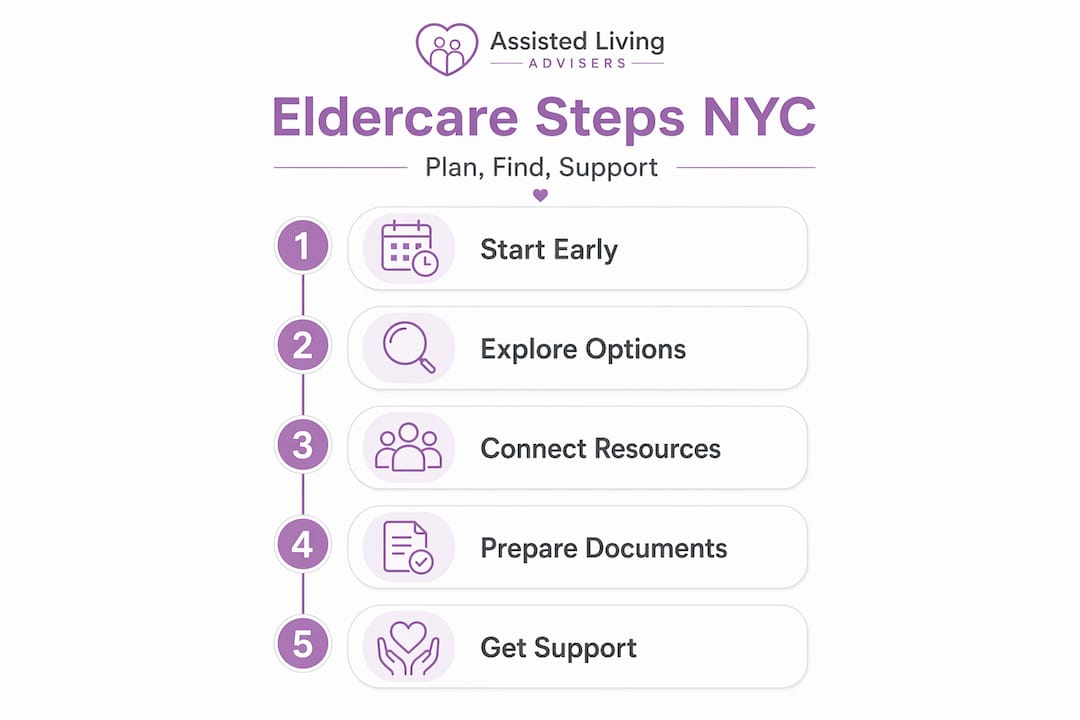
Most families start planning too late. A fall, a hospitalization, or a sudden memory lapse triggers the search, and everyone is scrambling. The NY State Bar Association recommends starting an eldercare plan after the first signs of health changes, not after a crisis. This distinction matters more than most people realize.
A solid eldercare plan rests on five pillars:
- Legal: Establish a power of attorney and health care proxy while your loved one can still designate them. Without these documents, families face lengthy court proceedings to gain decision-making authority.
- Medical: Identify all current physicians, compile a medication list, and designate one person to coordinate medical communication. A nurse or care coordinator can review prescriptions and advocate for medical management, reducing risks like drug interactions and preventable falls.
- Financial: Review income sources, savings, insurance coverage, and potential Medicaid eligibility. Knowing the numbers early prevents panic when care costs arrive.
- Housing: Assess whether the current home can be modified for safety, or whether a transition to assisted living or another community makes more sense over the next one to three years.
- Caretaking: Map out who provides daily support, which tasks they handle, and what happens when they cannot show up. This includes both family caregivers and paid help.
The single most practical step you can take today is designating one family member as the point person for all eldercare decisions. This person becomes the hub for communication with doctors, attorneys, agencies, and care facilities. Without a clear point person, everyone gives partial information and no one has the full picture.
Pro Tip: Use the assisted living checklist for NYC families to organize legal, medical, and housing documents before your first meeting with any agency or care advisor.
Medicaid and MLTC: what to expect
This is where most NYC families hit their first wall. Medicaid-funded home care sounds straightforward in theory. In practice, the process involves multiple agencies, assessments, and waiting periods that can stretch across weeks.

A 2026 Weill Cornell study on Medicaid home care found that while 83% of NYC home care agencies could take new patients and 74% accepted Medicaid, many required over a week just to begin evaluations. Even more striking, 80% of agency representatives had difficulty estimating how many hours Medicaid would approve, with guesses ranging from 10 to 30 hours per week. Families need a contingency plan for that gap.
Here is how MLTC enrollment generally works:
- Confirm Medicaid eligibility through the NYC Human Resources Administration.
- Contact an MLTC plan directly (MetroPlusHealth is one of the larger NYC options) or get a referral from NYC Aging.
- Complete a functional assessment where a clinical evaluator determines what level of care your loved one needs.
- An assigned care manager develops a personalized care plan that gets reviewed regularly as needs change.
- Services begin, though start dates vary depending on agency availability and staffing.
| Common challenge | What it means for your family | How to prepare |
|---|---|---|
| Long evaluation wait times | Care may not start for 1 to 2 weeks after applying | Begin outreach before urgent need arises |
| Unclear approved hours | Agencies often cannot predict Medicaid hours in advance | Budget for private pay bridging during gaps |
| Staffing shortages | Even approved care may face aide unavailability | Have a backup aide source or family coverage plan |
| Documentation gaps | Missing records delay the assessment process | Gather medical, financial, and ID records early |
Pro Tip: Start interviewing home care agencies and gathering your documentation weeks before the need becomes urgent. The families who prepare early for Medicaid are the ones who avoid gaps in care.
To learn more about how skilled nursing and MLTC services differ in scope, this overview of skilled nursing facilities breaks down care levels clearly.
Affordable senior housing options in NYC
Assisted living in New York City carries a reputation for being expensive. That reputation is partly earned. Private pay assisted living in Manhattan can exceed $8,000 per month. But several publicly supported alternatives exist, and many families never learn about them.
Here is what to explore when private pay is not realistic:
- Assisted Living Program (ALP): The ALP in New York covers meals, housekeeping, personal care, and nursing for eligible seniors. One important note: room and board costs are typically not covered by Medicaid through ALP, so families often need to contribute SSI/SSP payments or other income toward that portion.
- Enriched housing programs: These provide a residential setting with meals and supportive services at lower cost than a full assisted living community.
- PACE (Program of All-Inclusive Care for the Elderly): For seniors who would otherwise require nursing home-level care, PACE provides comprehensive medical and social services in a community-based setting funded by Medicare and Medicaid together.
- EISEP (Expanded In-Home Services for the Elderly Program): Offers home care assistance for seniors who do not qualify for Medicaid but still need support.
- Veterans benefits: If your loved one served in the military, VA benefits can offset assisted living costs significantly. This is one of the most underused funding sources in NYC eldercare.
| Housing option | Best for | Typical funding |
|---|---|---|
| ALP communities | Low-income seniors needing personal care | Medicaid (services only) + SSI/SSP |
| PACE programs | Nursing-home-eligible seniors preferring community care | Medicare + Medicaid |
| Private assisted living | Families with savings or long-term care insurance | Private pay or LTC insurance |
| Enriched housing | Independent seniors needing light support | State programs or private pay |
NY Connects, the state’s aging services network, and your local Department of Social Services are two starting points for applications. Both can help you understand which programs your loved one qualifies for based on income, health status, and housing situation.
Caregiver support and preventing burnout
Caregivers rarely talk about their own needs. They focus entirely on the person they are caring for, often at significant cost to their own health, careers, and relationships. NYC Aging’s caregiver support programs are specifically designed to close this gap with concrete services, not just encouragement.
What NYC Aging and community partners offer:
- Counseling: One-on-one sessions to process the emotional demands of caregiving.
- Training: Practical instruction on personal care tasks, medication management, and emergency response.
- Support groups: Peer communities where caregivers share experiences and strategies.
- Respite care: Temporary relief services that give caregivers scheduled breaks, whether for an afternoon or a weekend.
- Benefits navigation: Help applying for Medicaid, MLTC, food assistance, and other programs your loved one may qualify for.
Burnout does not arrive suddenly. It builds slowly through years of unacknowledged stress. The clearest warning signs are persistent exhaustion, irritability, withdrawal from your own social life, and a growing sense that nothing you do is enough. Recognizing these early gives you time to bring in help before a crisis occurs on both sides of the caregiving relationship.
Pro Tip: Mindfulness practices, when used consistently, measurably reduce caregiver anxiety. Practical mindfulness for caregivers offers techniques you can use in five minutes or less between caregiving tasks.
My honest take after years in NYC eldercare
I have seen the same pattern repeat itself hundreds of times. A family decides to “wait and see” after a parent’s first hospitalization. Six months later, the situation has escalated, and they are now making housing and care decisions in 48 hours while managing a discharge from a rehab facility.
The families who do best are not the ones with the most money. They are the ones who started assembling a team before the urgency hit. That means a point person for decisions, an attorney for legal documents, a financial advisor who understands Medicaid spend-down rules, and a nurse or care coordinator to manage the medical picture. No single person can master all of these domains alone.
The Medicaid hours problem is real and deeply frustrating. Agency representatives often struggle to give families a straight answer about approved hours. My advice: treat any Medicaid home care estimate as provisional, and always have a backup plan for the first four to six weeks.
What I have found most overlooked is the caregiver’s own need for support. Families pour everything into their loved ones and nothing into sustaining themselves. NYC Aging treats caregiver navigation as an essential service, not an add-on. Use it. You will be a better advocate for your parent when you are not running on empty.
— Eric
How Assistedlivingadvisers can help your family
Finding the right assisted living or memory care community in New York City is genuinely hard work. You are comparing communities, verifying care standards, understanding contracts, and trying to move quickly enough to meet your loved one’s current needs.

Assistedlivingadvisers specializes in exactly this. Their advisers know the NYC tri-state market, maintain relationships with vetted communities across New York, New Jersey, and Connecticut, and guide families through every step from initial assessment to move-in day, all at no cost to you. Whether you are exploring assisted living near you in the five boroughs or looking at memory care communities in New York for a loved one with dementia, Assistedlivingadvisers can match you with options that fit your family’s care needs, location preferences, and budget. Schedule a free consultation today to get personalized guidance without the guesswork.
FAQ
What eldercare resources are available in NYC for free?
The Eldercare Locator connects families to local aging services by ZIP code at no cost, and NYC Aging offers free caregiver support, benefits navigation, and referrals to community programs throughout the five boroughs.
How do I qualify for Medicaid home care in New York City?
Medicaid home care eligibility requires meeting both financial and functional criteria, and enrollment often involves a clinical assessment through an MLTC plan to determine the level of care needed.
What is the Assisted Living Program (ALP) in New York?
The ALP is a state-funded program that covers personal care services for eligible low-income seniors in residential settings, though room and board costs are typically not included in Medicaid coverage.
How long does Medicaid home care approval take in NYC?
Based on a recent Weill Cornell study, many NYC families wait more than a week just for an initial evaluation, with additional delays before care actually begins, making advance planning critical.
What is the difference between MLTC and standard Medicaid home care?
MLTC is a managed care model where a single plan coordinates all of a Medicaid enrollee’s long-term services, including a dedicated care manager, while standard home care may be arranged directly without that coordinated oversight.
Recommended
Let’s Work Together To Find The Ideal Senior Living Community For Your Loved One.
Assisted Living Advisers is a FREE, personalized service offering expert guidance in determining the ideal community for your loved one based on physical needs, location preferences and finances.