
Pre-screening assisted living facilities is the single most important step families take to confirm that a community can safely meet their loved one’s care needs before signing any contract. The process, formally called pre-admission assessment, evaluates physical health, cognitive status, functional capacity, and behavioral history to protect resident safety and ensure lawful placement. Skipping or rushing this step is the leading cause of unsafe placements, unexpected transfers, and preventable family distress. Assistedlivingadvisers works with families across the New York, New Jersey, and Connecticut tri-state area every day, and the pattern is consistent: families who treat pre-screening as a structured process find better fits and avoid costly mistakes.
Why pre-screen assisted living facilities: the core rationale
Pre-screening is not a formality. It is a fit-and-risk checkpoint where facilities and families both determine whether a placement is appropriate, safe, and sustainable. All 50 states and Washington, D.C. require some form of mandatory health screening before assisted living admission, though the instruments and professionals involved vary by jurisdiction. That regulatory requirement exists for a reason: assisted living communities are licensed to provide a defined scope of care, and admitting a resident whose needs exceed that scope creates legal liability and, more critically, real danger.
The pre-screening process addresses four core dimensions of a prospective resident’s situation. Physical health determines whether the facility’s medical support level is sufficient. Cognitive status identifies memory, judgment, and safety risks that require specific programming or supervision. Functional capacity, measured through activities of daily living (ADL) assessments, establishes how much hands-on assistance the person needs daily. Behavioral history flags patterns that may require specialized staff training or a memory care setting rather than standard assisted living. Together, these dimensions give both the family and the facility a clear picture of compatibility before any commitment is made.

Families who understand the importance of screening facilities gain a structural advantage. They arrive at assessments with organized documentation, ask the right questions, and recognize when a facility’s honest answers reveal a poor fit. Those who treat the process as a tour and a contract signing often discover the mismatch only after move-in, when the cost of correction is far higher.
What does a thorough pre-screening assessment include?
A complete pre-admission assessment covers six distinct areas, each designed to match resident needs to facility capabilities with precision.
- Medical history and physician’s health forms. The facility reviews current diagnoses, recent hospitalizations, chronic conditions, and physician-completed health forms. This establishes the baseline medical complexity of the prospective resident.
- Functional capacity and ADL assessment. Staff evaluate the person’s ability to perform bathing, dressing, toileting, transferring, continence management, and eating. The Katz Index of ADLs is a widely used standardized tool for this measurement.
- Cognitive and behavioral screening. The Mini-Mental State Examination (MMSE) is a common cognitive screening instrument. A score below 4 on the 30-point MMSE scale commonly flags cognitive impairment that affects placement decisions. Behavioral history, including aggression, wandering, or sundowning patterns, is reviewed separately.
- Medication management review. The number of medications, complexity of the regimen, and need for specialized administration (injections, wound care, IV therapy) determine whether the facility’s medication management program is adequate.
- Staffing review relative to care needs. The facility evaluates whether its current staffing model can absorb the prospective resident’s care demands without compromising care for existing residents.
- Admission determination. Based on all of the above, the facility makes a formal decision: admit, admit with a specific care plan, or refer to a higher level of care such as a skilled nursing facility or memory care community.
Pro Tip: Gather a complete medication list, your loved one’s most recent physician’s health form, and a written summary of their daily ADL routine before any pre-screening appointment. Pre-admission assessments produce far more accurate results when families provide detailed, organized clinical inputs rather than relying on verbal summaries during the visit.
Why skipping pre-screening leads to poor outcomes
The risks of bypassing a thorough evaluation are specific and well-documented. The five structural pillars that predict assisted living quality are regulatory compliance, staffing adequacy, care delivery systems, physical plant condition, and financial transparency. Pre-screening is the mechanism that lets families verify all five before committing.
Placement mismatch is the most common failure. When a resident’s needs exceed the facility’s licensed scope, such as requiring continuous skilled nursing or complex wound care, the facility is legally required to decline admission or initiate a transfer. States including California, Texas, and Florida have explicit exclusion criteria written into their licensing rules. Families who do not pre-screen often discover this boundary only after a crisis, when a transfer must happen under pressure and without adequate planning.
Staffing shortages represent the second major risk. A facility may present beautifully during a scheduled tour while operating with chronic understaffing on overnight and weekend shifts. Pre-screening visits that include direct questions about caregiver-to-resident ratios on all shifts expose this gap before it affects your loved one’s safety.
“Facilities legally must not admit residents whose care needs exceed licensed capabilities, preserving resident safety and facility compliance.” Pre-screening is the process that enforces this boundary on behalf of families who may not know it exists.
Behavioral and cognitive risks are the third category. A resident with moderate dementia and a history of wandering placed in a standard assisted living community without a secured memory care unit creates a safety emergency. Pre-screening identifies this mismatch before move-in. Finally, facilities that lack clear, written policies on handling residents whose needs evolve beyond their licensed scope put families in a reactive position. Pre-screening forces that conversation upfront, when families still have negotiating power and time to choose differently.
How to evaluate facilities effectively during pre-screening
Effective facility evaluation goes well beyond aesthetics and amenity lists. Use this structured approach during visits and communications.
- Ask about caregiver-to-resident ratios on every shift. Request specific numbers for morning, afternoon, and overnight shifts. Caregiver-to-resident ratios during peak care hours are a direct predictor of care quality and resident safety.
- Review licensing, inspection reports, and staffing credentials. Every state publishes inspection reports for licensed facilities. Request the most recent survey results and ask how any cited deficiencies were corrected.
- Assess the physical environment and safety features. Look for secured exits if memory care is relevant, call systems in bathrooms, non-slip flooring, and adequate lighting in hallways and common areas.
- Evaluate social wellness programming. A vibrant activity calendar with genuine resident participation signals a healthy community culture. An empty common room during a midday visit signals the opposite.
- Ask directly about care level change policies. What happens if your loved one’s needs increase beyond the facility’s scope? Get the answer in writing. Facilities that are evasive on this question are telling you something important.
- Visit at multiple times and on different days. Observing staff-resident interactions during an unannounced or off-peak visit reveals the community’s actual operational culture, not its marketing presentation.
Pro Tip: Use the assisted living tour checklist from Assistedlivingadvisers before each visit. Having a structured checklist prevents the common mistake of letting a beautiful lobby or a persuasive sales director substitute for hard operational data.
What criteria and standards define assisted living admission?
Assisted living admission criteria are defined by a combination of state licensing requirements and facility-specific policies. Understanding both protects your family from surprises after move-in.
| Criterion | Standard approach |
|---|---|
| ADL functional capacity | Assessed using the Katz Index; facilities define the maximum assistance level they can provide |
| Cognitive screening | MMSE or similar tool; scores indicating severe impairment may require memory care placement |
| Medical complexity | Exclusion of residents needing skilled nursing, IV therapy, or complex wound care |
| Behavioral history | Aggression, wandering, or elopement risk assessed against facility’s secured unit availability |
| Reassessment policy | Post-admission reassessments required by most states; frequency and triggers vary by jurisdiction |
State licensing requirements set the floor. California, Texas, and Florida, for example, publish explicit lists of conditions that disqualify a prospective resident from standard assisted living. The assisted living eligibility criteria vary enough by state that families relocating or comparing facilities across state lines need jurisdiction-specific guidance. Standardized tools like the Katz ADL Index and MMSE provide consistent measurement, but the thresholds for admission or exclusion are set by each facility within its state’s regulatory framework.
Post-admission reassessment policies matter as much as the initial screening. Most states require periodic reassessments, and facilities must have written protocols for what happens when a resident’s needs exceed their licensed scope after move-in. A facility without a clear, documented reassessment and transition policy is a facility that has not thought through what happens when things change. Things always change.
Key takeaways
Pre-screening assisted living facilities is the structured process that prevents unsafe placements, protects families from regulatory surprises, and confirms that a community’s staffing, care scope, and policies genuinely match a resident’s needs.
| Point | Details |
|---|---|
| Pre-screening is legally required | All 50 states mandate health screening before assisted living admission, with varying instruments and standards. |
| Six components define the assessment | Medical history, ADL capacity, cognitive screening, medication review, staffing fit, and admission determination. |
| Staffing ratios predict care quality | Ask for caregiver-to-resident ratios on all shifts, not just the standard daytime presentation. |
| Exclusion criteria protect residents | Facilities must decline residents whose needs exceed their licensed scope; knowing this prevents crisis transfers. |
| Multiple visits reveal operational truth | Visiting at different times and days exposes the real community culture beyond scheduled tours. |
What families get wrong about pre-screening
Most families I work with at Assistedlivingadvisers arrive at their first facility visit thinking of it as a tour. They are looking at the dining room, the activity calendar, and the friendliness of the front desk staff. Those things matter, but they are not pre-screening. Pre-screening is a clinical and operational audit, and families who treat it as one get dramatically better outcomes.
The mistake I see most often is families rushing the process because they are under time pressure, typically after a hospitalization or a fall at home. That urgency is real, but rushing pre-screening increases the risk of gaps between what a resident needs and what a facility can actually deliver. A placement that collapses three months after move-in costs far more in emotional and financial terms than the extra two weeks it takes to screen properly.
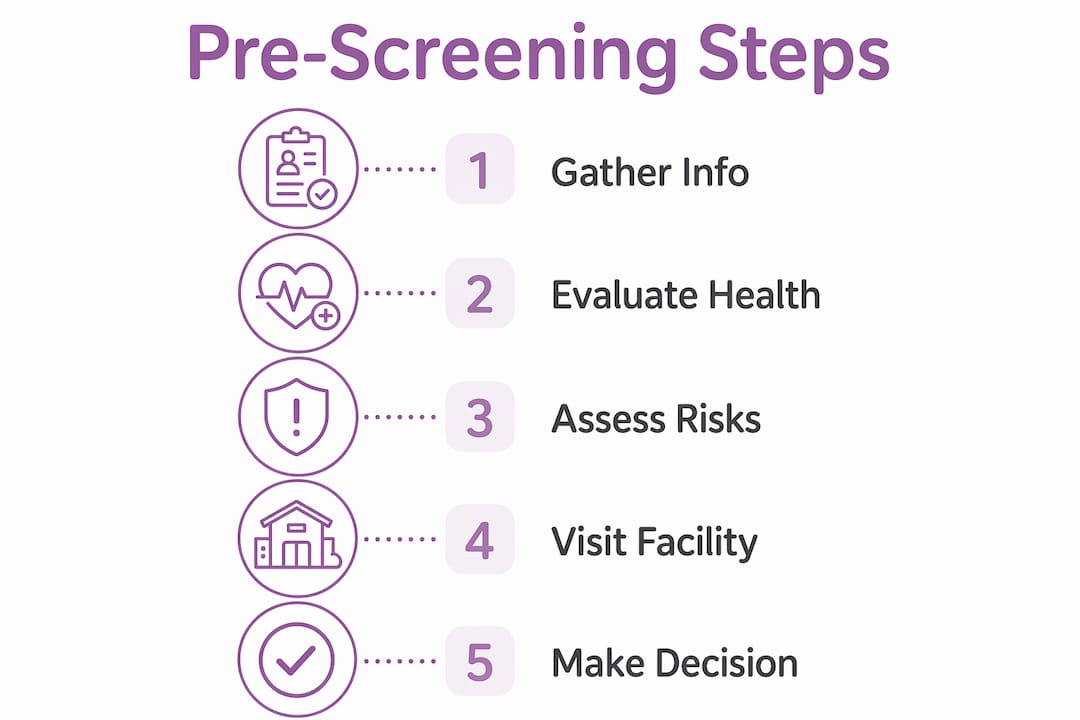
My honest recommendation: treat pre-screening as a structured funnel. Start with a clear baseline of your loved one’s medical, functional, and cognitive status. Use that baseline to filter facilities by care scope before you ever schedule a visit. Then verify staffing, inspect licensing records, and ask the hard questions about care level change policies. The facilities that answer those questions directly and honestly are the ones worth trusting. The ones that deflect or pivot to amenities are telling you exactly what you need to know.
How Assistedlivingadvisers helps families pre-screen with confidence

Assistedlivingadvisers provides families across New York, New Jersey, and Connecticut with expert guidance through every stage of the pre-screening and placement process, at no cost to families. The team accesses verified facility data, licensing records, and inspection reports so you are not relying on a facility’s self-presentation. Advisers help families organize clinical documentation, prepare for pre-admission assessments, and compare assisted living communities against each other using consistent criteria. If you are ready to find vetted options near you, start with assisted living near me to connect with an adviser who knows your local market. The goal is a placement that holds, not one that requires a painful correction six months later.
FAQ
What does pre-screening an assisted living facility mean?
Pre-screening, formally called pre-admission assessment, is the process by which a facility evaluates a prospective resident’s medical history, functional capacity, cognitive status, and behavioral history to determine whether the community can safely meet their care needs. It is required in all 50 states before admission.
What questions should families ask during a pre-screening visit?
Ask about caregiver-to-resident ratios on all shifts, the facility’s most recent state inspection results, how care level changes are handled after move-in, and what conditions would trigger a required transfer. Get the answers to the last two questions in writing before signing any contract.
What happens if a resident’s needs exceed the facility’s licensed scope?
Facilities are legally required to decline admission or initiate a transfer when a resident’s needs exceed their licensed care capabilities. States like California, Texas, and Florida define explicit exclusion criteria in their licensing rules, covering conditions such as continuous skilled nursing needs or complex wound care.
How do families prepare for a pre-admission assessment?
Bring a complete medication list, recent physician health forms, and a written summary of your loved one’s daily ADL routine to every assessment. Detailed, organized clinical inputs produce more accurate placement decisions and prevent gaps in care planning after move-in.
How many times should you visit a facility before deciding?
Visit at least twice, on different days and at different times of day. A midday visit on a Tuesday and an early morning visit on a weekend will show you two very different operational realities. Staff-resident interactions during off-peak hours are the most reliable indicator of community culture.
Recommended
Let’s Work Together To Find The Ideal Senior Living Community For Your Loved One.
Assisted Living Advisers is a FREE, personalized service offering expert guidance in determining the ideal community for your loved one based on physical needs, location preferences and finances.