
When families start searching for senior living options, the phrase “all-inclusive” sounds like a dream come true. One monthly fee, no surprises, everything taken care of. But here’s the reality: what counts as “all-inclusive” varies dramatically from one community to the next, and assuming otherwise can lead to real financial and emotional stress. Understanding exactly what this term means, what it covers, and where it falls short gives your family the clarity needed to make a confident, informed decision for your loved one.
Table of Contents
- What does all-inclusive senior living actually mean?
- Services and amenities in all-inclusive senior living
- Comparing all-inclusive senior living to other senior care options
- How to choose the right all-inclusive senior living community
- A fresh perspective: why all-inclusive senior living isn’t always the obvious choice
- Connect with trusted senior living advisers
- Frequently asked questions
Key Takeaways
| Point | Details |
|---|---|
| All-inclusive defined | All-inclusive senior living includes basic services like meals, housekeeping, and social activities. |
| Service variation | Services and amenities can differ significantly between communities, so always verify what’s included. |
| Comparison matters | Comparing all-inclusive with other models can help you find the best fit for your loved one. |
| Evaluation is essential | Use a step-by-step checklist to assess each community’s offerings and suitability. |
| Expert guidance | Professional advisers can help families navigate options and find optimal senior care solutions. |
What does all-inclusive senior living actually mean?
The term “all-inclusive senior living” describes communities that bundle most or all core services into a single monthly fee. Rather than billing separately for meals, housekeeping, activities, and personal care, these communities roll everything into one predictable payment. For many families, that simplicity is enormously appealing, especially when managing a loved one’s finances from a distance.
Core services typically bundled into an all-inclusive rate include:
- Three daily meals and snacks in a communal dining room
- Weekly or daily housekeeping and laundry services
- Scheduled transportation to medical appointments and local errands
- Social activities, fitness classes, and community events
- Basic wellness monitoring and medication reminders
- Utilities including electricity, water, and cable or Wi-Fi
However, the word “basic” carries a lot of weight here. Many communities use “all-inclusive” as a marketing term while still charging extra for services like physical therapy, specialized memory care, incontinence supplies, or one-on-one personal care beyond a certain number of hours per week. These add-ons can add hundreds or even thousands of dollars monthly to what initially seemed like a flat rate.
“All-inclusive doesn’t mean unlimited. It means the community has decided which services most residents use most often and bundled those together. Everything beyond that baseline is still a negotiation.”
This distinction matters enormously when you’re exploring senior living facility options for a parent or spouse. A community advertising all-inclusive pricing for $5,000 per month may actually cost $7,500 once your loved one’s specific needs are factored in. Getting a written breakdown of what’s included and what triggers extra charges is not optional. It’s essential.
One common misconception is that all-inclusive automatically means a higher level of medical care. In reality, many all-inclusive communities are designed for relatively independent seniors who need light support. If your loved one has complex medical needs, an all-inclusive package may not provide the clinical oversight they require.
Services and amenities in all-inclusive senior living
Once you understand the general definition, the next step is knowing what to look for when comparing specific communities. The range of services and amenities can vary widely, even between communities in the same city or neighborhood.
Here are the services most families can reasonably expect in a well-structured all-inclusive community:
- Daily dining: Most communities offer three meals a day in a restaurant-style dining room, with menu choices and dietary accommodations for residents with diabetes, heart conditions, or food allergies.
- Housekeeping and laundry: Weekly room cleaning and personal laundry service are standard in most all-inclusive packages. Some communities offer daily tidying as well.
- Scheduled transportation: Rides to doctor’s appointments, pharmacies, grocery stores, and local outings are typically included, though the frequency and distance may be capped.
- Wellness and fitness programs: Group exercise classes, walking clubs, yoga, and swimming are common in communities with strong wellness cultures. These programs are linked directly to better resident outcomes.
- Social and recreational activities: Bingo, movie nights, art classes, holiday parties, and cultural outings keep residents engaged and reduce isolation.
- Personal care assistance: Help with bathing, dressing, grooming, and medication management is included in many communities but often tiered by the level of assistance required.
- 24-hour staffing: Most all-inclusive communities have staff available around the clock, though the level of clinical training varies considerably.
Where communities diverge most significantly is in medical and personal care services. Some bundle light personal care into the base rate. Others charge by the hour or by a tiered care level system. The top benefits of assisted living are most fully realized when the services included actually match what your loved one needs day to day.

Pro Tip: Before signing any contract, ask the community to give you a written list of every service included in the monthly fee and every service that triggers an additional charge. Then go through that list with your loved one’s physician to see whether the included services actually meet their care needs.
Personalized services matter more than the length of the amenity list. A community with fewer listed services that genuinely tailors care to your loved one’s preferences will outperform a community with an impressive brochure but a one-size-fits-all approach.
Comparing all-inclusive senior living to other senior care options
To truly understand all-inclusive living, it helps to see how it stacks up against other senior care options available in the tri-state area.
| Care model | Pricing structure | Medical support | Best for |
|---|---|---|---|
| All-inclusive senior living | Single monthly fee | Basic to moderate | Seniors needing predictable costs |
| Fee-for-service assisted living | Base rate plus add-ons | Moderate to advanced | Seniors with variable or complex needs |
| Independent living | Rent-based, few services | Minimal | Active, healthy seniors |
| Continuing care retirement communities (CCRCs) | Entry fee plus monthly | Full spectrum | Seniors planning long-term transitions |
| In-home care | Hourly or daily rates | Varies by agency | Seniors preferring to stay home |
The financial comparison is important but not the whole picture. Understanding retirement communities vs. assisted living communities helps families see that the right choice depends heavily on where your loved one falls on the independence-to-care spectrum.
All-inclusive communities offer clear advantages in terms of budget predictability. Families know what to expect each month, which makes financial planning significantly easier. However, if your loved one is largely independent and uses very few services, you may end up paying for things they never use. Conversely, if their needs are high, the all-inclusive rate may not cover everything, and you could face significant add-on costs anyway.
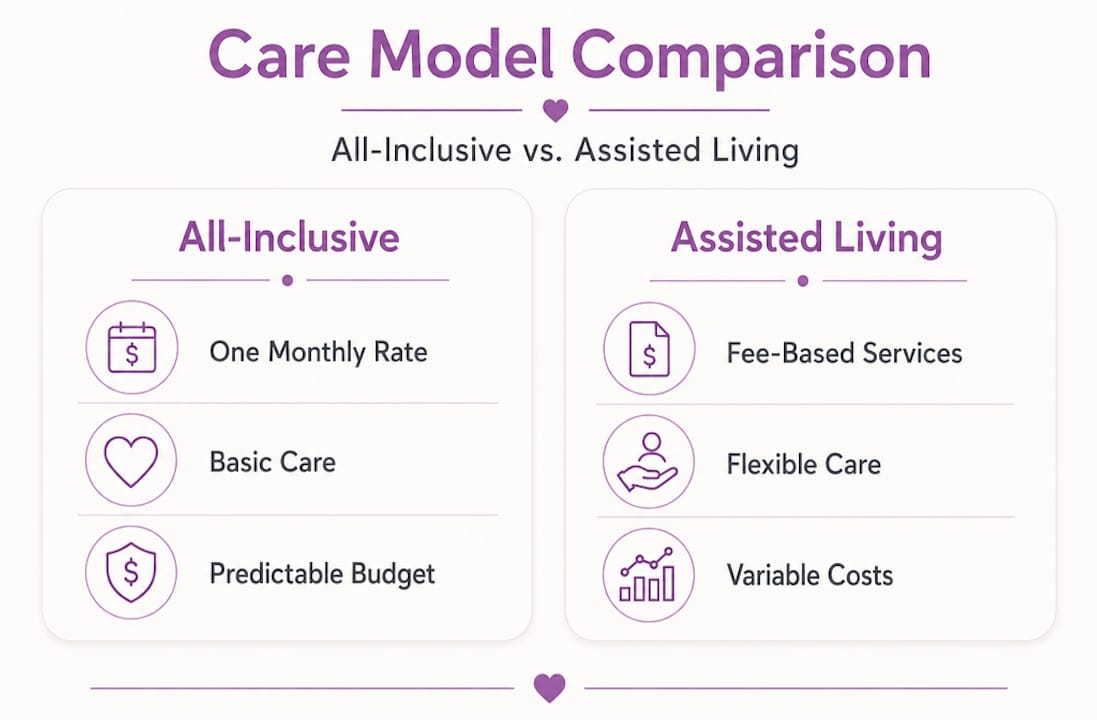
Fee-for-service models, by contrast, charge only for what’s used. This can be cost-effective for healthier seniors but unpredictable for those whose needs fluctuate. Families dealing with progressive conditions like Parkinson’s disease or Alzheimer’s often find that costs escalate quickly under a fee-for-service model.
Key considerations when comparing models:
- How stable or predictable are your loved one’s care needs right now?
- How quickly do you expect their needs to change over the next one to three years?
- Is financial predictability a priority for your family’s planning?
- Does your loved one value a wide range of social activities and amenities, or do they prefer a quieter, simpler environment?
Exploring the full range of types of senior care with a knowledgeable adviser helps families avoid locking into a model that looks good on paper but doesn’t fit the reality of their loved one’s daily life.
How to choose the right all-inclusive senior living community
Selecting the right community is where the real work begins. The tri-state area, covering New York City, New Jersey, and Connecticut, has hundreds of senior living communities, and not all of them are equal in quality, transparency, or care.
Here’s a practical step-by-step approach to evaluating communities:
- Assess your loved one’s current and anticipated care needs. Talk to their primary care physician about what level of support they need now and what they’re likely to need within the next two to three years. This prevents placing them in a community that will quickly become inadequate.
- Set a realistic budget. Factor in not just the base monthly fee but potential add-ons, annual rate increases, and the community’s policy on what happens if your loved one’s care needs increase significantly.
- Research communities in your preferred geographic area. Proximity to family, familiar neighborhoods, and preferred healthcare providers all matter for quality of life. Resources for choosing senior living in Manhattan and surrounding areas can help narrow your options.
- Schedule in-person tours. A community’s brochure and website tell you very little compared to what you observe during a visit. Arrive unannounced if possible, or visit at mealtime to see how staff interact with residents.
- Ask detailed questions about inclusions and exclusions. Use the written service list you requested and go through it line by line during your tour.
- Talk to current residents and their families. Their candid feedback about daily life, staff responsiveness, and whether the community delivers on its promises is invaluable.
- Review the contract carefully. Look for clauses about rate increases, care level changes, and discharge policies before signing anything.
| Evaluation factor | Questions to ask | Red flags |
|---|---|---|
| Staffing levels | What is the staff-to-resident ratio? | High turnover, vague answers |
| Included services | What exactly is in the monthly fee? | No written list available |
| Medical support | Is a nurse on-site 24 hours? | Only on-call or part-time nursing |
| Contract terms | What triggers a rate increase? | Annual increases above 5% with no cap |
| Community culture | How are residents’ preferences accommodated? | Rigid schedules, limited choices |
| Safety and cleanliness | When was the last state inspection? | Unresolved violations on record |
Pro Tip: Visit at least three communities before making any decision. The contrast between communities becomes much clearer when you have direct comparisons. Use the checklist above during each visit and take notes immediately afterward while your impressions are fresh. Guidance on how to find best assisted living for your loved one can also help you structure your search more efficiently.
A fresh perspective: why all-inclusive senior living isn’t always the obvious choice
After years of advising families across New York, New Jersey, and Connecticut, we’ve noticed a consistent pattern. Families arrive at their first consultation convinced that all-inclusive is the safest, simplest answer. They want to stop worrying. They want one number, one decision, one solution. That instinct is completely understandable.
But here’s the uncomfortable truth: all-inclusive pricing can sometimes work against a family’s best interests. When communities bundle services together, they often build in a margin that assumes average usage. If your loved one uses most of those services, the value is real. If they use only a fraction of them, you’re subsidizing amenities they’ll never touch.
More importantly, the all-inclusive label can create a false sense of security. Families sometimes assume that once their loved one is settled in an all-inclusive community, their care needs are fully covered. Then a health event occurs, needs escalate, and suddenly the family is facing significant additional charges or, worse, a transfer to a higher-care facility that disrupts everything.
The communities that genuinely serve residents well are not necessarily the ones with the longest list of included services. They’re the ones that are transparent about what they offer, honest about their limitations, and flexible enough to adapt as residents’ needs change. True quality of life for seniors comes from environments that treat residents as individuals, not from a pricing model.
Our advice: resist the pull toward all-inclusive simply because it feels easier. Focus instead on finding a community that is deeply honest about what it includes, what it doesn’t, and how it handles the inevitable changes that come with aging. That transparency is worth far more than any bundled amenity package.
Connect with trusted senior living advisers
Navigating senior living options across the tri-state area is genuinely complex, and you don’t have to do it alone. Whether your loved one needs a community with strong all-inclusive services or a more customized care arrangement, getting expert guidance makes the process far less overwhelming.

At Assisted Living Advisers, we specialize in helping families in New York, New Jersey, and Connecticut find the right fit, at no cost to you. Our advisers personally know the communities in the region, understand what’s truly included in various pricing models, and can match your loved one’s specific needs to the right environment. From assisted living near me searches to detailed comparisons of assisted living communities across the tri-state area, we’re here to help every step of the way. Contact us today to schedule a free consultation and take the guesswork out of one of the most important decisions your family will make.
Frequently asked questions
Is all-inclusive senior living more expensive than fee-based options?
All-inclusive communities typically cost more upfront, but they can be cost-effective when your loved one regularly uses most of the bundled services, since individual fees in fee-based models add up quickly.
What services are typically included in all-inclusive senior living?
Standard inclusions usually cover three daily meals, housekeeping, laundry, scheduled transportation, social activities, and basic wellness support, though exact offerings vary by community.
Can all-inclusive senior living cover advanced medical needs?
Most all-inclusive communities provide basic to moderate medical support, but advanced or specialized needs such as wound care, physical therapy, or memory care often require additional fees or a transition to a higher level of care.
How can I compare different all-inclusive senior communities in the tri-state area?
Request a detailed written service list from each community, tour multiple locations, speak with current residents and their families, and use a structured evaluation checklist to compare what’s genuinely included versus what costs extra.
Recommended
- A Guide to Luxury Assisted Living | Assisted Living Advisers
- What Is Assisted Living? | Assisted Living Advisers
- How Assisted Living Communities are Evolving to Better Suit the Needs of Senior Residents. – Assisted Living Advisers
- Sometimes Saving a Life is as Simple as Finding the Right Senior Living Accommodation for Your Loved One. – Assisted Living Advisers
Let’s Work Together To Find The Ideal Senior Living Community For Your Loved One.
Assisted Living Advisers is a FREE, personalized service offering expert guidance in determining the ideal community for your loved one based on physical needs, location preferences and finances.