
Assisted living licensure is a state-issued authorization that legally permits a facility to provide residential personal care services to seniors and adults who need daily support. Every U.S. state, including Washington D.C., independently licenses assisted living under its own definitions and requirements. No federal assisted living license exists. That single fact surprises most families, who assume the same federal oversight that governs nursing homes applies here. It does not. Understanding what is assisted living licensure, and how it works in your state, is the first step toward choosing a facility that meets both legal standards and your loved one’s actual needs.
What is assisted living licensure and why it matters
Assisted living licensure is the formal state-level permission a facility must hold before it can legally house and care for unrelated adults who need personal assistance. Each U.S. state independently licenses assisted living with its own definitions, standards, and enforcement mechanisms. This is not a one-time paperwork exercise. Maryland’s Office of Health Care Quality, for example, treats licensure as ongoing public protection and quality oversight, not merely an entry permit. That distinction matters because it means a licensed facility is subject to continued monitoring, not just an initial approval.
The license itself covers several dimensions of facility operation. State agencies typically regulate physical plant standards, staffing ratios, resident admission criteria, medication management protocols, and emergency procedures. A facility operating without a valid license is doing so illegally and outside any regulatory safety net. For families, that means no guaranteed inspections, no complaint investigation process, and no state enforcement if care falls short.
Licensure also determines what level of care a facility may legally provide. A facility licensed for basic personal care cannot legally provide skilled nursing services. Matching your loved one’s care needs to the correct license category is not optional. It is the foundation of a safe placement decision.
How state licensing for assisted living works and varies
State licensing for assisted living is governed by agencies that differ by state, including Departments of Health, Departments of Social Services, or dedicated long-term care offices. The terminology alone can be disorienting. What one state calls an “assisted living facility,” another calls a “residential care home,” a “personal care home,” or a “board and care facility.” These are not interchangeable marketing labels. They are distinct legal categories with different rules attached.
Three states illustrate how wide this variation runs:
- Alaska defines an assisted living home as a residential facility serving at least three unrelated adults or receiving state or federal payments. A home with one or two residents that accepts no government payments may legally operate without a license under Alaska’s rules. That exemption has real consequences for oversight.
- Wisconsin requires community-based residential facilities (CBRFs) and adult family homes with three or more beds to be licensed, while 1 to 2 bed adult family homes require certification rather than full licensure. The distinction affects Medicaid waiver eligibility directly.
- Maryland requires providers to submit typed applications with supporting documentation to the Office of Health Care Quality, and the agency oversees both initial licensure and ongoing service quality.
The table below shows how key licensing elements differ across these three states:
| State | Licensing authority | Minimum resident threshold | Medicaid waiver link |
|---|---|---|---|
| Alaska | Dept. of Health | 3 residents or government payment | Varies by license type |
| Wisconsin | Dept. of Health Services | 3 beds for CBRF; 1 bed for AFH certification | Certification affects eligibility |
| Maryland | Office of Health Care Quality | No minimum stated; all programs licensed | Tied to OHCQ oversight |
The requirements for assisted living also include physical standards such as room size minimums, fire safety compliance, and accessibility features. Staffing rules specify minimum training levels for direct care workers and, in some states, mandatory background checks. Resident criteria define who a facility may admit and when a resident must be transferred to a higher level of care. These rules exist at the state level only, which is why the assisted living licensure process looks fundamentally different depending on where your family member lives.
How assisted living licensure differs from nursing home regulations
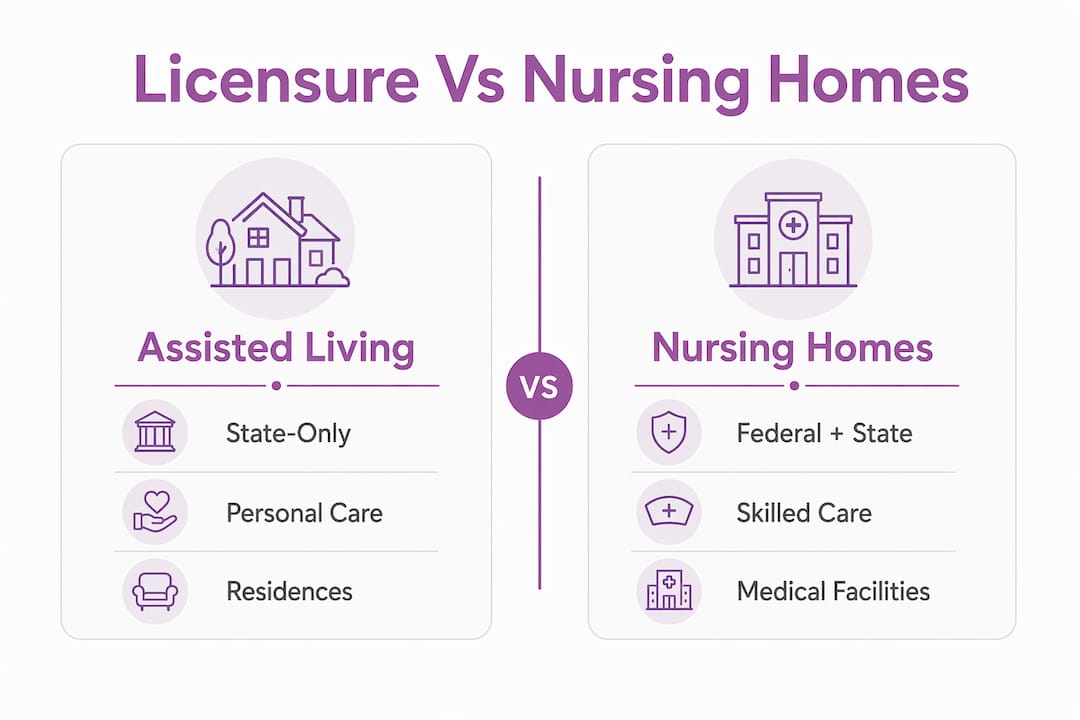
The most persistent misconception families carry into this process is that assisted living and nursing homes operate under the same regulatory framework. They do not. Skilled nursing facilities are federally certified under the Centers for Medicare and Medicaid Services (CMS) Conditions of Participation. That federal certification is what makes a nursing home eligible to receive Medicare and Medicaid reimbursements under those programs. Assisted living facilities have no federal license and follow state rules exclusively.
The table below captures the core regulatory differences:
| Feature | Assisted living | Skilled nursing facility |
|---|---|---|
| Licensing authority | State agency only | Federal CMS certification plus state |
| Federal oversight | Indirect via Medicaid waivers | Direct under Conditions of Participation |
| Staffing requirements | Varies by state | Federal minimums apply |
| Inspection mandate | State-determined frequency | Federal annual survey required |
| Care level | Personal and supportive care | Skilled medical and nursing care |
The federal role in assisted living is limited and indirect. Some states access federal Medicaid waiver funding to help residents pay for assisted living services, and those waivers carry their own requirements. But the facility’s license itself remains entirely a state matter. This is why comparing assisted living to nursing homes requires understanding two separate regulatory systems, not one.
How to get an assisted living license: the typical process
The assisted living licensure process follows a general sequence across most states, though the specific requirements vary. Here is how it typically unfolds:
- Application submission. The provider submits a detailed application to the state licensing agency. This includes facility floor plans, ownership disclosures, staffing plans, policies and procedures, and proof of financial viability.
- Pre-opening inspection. State inspectors conduct an on-site visit before the facility opens to verify that the physical environment, safety systems, and operational policies meet licensing standards.
- License issuance. Once the facility passes inspection and the application is approved, the state issues a license with a defined term, typically one to two years, and conditions of operation.
- Routine inspections. After opening, the facility receives scheduled inspections. In New York State, 1,362 full inspections were completed between January 2018 and October 2024, alongside 6,498 complaint investigations. That volume reflects how active oversight can be in a well-resourced state program.
- Complaint investigations. Residents, families, or staff can file complaints with the state agency. Substantiated complaints can trigger corrective action plans, fines, or license suspension.
- License renewal. Providers must renew their license periodically by demonstrating continued compliance, submitting updated documentation, and paying renewal fees.
Pro Tip: Ask any facility you are considering for its current license number and expiration date. Then verify that information directly through your state’s online licensing database before scheduling a tour.
Maryland’s OHCQ model treats this entire cycle as a public protection mechanism, not a bureaucratic formality. That framing is accurate. The ongoing inspection and renewal cycle is what separates a licensed facility from an unlicensed one in terms of accountability.
How families can use licensure information when choosing a facility
Licensure status is a starting point for evaluation, not a finish line. A license confirms that a facility met minimum legal standards at the time of its last inspection. It does not guarantee excellent care, adequate staffing on any given day, or a culture of resident dignity. Here is how to use licensure information effectively:
- Verify the license category matches care needs. A facility licensed for personal care cannot legally provide skilled nursing. If your loved one needs wound care, medication injections, or physical therapy, confirm the facility holds the correct license or has a formal arrangement with licensed providers.
- Understand state-specific terms. Terms like “memory care” or “residential care” are often marketing labels that do not align with official state licensing categories. Ask the facility what its exact licensed provider type is under state law.
- Check inspection and complaint history. Inspection frequency and enforcement vary widely by state due to administrative capacity. A facility with multiple unresolved complaints or a pattern of deficiencies is a red flag regardless of its current license status.
- Use state databases. Most states publish licensure status, inspection reports, and complaint histories online. In New York, the Department of Health maintains public records for adult care facilities. In New Jersey and Connecticut, similar databases exist through their respective health departments.
- Consult a placement adviser. Local experts who work with licensed facilities daily can identify patterns that public databases do not capture, including staff turnover rates and management responsiveness.
Pro Tip: When reviewing inspection reports, focus on repeat deficiencies across multiple inspection cycles. A single citation is common. The same citation appearing in three consecutive inspections signals a systemic problem.
Learning how to compare assisted living communities goes beyond checking a license. It requires reading inspection histories, asking direct questions about staffing, and visiting at different times of day.
Key takeaways
Assisted living licensure is a state-controlled authorization that sets the legal floor for facility operation, and families must look beyond the license itself to assess actual care quality.
| Point | Details |
|---|---|
| State-only regulation | No federal assisted living license exists; each state sets its own standards and definitions. |
| Terminology varies by state | Terms like “residential care” or “personal care home” are legal categories, not interchangeable labels. |
| Licensure is not a quality guarantee | A license confirms minimum legal compliance, not care excellence or staffing adequacy. |
| Inspection history matters | Check complaint investigations and repeat deficiencies, not just current license status. |
| License category must match care needs | A personal care license does not authorize skilled nursing; verify the match before placement. |
What families often get wrong about assisted living oversight
Working with families across the tri-state area, I have seen the same misunderstanding surface repeatedly. Families arrive assuming that because a facility looks professional and uses terms like “memory care” or “senior living community,” it must be operating under a clear, federally standardized license. That assumption leads to real mistakes.
The first mistake is treating the license as a quality signal. A license means the facility cleared a regulatory bar. That bar varies enormously by state, and clearing it once does not mean the facility maintains those standards every day. I have seen facilities with clean licenses that had serious staffing gaps, and facilities with recent citations that were genuinely responsive and improving.
The second mistake is ignoring the complaint investigation record. New York’s own comptroller audit found that oversight resources are stretched, and inspection timelines can slip. A facility that has not been inspected recently is not necessarily compliant. It may simply not have been checked. Families should ask directly: “When was your last full inspection, and what were the findings?”
The third mistake is accepting marketing language as regulatory fact. “Memory care” is not a license type in most states. It is a program description. The underlying license may be for assisted living, residential care, or something else entirely. Ask for the exact licensed provider category and look it up in the state database yourself.
What I tell every family: the license is the floor, not the ceiling. Use it to screen out facilities that should not be operating at all. Then do the deeper work of evaluating what happens inside those walls every day.
— Eric
Find licensed assisted living facilities with expert guidance
Sorting through state licensing categories, inspection records, and facility marketing claims takes time that most families do not have during an already stressful transition. Assistedlivingadvisers specializes in exactly this work across New York City, New Jersey, and Connecticut, connecting families to vetted, licensed communities that match their loved one’s specific care needs and budget.

The team at Assistedlivingadvisers provides free, personalized placement guidance, including needs assessments, facility tours, and move-in coordination. Every community in the network holds the appropriate state license for the care level it provides. Start your search by exploring assisted living near you or schedule a free consultation to get matched with licensed options in your area today.
FAQ
What is assisted living licensure in simple terms?
Assisted living licensure is a state-issued permit that allows a facility to legally provide personal care and housing to adults who need daily support. Each state independently licenses these facilities with its own definitions and standards.
Is assisted living regulated by the federal government?
Assisted living is not federally licensed or regulated the way nursing homes are. The federal government’s role is indirect, primarily through Medicaid waiver programs, while all direct licensing authority rests with state agencies.
How do I verify a facility’s license status?
Contact your state’s Department of Health or equivalent agency and request the facility’s current license number, category, and inspection history. Most states publish this information through an online public database.
Does a license guarantee quality care?
A license confirms that a facility met minimum legal standards at its last inspection. It does not guarantee staffing levels, care culture, or resident outcomes. Reviewing complaint investigation records alongside the license provides a more complete picture.
Why do assisted living terms differ so much by state?
States independently developed their own licensing frameworks, resulting in different names for similar facility types. Terms like “personal care home,” “residential care facility,” and “assisted living” may describe nearly identical care settings in different states, each governed by distinct rules.
Recommended
Let’s Work Together To Find The Ideal Senior Living Community For Your Loved One.
Assisted Living Advisers is a FREE, personalized service offering expert guidance in determining the ideal community for your loved one based on physical needs, location preferences and finances.