
Finding the right assisted living community for someone you love is one of the hardest decisions you will ever make. This assisted living placement guide exists because most families start this process in the middle of a crisis, overwhelmed, underprepared, and unsure where to begin. The stakes are real. A poor placement can affect your loved one’s health, happiness, and dignity. A good one can genuinely transform their daily life. What follows is a clear, honest roadmap covering how to assess care needs, evaluate facilities, avoid costly mistakes, and verify quality after move-in.
Table of Contents
- Key Takeaways
- Your assisted living placement guide starts here: understanding care types
- Preparing for the search: needs assessment and financial planning
- Executing the search: how to research and visit facilities effectively
- Common mistakes families make in placement
- Verifying quality and staying involved after move-in
- What I have learned after years in this field
- How Assistedlivingadvisers can help you find the right fit
- FAQ
Key Takeaways
| Point | Details |
|---|---|
| Start before a crisis hits | Families who research early make better placements and experience far less stress during the process. |
| Know your state’s licensing rules | State regulations affect what medical care facilities can legally provide, including insulin administration. |
| Financial planning is non-negotiable | Medicaid waivers cover services but not room and board, and waitlists exceed 710,000 people nationally. |
| Evaluate the whole person | Hobbies, routines, and social preferences matter as much as medical needs for long-term satisfaction. |
| Monitor care quality after move-in | Placement is not a one-time decision. Ongoing communication with staff protects your loved one’s wellbeing. |
Your assisted living placement guide starts here: understanding care types
Before you tour a single facility, you need to understand what assisted living actually is and what it is not. The term gets used loosely, and that creates confusion that leads to wrong placements.
There are three primary senior housing options families typically consider:
- Independent living is designed for active seniors who want community amenities and minimal assistance. No personal care services are included by default.
- Assisted living provides help with activities of daily living such as bathing, dressing, medication management, and meals. It is not a nursing home, and it is not a hospital.
- Memory care is a specialized environment for individuals with Alzheimer’s disease or other forms of dementia. It features secured spaces, structured programming, and staff trained in cognitive decline.
Within assisted living itself, most states recognize multiple levels of care, typically ranging from minimal supervision to high levels of personal care support. Understanding where your loved one falls on that spectrum now, and where they may fall in two or three years, is critical.
Here is how those levels break down in practical terms:
| Care level | What it typically includes |
|---|---|
| Level 1 (minimal) | Reminders for medications, occasional supervision |
| Level 2 (low) | Help with one or two daily tasks, some mobility assistance |
| Level 3 (moderate) | Regular personal care, frequent check-ins |
| Level 4 (high) | Extensive daily assistance with most personal care tasks |
| Level 5 (complex) | Near-continuous support, often approaching skilled nursing needs |
One factor most families do not discover until it is too late: state licensing restrictions determine what medical tasks staff at assisted living facilities can legally perform. In some states, administering insulin is not permitted in standard assisted living settings. If your loved one requires that level of medical intervention, you may be looking at a different category of care entirely. Understanding these limits upfront prevents disruptive transitions later.
For a deeper look at facility type differences, the distinctions between assisted living facilities, communities, and continuing care retirement communities also matter when projecting long-term needs.
Preparing for the search: needs assessment and financial planning
Effective placement starts with a complete picture of your loved one, not just their diagnoses, but their personality, daily routines, social preferences, and what genuinely makes them feel at home. Person-centered placement that accounts for hobbies, social preferences, and established routines consistently produces better long-term satisfaction than placements driven by medical criteria alone.
Ask yourself these questions before you begin touring:
- Does your loved one prefer a quiet environment or an active social calendar?
- Are they comfortable sharing common spaces, or do they strongly value privacy?
- Do they have dietary requirements beyond basic meal service?
- What does a good day look like for them right now?
The financial side of this process requires equal attention. Assisted living costs vary significantly by region, room type, and care level. In the New York, New Jersey, and Connecticut area, monthly costs often run well above national averages.
Medicaid does not cover room and board in assisted living. It may cover personal care services through state Home and Community Based Services (HCBS) waivers, but those programs come with income limits. In 2026, the Federal Benefit Rate sits at $994 per month for a single individual, and income eligibility for waivers is often capped at 300% of that figure, which is $2,982 per month for a single person.

The waitlist problem is severe. More than 710,000 people were on HCBS waiting lists in 2024, and priority is given by care need, not application date. Applying early matters, and you should not count on Medicaid as an immediate resource.
Other payment options include long-term care insurance, veterans’ benefits through the Aid and Attendance program, bridge loans, and private pay. Clarify what resources are available before you commit to any facility.
Pro Tip: Request a full fee schedule from every facility you consider, not just the base rate. Many communities charge separately for laundry, transportation, incontinence supplies, and additional care levels. The true monthly cost is often 20 to 40 percent higher than the advertised rate.
Executing the search: how to research and visit facilities effectively
Most families begin searching only after a crisis has already occurred. That reactive approach limits your options and increases pressure. Starting the search process before an urgent need arises gives you time to visit multiple communities, ask hard questions, and involve your loved one in the decision.
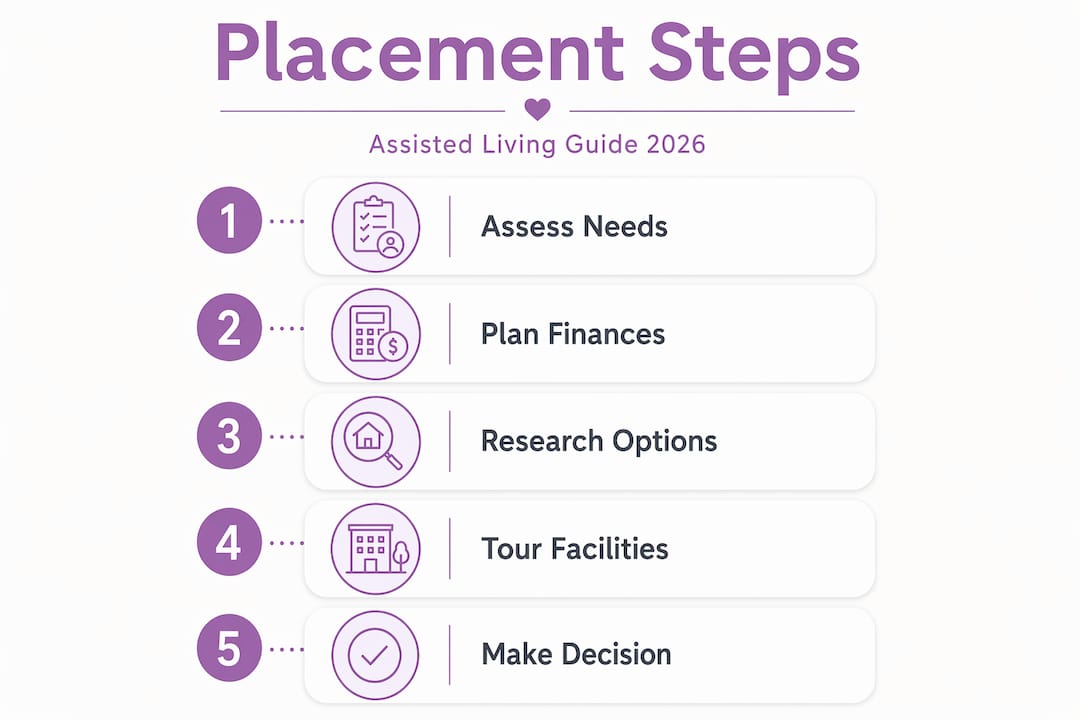
Here is a step-by-step process that actually works:
- Build a list of candidates. Use your state’s licensing database to identify facilities in your target area. Cross-reference with online reviews, but treat them as one input among many, not the final word.
- Call before you visit. Ask about current availability, care levels served, staffing ratios, and whether they accept Medicaid waivers. This filters out poor fits immediately.
- Tour in person, unannounced if possible. A scheduled tour shows you a prepared facility. An unannounced visit shows you the real operation. Pay attention to how staff interact with residents when they do not know you are watching.
- Ask specific questions about staffing. Staffing ratios, staff qualifications, and emergency response systems are among the strongest predictors of care quality. Ask what happens during overnight hours and weekends specifically.
- Assess dining and social programming. Dining quality and social activities directly affect how residents experience daily life. Eat a meal there if you can. Sit in on an activity.
- Review the care plan process. Ask how individualized care plans are developed, who participates, and how often they are updated as needs change.
Pro Tip: Bring a list of your loved one’s current medications to every tour and ask directly how the facility handles medication management. Errors in this area are among the most common, and most preventable, quality failures in assisted living.
Safety features also deserve direct scrutiny. Emergency call systems, fall prevention protocols, and secured entry points for memory care units are not optional niceties. They are baseline requirements. For context on what good safety infrastructure looks like, review what safer environments for seniors actually involve in well-run communities. Consider also whether your loved one would benefit from wearing emergency contact jewelry as an additional safety layer during the transition period.
Common mistakes families make in placement
Knowing what to do is half the equation. Knowing what to avoid is the other half.
- Deciding under pressure without preparation. Rushed decisions made during hospitalizations or sudden declines rarely result in the best fit. Even one or two weeks of prior research dramatically improves outcomes.
- Ignoring state licensing limits. If your loved one has complex medical needs now or is likely to develop them, verifying that the facility is licensed to provide that care is not optional. Overlooking these limits leads to disruptive and expensive transitions.
- Focusing on aesthetics over care quality. A beautiful lobby and freshly renovated apartments do not indicate good care. Red flags in care quality are often invisible during a surface-level tour. High staff turnover, vague answers about care policies, and residents who seem disengaged are far more meaningful indicators.
- Underestimating total costs. The base monthly rate rarely reflects what you will actually pay. Variable fees for additional care tiers, medications, and personal services can add up fast.
- Making assumptions about your loved one’s preferences. What they wanted five years ago and what they want now may be different. Involve them directly in the decision whenever possible. Their buy-in affects how well they adjust after move-in.
- Skipping the social and emotional fit. A community with excellent clinical care but no programming that interests your loved one will still feel like a poor placement to them.
Verifying quality and staying involved after move-in
Placing a loved one in assisted living is not the end of the process. It is the beginning of an ongoing relationship that requires your continued attention.
Follow these steps after move-in to protect your loved one’s wellbeing:
- Review the residency agreement carefully before signing. Understand the termination policy, rate increase procedures, and the facility’s stated obligations. Know your loved one’s rights as a resident under your state’s regulations.
- Schedule a care plan meeting within the first 30 days. Confirm that the care plan reflects your loved one’s actual needs and preferences. Ask what triggers a care plan review.
- Visit at varying times of day. Morning visits show you how staff handle the busiest part of the day. Evening visits reveal what happens when staffing is thinner.
- Build a relationship with direct care staff. The aides and caregivers who interact with your loved one daily are your most valuable source of honest information about how things are going.
“The best families I have worked with do not disappear after move-in. They stay engaged, attend care conferences, and advocate clearly. That involvement consistently leads to better outcomes for their loved ones.”
When problems arise, start by raising concerns directly with the director of care or the executive director. If issues persist, your state’s Long-Term Care Ombudsman Program is a free resource that advocates for residents’ rights and investigates complaints.
What I have learned after years in this field
I have watched families agonize over this decision, and I have seen what separates the placements that work from the ones that do not. The difference almost never comes down to which community had the nicest common areas or the most elaborate activity calendar.
What actually determines success is how well the community matches the whole person. I have seen residents thrive in modest, no-frills communities because the staff knew their name on day one and the weekly card game matched their personality exactly. I have seen residents decline in expensive, beautifully appointed facilities because nobody took the time to understand what mattered to them.
My honest advice: stop treating this as a search for the objectively “best” facility and start treating it as a search for the right fit for your specific loved one. That means gathering current, honest input from them. That means being realistic about care needs now and in the future. And it means not letting cost, geography, or external pressure override what you know to be true about who this person is.
The families who struggle most are those who never prepared for this moment. The ones who do it well are not necessarily the ones with the most money or the most time. They are the ones who asked the hard questions early, stayed engaged throughout, and trusted their instincts when something felt wrong. You can be that family. And if you need support getting there, you do not have to figure it out alone.
— Eric
How Assistedlivingadvisers can help you find the right fit
Choosing the right community takes time, local knowledge, and access to facilities you would never find through a Google search alone. Assistedlivingadvisers provides exactly that, at no cost to your family.

The team at Assistedlivingadvisers specializes in the New York, New Jersey, and Connecticut tri-state area, offering personalized needs assessments, guided facility tours, and full move-in support. Whether you are exploring assisted living communities for the first time, weighing memory care communities for a loved one with dementia, or simply trying to understand your options, the team matches families with vetted communities that fit their care needs and budget. Start by searching for assisted living near you and scheduling a free consultation today.
FAQ
What does an assisted living placement guide cover?
An assisted living placement guide covers care types, needs assessment, financial planning, facility evaluation, common mistakes, and how to monitor care quality after move-in. It is designed to help families make informed, confident decisions.
How much does assisted living cost in 2026?
Costs vary widely by region and care level, but in metro areas like New York and New Jersey, monthly fees often exceed national averages significantly. Base rates rarely reflect total costs once additional care tiers and personal services are added.
Does Medicaid pay for assisted living?
Medicaid does not cover room and board but may fund personal care services through state HCBS waivers. Income limits apply, and over 710,000 people were on waiting lists in 2024, so applying early is strongly recommended.
What red flags should I watch for when touring a facility?
Watch for high staff turnover, vague answers about care policies, residents who appear disengaged, and inconsistency between what staff say and what you observe. Red flags in care quality are often not visible at first glance and require specific, direct questions to uncover.
How do I choose between assisted living and memory care?
Assisted living suits seniors who need help with daily tasks but retain general cognitive function. Memory care is designed for individuals with dementia or Alzheimer’s disease, offering secured environments, specialized programming, and staff trained in cognitive care. If cognitive decline is present or progressing, comparing these options carefully is worth the time.
Recommended
Let’s Work Together To Find The Ideal Senior Living Community For Your Loved One.
Assisted Living Advisers is a FREE, personalized service offering expert guidance in determining the ideal community for your loved one based on physical needs, location preferences and finances.