
An assisted living waitlist is a managed queue that organizes prospective residents awaiting placement in a senior living community, based on care needs, unit availability, and readiness to move. Most families assume it works like a numbered line at the deli counter. It does not. Communities like Woodcrest Villa and Meadow Ridge use multi-factor prioritization systems that weigh health status, cognitive needs, and care compatibility far more heavily than the date you signed up. Understanding what is an assisted living waitlist, how it actually functions, and when to join one can mean the difference between a calm, planned transition and a crisis-driven scramble.
What is an assisted living waitlist and how does it work?
An assisted living waitlist is a formal registration system that tracks prospective residents until a compatible unit becomes available. The key word is compatible. Admissions prioritization factors in health status, cognitive needs, care level, age, residency status, and financial eligibility. That means two families who applied on the same day may receive very different timelines depending on how well each resident’s needs match an available unit.
Most communities distinguish between an informal inquiry and a formal waitlist application. Calling to ask about availability does not put your loved one on the list. A formal application typically requires paperwork, a health summary, and an upfront deposit. Woodcrest Villa, for example, requires a deposit around $300 that is non-refundable but credited toward move-in fees once the resident transitions in. That deposit signals genuine intent and secures a formal position.

The care-match system is the part most families never see. Waitlist openings are offered based on care needs and unit compatibility, not strict chronological order. A memory care unit opening will go to the applicant whose cognitive profile fits that unit, not necessarily the person who has waited longest. This is why two families on the same list can have wildly different experiences.
Pass and deferral policies add another layer of complexity. Some communities allow you to decline an offered unit once or twice without losing your spot. Others will reprioritize or remove applicants after multiple passes. Read the specific policy before you sign anything. Some communities, including Woodcrest Villa, offer specialized programs like Fast Track or Early Advantage that carry different deferral rules and potentially shorter waits.
Pro Tip: Ask every community you contact for their written pass and deferral policy before paying a deposit. This one question reveals how seriously they manage their list and protects your family from surprises.
How long is the assisted living waiting list?
Wait times vary significantly by community type, unit type, and payment model. Private-pay assisted living facilities typically have waits ranging from a few weeks to a few months. Continuing Care Retirement Communities, known as CCRCs, are a different story entirely.
| Community Type | Typical Wait Time | Key Variable |
|---|---|---|
| Private-pay assisted living | Weeks to a few months | Unit turnover rate |
| Memory care communities | 3–12 months | Specialized unit availability |
| Independent living | 1–6 months | Demand and location |
| CCRCs (entry-level units) | 6 months to 2 years | Contract type |
| CCRCs (high-demand units) | Up to 8+ years | Popularity and unit scarcity |
CCRCs can carry waits from 6 months to over 8 years depending on the unit type and the community’s reputation. That is not a typo. The most sought-after independent living cottages at top-tier CCRCs in the Northeast can have waitlists that outlast the health window of the person who applied. This is why placement strategy matters as much as the application itself.
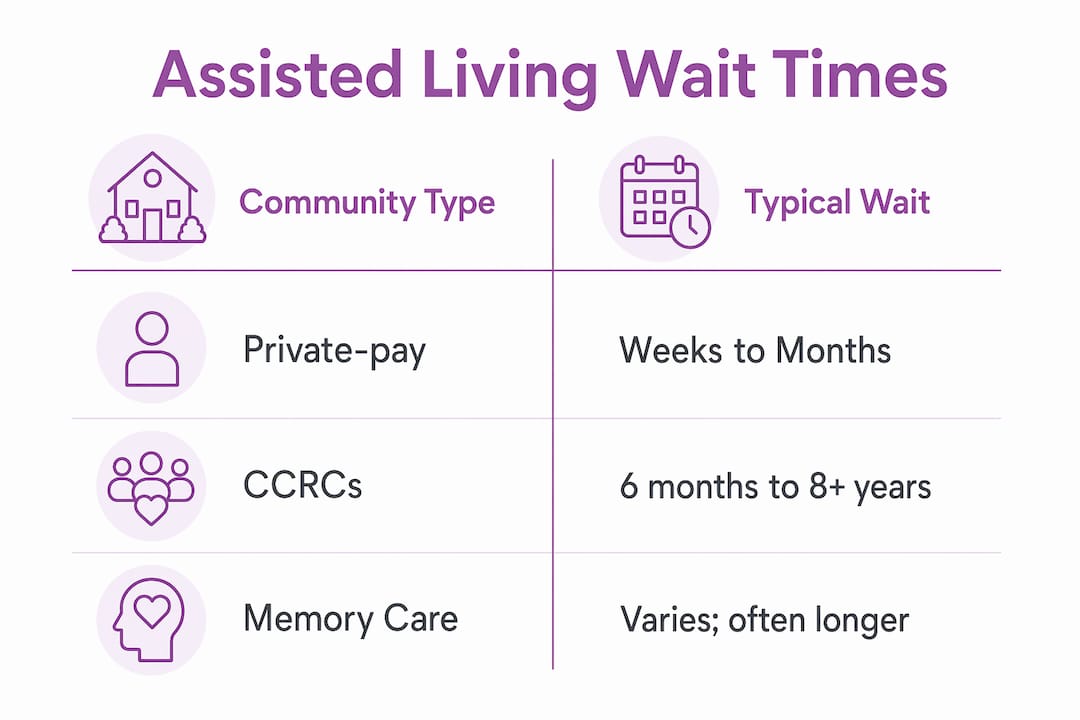
Memory care communities often have tighter capacity than standard assisted living floors, which means waits can stretch longer than families expect. Location also plays a role. Communities in high-density metro areas like New York City and northern New Jersey tend to fill faster than those in suburban or rural settings.
Pro Tip: Apply to at least two or three communities simultaneously. Waitlists are not exclusive contracts. Spreading your applications gives you options and real leverage when a spot opens.
When is the right time to join a senior living waitlist?
The right time to join a waitlist is while your loved one is still healthy, independent, and not facing an immediate care crisis. Experts consistently recommend early waitlist entry during a period of stable health, precisely because it removes the pressure of a rushed decision. Joining early also opens access to preferred communities that would otherwise be unavailable during an emergency.
Here is what the timing looks like in practice:
- Stable health phase. Your parent is managing well at home but you recognize that needs will increase. This is the ideal moment to tour communities, compare options, and submit formal applications to your top two or three choices.
- Early care needs phase. Some daily assistance is needed but no crisis has occurred. You still have time to be selective, but the window is narrowing. Apply immediately and follow up monthly.
- Crisis phase. A fall, hospitalization, or sudden cognitive decline forces an urgent placement. At this point, waitlists serve as a safety net but you are no longer in a position to wait. You will likely need to accept whatever is available quickly, which may not be your first choice.
The risk of waiting too long is not just emotional stress. It is also financial. Rushed placements often mean accepting a community that does not fit the budget or care model your family wanted. Meadow Ridge and similar communities note that joining a waitlist early opens access to preferred options and reduces stress during transitions. That observation is backed by the reality that the best communities fill first and stay full.
Maintaining active contact after joining is just as important as the timing of your application. Call the community every 60–90 days to confirm your position, update any changes in health status, and signal that you remain a serious candidate. Communities notice who is engaged and who has gone silent.
What should families do while on an assisted living waitlist?
Being on a waitlist is not a passive state. Families who treat it as “set it and forget it” often get caught off guard when a spot opens or when their loved one’s needs change faster than expected.
- Keep contact information current. If the community cannot reach you when a unit opens, they will move to the next candidate. Update your phone number, email, and emergency contact every time anything changes.
- Understand the pass and deferral policy. Deposit and pass policies vary widely across communities and can affect your position or cause removal. Know exactly how many times you can decline before losing your spot.
- Reassess care needs regularly. Health can change faster than a waitlist moves. If your loved one’s needs now exceed what a community is licensed to provide, failure to update health status can remove them from eligibility entirely. Schedule a formal reassessment every six months.
- Prepare for the admission process. The formal admission process begins with a clinical pre-admission assessment, often using standardized tools, to confirm the facility can meet care requirements. Gather medical records, physician statements, and insurance documentation now, not when the call comes.
- Apply to multiple communities. A single waitlist is not a plan. Apply to your top three choices and treat each one seriously. Review the assisted living placement options available in your area to make sure you are not limiting yourself unnecessarily.
- Explore the full range of community types. If standard assisted living has a long wait, check whether independent living communities or a CCRC with a continuum of care might serve your loved one’s current and future needs better.
Active monitoring is the single most effective way to prevent a crisis move. Families who stay engaged with communities, update health records proactively, and maintain backup options are the ones who land in the right place at the right time.
Key takeaways
An assisted living waitlist is a care-matched prioritization system, not a simple queue, and families who treat it as one will be unprepared when a placement opportunity arrives.
| Point | Details |
|---|---|
| Waitlists are care-matched, not chronological | Position depends on health, cognitive needs, and unit compatibility, not just application date. |
| Deposits are standard and binding | Most communities require a deposit around $300, often non-refundable but credited toward move-in costs. |
| Wait times vary widely by community type | Private-pay assisted living waits weeks to months; CCRCs can take 6 months to over 8 years. |
| Early application reduces risk | Joining while your loved one is healthy gives you access to preferred communities and time to be selective. |
| Active management prevents crisis moves | Updating health status, maintaining contact, and applying to multiple communities protects your options. |
What i’ve learned after years of watching families navigate waitlists
The most common mistake I see families make is treating the waitlist like a ticket stub. They pay the deposit, file the paperwork, and then wait by the phone for years. That is not how this works, and the communities know it.
The care-match system genuinely surprises people. A family that applied 18 months ago may get passed over for a family that applied 6 months ago, simply because the unit that opened matches the newer applicant’s care profile more precisely. That is not unfair. It is how the system is designed to protect residents. But it does mean that passive waiting is a losing strategy.
What actually works is treating the waitlist as one piece of a larger plan. Apply early, apply to multiple communities, and stay in contact. When a community calls with an offer, be ready to move within days, not weeks. The families who have their medical records organized, their finances in order, and their move-in logistics thought through are the ones who land in the right place. The ones who need three more weeks to “get organized” often lose the spot.
I also want to be direct about something most articles skip. Not every community is worth waiting for. Some waitlists are long because the community is genuinely excellent. Others are long because the community has not updated its marketing in a decade and families assume popularity equals quality. Tour the community before you pay a deposit. Talk to current residents. Ask about staff turnover. A shorter wait at a better-matched community beats a long wait at a prestigious name.
— Eric
How Assistedlivingadvisers helps families navigate the waitlist process
Waitlist navigation is one of the most stressful parts of planning senior care, and most families do it without any professional guidance. Assistedlivingadvisers specializes in exactly this process for families across New York, New Jersey, and Connecticut.

The team at Assistedlivingadvisers conducts personalized needs assessments, identifies communities that match your loved one’s care profile and budget, and helps you apply strategically to multiple options at once. That means no wasted deposits on communities that were never the right fit. If you are ready to find assisted living near you or want expert guidance on which communities to prioritize, Assistedlivingadvisers offers free consultations with no obligation. Starting early with professional support is the single best way to protect your family’s options.
FAQ
What is an assisted living waitlist?
An assisted living waitlist is a formal registration system that tracks prospective residents until a compatible unit and care match become available. Position on the list depends on health needs, unit type, and community capacity, not strictly the date of application.
How do i join an assisted living waitlist?
Joining requires a formal application, a health summary, and typically an upfront deposit. An informal inquiry or tour does not place your loved one on the list. Contact the community’s admissions office directly to begin the formal process.
How long is the average assisted living waiting list?
Private-pay assisted living typically has waits from a few weeks to a few months. CCRCs can have waits ranging from 6 months to over 8 years depending on unit type and demand.
Can i be removed from an assisted living waitlist?
Yes. Communities can remove or reprioritize applicants who pass or defer multiple times, fail to update health status, or whose care needs exceed the facility’s licensing. Review the community’s specific policy before applying.
Should i join multiple assisted living waitlists at once?
Joining multiple waitlists simultaneously is strongly recommended. Waitlists serve as a safety net but should be paired with an active search and backup plans to avoid being left without options during a health crisis.
Recommended
Let’s Work Together To Find The Ideal Senior Living Community For Your Loved One.
Assisted Living Advisers is a FREE, personalized service offering expert guidance in determining the ideal community for your loved one based on physical needs, location preferences and finances.