
Many families in the New York, New Jersey, and Connecticut area assume assisted living and independent living are just two names for the same thing. They picture similar campuses, similar amenities, and similar routines. In reality, the differences are significant and choosing the wrong option can affect your loved one’s safety, quality of life, and ability to transition smoothly as health needs change. This guide breaks down what each option actually provides, how costs compare, and what questions to ask before you sign anything.
Table of Contents
- What defines assisted living and independent living?
- Daily life, services, and amenities compared
- Cost differences and what impacts price
- Choosing the right fit: Key local questions to ask
- Why “campus continuum” models change everything for families
- Expert guidance for your family: Find the right fit now
- Frequently asked questions
Key Takeaways
| Point | Details |
|---|---|
| Assisted vs independent living | Assisted living includes health support and personal care, independent living offers minimal support and lifestyle amenities. |
| Local campus flexibility | Many tri-state communities feature both models and allow transitions as needs change. |
| Cost can vary widely | Compare national benchmarks and request local, itemized pricing to prevent surprise expenses. |
| Trigger criteria matter | Always ask communities how and when care levels are authorized or escalated for residents. |
What defines assisted living and independent living?
Let’s start with the basics, because the labels alone do not tell the full story.
Independent living is designed for older adults who are largely self-sufficient. Think active seniors who want community, convenience, and social engagement without the responsibilities of maintaining a home. These communities offer amenities like fitness centers, dining rooms, group outings, and housekeeping. Medical care is not the focus. Staff are not trained to monitor health conditions or assist with bathing, dressing, or medication management on a regular basis.
Assisted living is a licensed care setting. It is built for seniors who need hands-on support with activities of daily living, which include bathing, dressing, grooming, medication management, and mobility. Staff are trained and available around the clock. Residents have their own apartments or rooms, but they receive structured care tailored to their individual needs.
Here is a quick breakdown of what each option typically includes:
Independent living typically offers:
- Private apartments or cottages
- Communal dining (often optional)
- Social and recreational programming
- Transportation services
- Housekeeping and maintenance
- Little to no personal care support
Assisted living typically offers:
- 24-hour staffing with trained caregivers
- Help with activities of daily living
- Medication management and health monitoring
- Structured meals included in the base cost
- Emergency call systems and safety protocols
- Access to visiting healthcare professionals
One important nuance that families often miss: many campuses in the tri-state area offer what is called a continuum of care. This means independent living, assisted living, memory care, and sometimes skilled nursing are all available on the same property. But as Harvard Health notes, families should ask about care escalation criteria and how quickly level-of-care changes are authorized when needs escalate.
Understanding the difference between these two models is also key when exploring retirement vs assisted living options, or when choosing senior living options that match both current and future needs.
Daily life, services, and amenities compared
Now that we know what defines these living options, let’s visualize their day-to-day routines and service differences.
Imagine a typical Tuesday morning. In an independent living community, your parent wakes up, makes their own breakfast or heads to the dining room, signs up for a yoga class, and meets friends for a card game in the afternoon. Staff are present but not involved in personal care. The environment feels more like an upscale apartment community with built-in social programming.
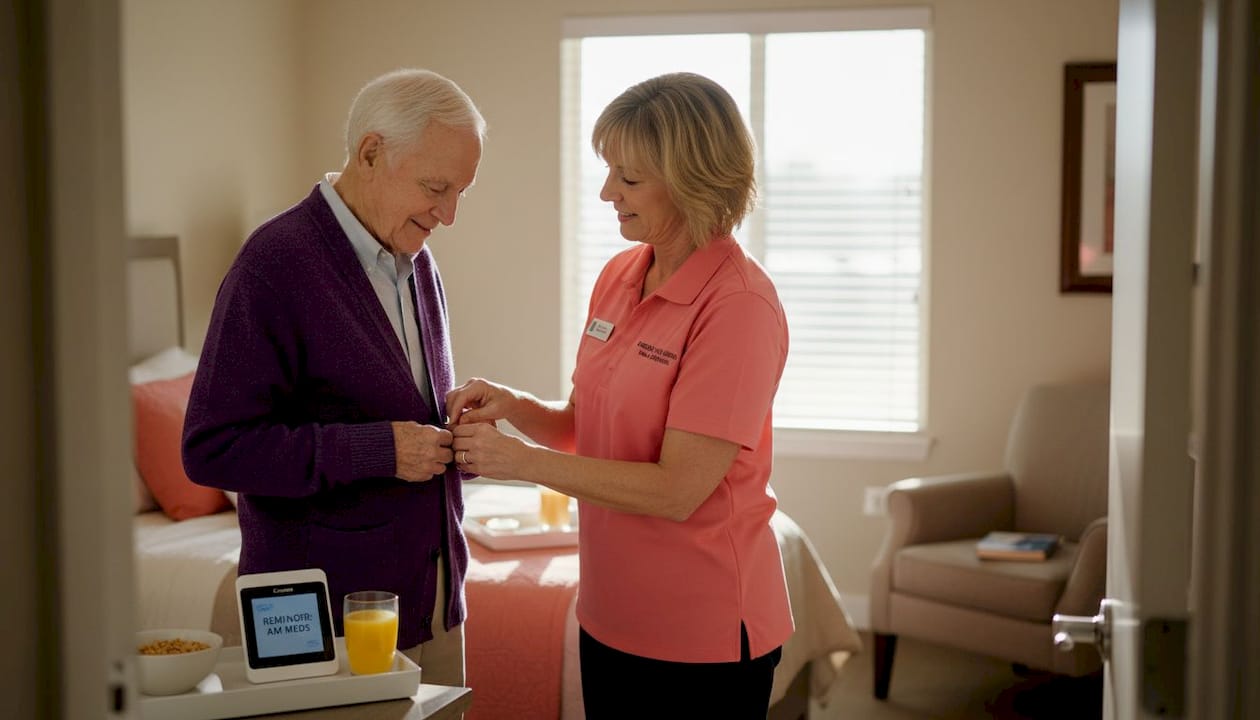
In an assisted living community, that same Tuesday looks different. A caregiver stops by in the morning to help with dressing and medication. Meals are served at set times in a dining room, and staff monitor whether your parent is eating well. If your parent has mobility challenges, a caregiver assists with walking to activities. The social programming still exists, but safety and care are woven into every part of the day.
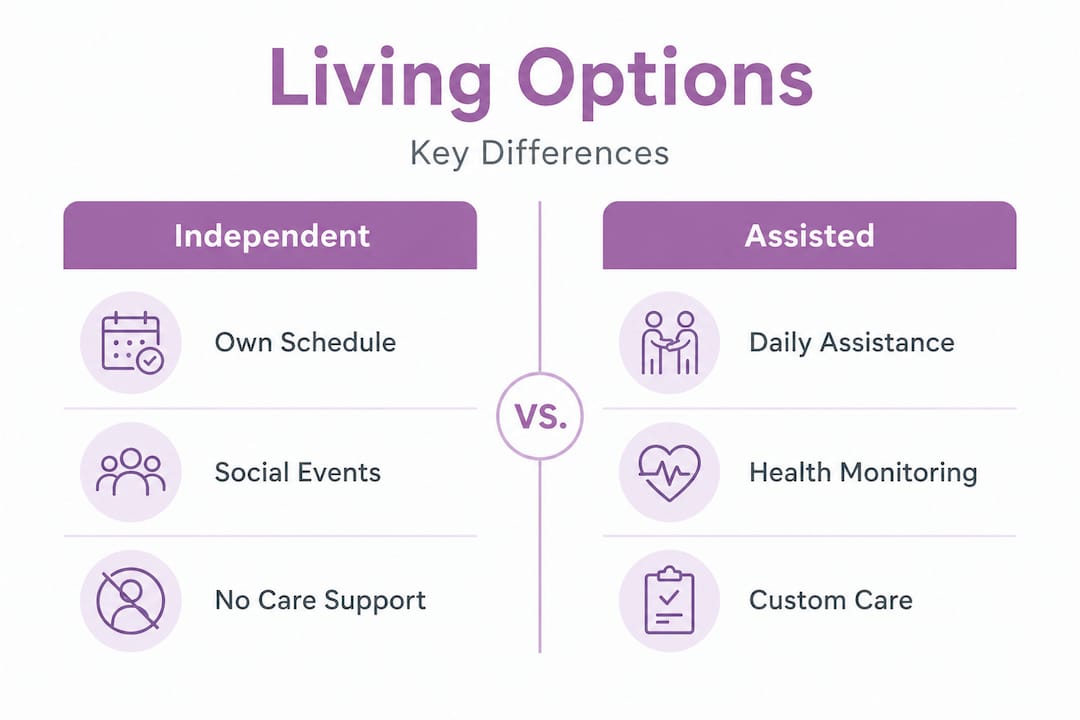
Here is a side-by-side comparison to make this concrete:
| Feature | Independent living | Assisted living |
|---|---|---|
| Personal care support | Not provided | Included, customized |
| Medication management | Self-managed | Staff-managed |
| Meals | Optional or included | Typically included |
| 24-hour staffing | Not standard | Required by licensing |
| Emergency response | Call system only | Trained staff on site |
| Health monitoring | Not routine | Regular check-ins |
| Social programming | Extensive | Available but care-focused |
| Licensing requirements | Minimal | State-regulated |
Staffing levels and emergency response protocols are where the gap becomes most critical. An independent living community may have a front desk attendant overnight. An assisted living community has trained caregivers available at all hours, which matters enormously if your parent falls, experiences a health episode, or becomes confused during the night.
When evaluating options, consider these steps before committing:
- Request a full list of services included in the base monthly fee.
- Ask what services cost extra and how those fees are billed.
- Find out the staff-to-resident ratio during overnight hours.
- Ask how staff are trained and what certifications they hold.
- Request a sample weekly activity schedule to understand the social environment.
Understanding the role of assisted living in a broader care plan helps families set realistic expectations. It is also worth understanding the difference between facility vs community options, since the terminology itself can be misleading.
Pro Tip: When you tour a community, visit during a meal service and an activity. Watch how staff interact with residents. The quality of those interactions tells you more than any brochure will.
Cost differences and what impacts price
While service differences are significant, costs and pricing structures are where families often face unexpected surprises.
Here is the honest truth: pricing for senior living is not standardized, and national benchmarks vary widely depending on the source, the year the data was collected, and how “average cost” is defined. Some figures represent the community fee alone. Others factor in the care add-ons that most residents actually need. This is why a number you read online may look very different from what a community quotes you directly.
That said, here are general cost ranges to orient your planning:
| Living type | National monthly range (approximate) | What is typically included |
|---|---|---|
| Independent living | $1,500 to $4,500 | Housing, amenities, some meals |
| Assisted living | $3,500 to $7,500+ | Housing, meals, personal care |
| Memory care | $5,000 to $9,000+ | Specialized dementia care |
In the New York, New Jersey, and Connecticut market, costs tend to run higher than national averages due to real estate costs, staffing expenses, and state licensing requirements. A mid-range assisted living community in northern New Jersey or Westchester County may cost $5,500 to $7,000 per month before care add-ons. Manhattan and its immediate suburbs can push well above that.
“National median monthly cost figures differ across reputable sources because they use different years, sample definitions, and whether figures represent a community fee versus what families actually pay. Always compare multiple benchmarks and then request itemized pricing from target providers.”
Key factors that drive assisted living costs higher than independent living include:
- Staffing ratios: Assisted living requires more trained staff per resident, and those wages are regulated.
- State licensing: Assisted living communities must meet state health and safety standards, which adds operational costs.
- Care assessments: Most assisted living communities charge based on a care level assessment, meaning residents with higher needs pay more.
- Medication management: This is often billed as a separate service on top of the base rate.
- Incontinence care: Frequently an add-on fee that families do not anticipate.
For independent living, the pricing model is simpler. You typically pay a flat monthly fee for your apartment and access to amenities. Medical care is not included because it is not provided. If your parent later needs care, they would either hire private home health aides (at additional cost) or transition to assisted living.
When comparing costs, always compare costs for living options side by side using itemized quotes, not brochure rates. Ask each community to walk you through a realistic monthly total for someone with your parent’s specific needs.
Choosing the right fit: Key local questions to ask
Understanding costs is essential, but choosing the best fit means asking smart questions, especially in tri-state area communities.
The single most important question many families forget to ask is this: what happens if my parent’s needs change? In a standalone independent living community, the answer is often “they would need to move.” In a continuum campus, the answer should be a clear, documented process for transitioning to a higher level of care without requiring a full relocation.
As Harvard Health emphasizes, families should ask about care transitions and understand exactly what triggers a level-of-care change and how quickly it can happen.
Here is a practical list of questions to bring to every tour:
- What specific criteria trigger a transition from independent to assisted living on this campus?
- How long does the transition process typically take once a need is identified?
- Is there a waiting list for assisted living if my parent is currently in independent living?
- Who initiates the care level review: family, staff, or a physician?
- What happens if my parent’s needs exceed what assisted living can provide? Is skilled nursing available on campus?
- Can we see the care assessment tool you use to determine monthly pricing?
- What is your staff turnover rate? (High turnover often signals management or culture problems.)
- Are there any move-out policies tied to care level changes?
These questions are especially relevant in the tri-state area, where communities vary significantly in how they handle care escalation. Some campuses have seamless internal transfer processes. Others require families to start the search all over again when needs change, which is disruptive and expensive.
If you are still in the early stages of deciding whether it is time to make a move at all, resources on timing senior care decisions can help you recognize the right moment. And once you have chosen a community, understanding how to prepare for an assisted living move makes the transition far smoother for everyone.
Pro Tip: Always ask for the community’s state inspection report. In New Jersey, New York, and Connecticut, assisted living communities are inspected regularly, and those reports are public. They reveal complaint histories and citation patterns that tours will not show you.
Why “campus continuum” models change everything for families
Here is a perspective that most articles on this topic skip entirely: the distinction between assisted and independent living matters far less than whether the campus you choose can adapt as your loved one’s needs evolve.
We work with families across New York, New Jersey, and Connecticut, and the most common regret we hear is not “we picked the wrong level of care.” It is “we did not ask about what happens next.” A parent moves into a beautiful independent living community, thrives for two years, then has a fall or a cognitive shift, and suddenly the family is scrambling to find an assisted living placement in the middle of a health crisis.
The families who navigate this most successfully are the ones who chose a continuum of care community from the start, even if their parent only needed independent living at the time of move-in. The logic is simple: you are not just choosing care for today. You are building a safety net for the years ahead.
But here is the part that surprises families: not all continuum campuses operate the same way. Some have seamless internal transfer policies with priority placement for existing residents. Others treat the independent living and assisted living wings as separate operations with separate waitlists, separate contracts, and no guaranteed pathway between them. Asking about care escalation policies is not just a smart question. It is the question that separates a good decision from a great one.
Local expertise matters here in a way that online research simply cannot replace. Knowing which campuses in Bergen County or Fairfield County or Long Island actually deliver on their continuum promise, versus which ones use the language without the infrastructure, is the kind of knowledge that comes from visiting dozens of communities and talking to families who have lived through the transitions.
Expert guidance for your family: Find the right fit now
Sorting through assisted living and independent living options in the New York, New Jersey, and Connecticut area is genuinely complex. Pricing structures, care policies, and campus quality vary enormously from one community to the next, and the stakes for getting it right are high.

At Assisted Living Advisers, we help tri-state families cut through the confusion at no cost to you. Our advisers know the local communities, have toured the campuses, and understand which ones truly deliver on their promises. Whether you are exploring assisted living nearby, comparing independent living communities, or trying to understand how a move might improve your parent’s quality of life, we provide personalized guidance from the first conversation through move-in day. Reach out today to schedule your free consultation.
Frequently asked questions
What is the main difference between assisted and independent living?
Assisted living provides hands-on help with daily activities and healthcare support, while independent living focuses on social engagement and lifestyle amenities with minimal personal care. Many campuses offer both, but families should ask about transitions between levels before committing.
How can I tell when my parent needs to switch from independent to assisted living?
Watch for changes in mobility, memory, personal hygiene, medication management, or nutrition. Ask any community you are considering about their specific criteria for care transitions so you know what the process looks like before a crisis forces the decision.
Are assisted living costs always higher than independent living?
Generally yes, because assisted living requires licensed staff, state oversight, and individualized care services. However, cost benchmarks vary widely across sources, so always request itemized local pricing rather than relying on national averages.
Can my parent stay on the same campus if they need more care later?
Many tri-state campuses offer a continuum that includes independent living, assisted living, and memory care. But policies differ significantly, so ask each community about their care escalation process and whether existing residents get priority placement when needs change.
Recommended
- Assisted Living vs Board and Care | Assisted Living Advisors
- Assisted Living vs. Nursing Homes: What’s the Difference? – Assisted Living Advisers
- Retirement Communities vs. Assisted Living Communities – Assisted Living Advisers
- Understanding the Role of Assisted Living Communities in Senior Care – Assisted Living Advisers
- Difference between Domiciliary Care and Supported Living
Let’s Work Together To Find The Ideal Senior Living Community For Your Loved One.
Assisted Living Advisers is a FREE, personalized service offering expert guidance in determining the ideal community for your loved one based on physical needs, location preferences and finances.