
Most families assume getting into assisted living is as simple as being old enough or having a certain diagnosis. It isn’t. Defining assisted living eligibility, which senior care professionals call the admissions criteria or level-of-care determination, involves a specific set of functional and cognitive assessments that vary by state and by facility. If you’re trying to figure out whether your parent, spouse, or loved one qualifies, this guide gives you the real framework used by communities to make that decision, including what Medicaid requires and how eligibility differs from nursing home or memory care thresholds.
Table of Contents
- Key Takeaways
- Defining assisted living eligibility: core criteria
- The intake evaluation and admission process
- Medicaid eligibility and state rule variations
- Matching the right care level to the right setting
- My experience with families and eligibility decisions
- How Assistedlivingadvisers can simplify this for you
- FAQ
Key Takeaways
| Point | Details |
|---|---|
| ADL needs drive eligibility | Most facilities require help with at least 1-2 Activities of Daily Living to qualify for admission. |
| Medical stability matters | Seniors needing 24-hour nursing or complex devices like ventilators typically fall outside assisted living scope. |
| State rules vary significantly | Eligibility criteria depend on both state licensing rules and each facility’s approved scope of care. |
| Medicaid has two separate gates | Financial enrollment and nursing-facility level-of-care certification must both be satisfied for Medicaid coverage. |
| Cognitive issues alone don’t decide | Safety risks and behavioral factors are more decisive than a memory diagnosis alone. |
Defining assisted living eligibility: core criteria
The most important thing to understand is that assisted living eligibility is not primarily about age or diagnosis. It centers on functional need. Specifically, facilities look at how much help a person requires with Activities of Daily Living, commonly called ADLs. These are the basic physical tasks that define independent functioning: bathing, dressing, eating, toileting, transferring (moving from bed to chair), and maintaining continence.
Qualifying for placement typically requires documented need for assistance with at least one or two of these ADLs. A senior who can manage all six independently, even with some memory concerns, may not meet the threshold for assisted living and could be better suited to independent living. That distinction surprises many families.
Beyond ADLs, facilities also assess Instrumental Activities of Daily Living, known as IADLs. These include managing medications, handling finances, preparing meals, housekeeping, and using transportation. Struggles with IADLs alone usually don’t qualify someone for assisted living, but they paint a fuller picture of cognitive and functional decline.
Cognitive status is evaluated separately but weighed alongside physical function. The key question isn’t whether someone has dementia. Cognitive impairment is assessed in the context of safety and the facility’s care capacity. A resident with moderate memory loss who is physically stable and doesn’t wander may be well-suited to a standard assisted living community. Someone with the same diagnosis who displays aggressive behavior or significant wandering risk will likely need a dedicated memory care unit.
It’s also worth knowing what conditions typically exclude admission. Ventilator dependence and advanced pressure wounds requiring clinical wound care are common disqualifiers because they exceed what most assisted living licenses permit. The underlying logic: assisted living is for personal care support, not continuous skilled nursing.
- Needing help with 1-2 ADLs: generally qualifies
- Needing help with all 6 ADLs plus complex medical equipment: typically exceeds scope
- Cognitive impairment with stable behavior: often eligible
- Active wandering risk or aggression: may require memory care instead
- Behavioral issues that create safety risks for others: usually a disqualifier
Pro Tip: Ask any facility you’re evaluating to share their specific admissions criteria in writing. Since eligibility varies by state licensing and facility type, two communities in the same city may have meaningfully different thresholds.
The intake evaluation and admission process
Understanding what the facility actually does before accepting a resident helps families prepare and avoid surprises. The assisted living admission process follows a structured sequence that most licensed communities must complete before signing any agreement.
- Pre-admission assessment request. The family or referring party submits basic health information and requests a formal evaluation. Most facilities will ask for recent medical records and a physician’s statement at this stage.
- Physician statement. A licensed doctor certifies the applicant’s current diagnoses, medication list, and medical stability. This document confirms the person doesn’t require care beyond the facility’s licensed scope.
- Functional assessment. A nurse or trained staff member evaluates the applicant’s ADL performance directly. Pre-admission evaluations typically include ADL scales, cognitive screening tools like the Mini-Mental State Examination (MMSE), and behavioral risk screening.
- Cognitive and behavioral screening. This step assesses memory, orientation, judgment, and any behavioral patterns that could create safety risks. The facility is determining whether their staff and environment can meet the person’s needs safely.
- Care plan development. If the applicant clears the assessment, the facility drafts an individualized care plan outlining specific support services, staffing ratios, and any specialized programming needed.
- Admission contract review. The family reviews and signs a contract that details services, costs, and the facility’s criteria for continued residence. Pay close attention to the discharge criteria here.
- Ongoing reassessment. Admission isn’t permanent. Assessments are repeated periodically to detect changes that might affect continued suitability for that care level.
A critical point many families miss: the pre-admission assessment protects both the resident and the facility. If a senior’s needs escalate beyond the facility’s licensed scope, they are legally required to initiate a transfer. Knowing this upfront helps families plan for that possibility rather than being blindsided later.
Pro Tip: Bring a written summary of your loved one’s daily routine, medication schedule, and any recent behavioral changes to the assessment. Facilities rely on family input to fill gaps that medical records don’t capture, and detailed information speeds up the process considerably.

Medicaid eligibility and state rule variations
Private pay is straightforward. Medicaid is not. Families pursuing Medicaid funding for assisted living need to understand that Medicaid eligibility has two distinct requirements that must both be satisfied before coverage begins.
The first is financial qualification. Medicaid sets income and asset limits that applicants must fall below to enroll. Income thresholds are often set below 300% of the Federal Benefit Rate, and asset limits are strict. Medicaid covers the cost of care services in assisted living but does not cover room and board. That portion still falls to the resident.
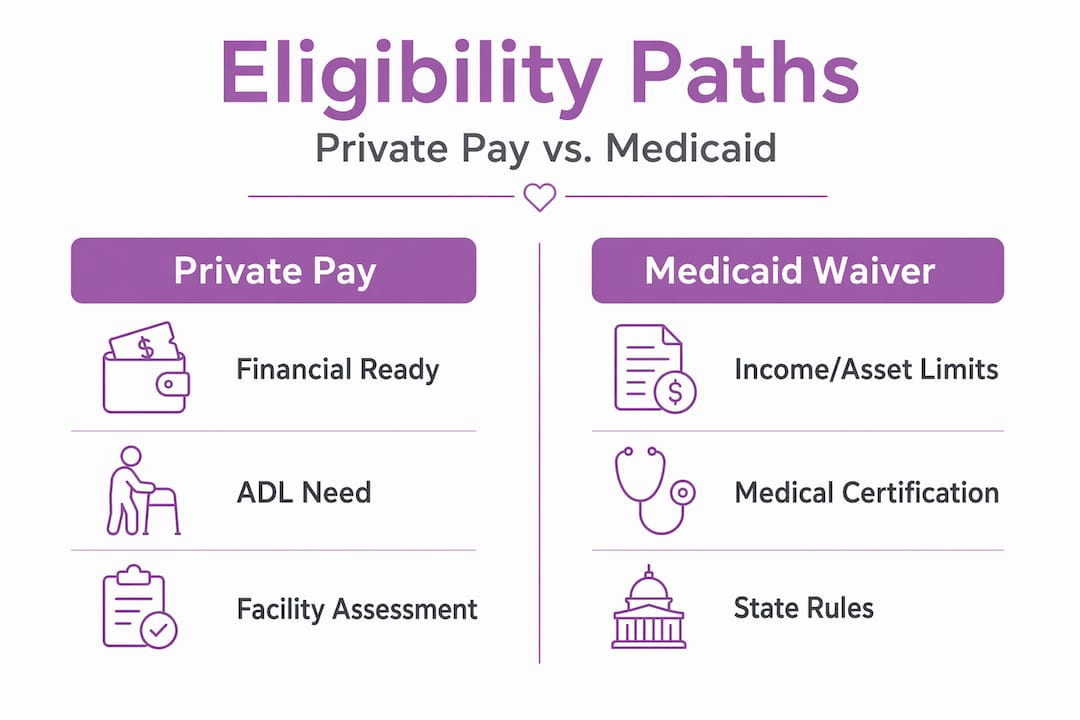
The second requirement is medical and functional certification. Specifically, most states require nursing-facility level of care certification, known as an NFLOC screen, to qualify for Home and Community-Based Services waivers. This means a healthcare professional must certify that the applicant’s care needs are serious enough that they could qualify for a nursing home. Clearing the financial threshold without meeting the NFLOC requirement means no coverage.
| Eligibility factor | Private pay | Medicaid waiver |
|---|---|---|
| Functional need (ADLs) | Required by facility | Required, plus NFLOC certification |
| Income/asset limits | Not applicable | Strict limits apply |
| State residency | Not required | Required |
| U.S. citizenship/status | Not required | Required |
| Room and board covered | Included in fee | Not covered by Medicaid |
State-by-state differences add another layer of complexity. Some states fund assisted living through Medicaid waivers generously; others offer limited slots or have long waiting lists. State licensing also shapes which residents a facility can legally accept. Eligibility standards vary because some states allow facilities to perform medical tasks that others reserve for nursing homes. A senior who qualifies at a facility in New Jersey might not qualify at one in Connecticut under the same circumstances.
Families preparing a Medicaid application should gather financial records, get a current physician statement, and start the NFLOC screening process early. In high-demand markets like the New York tri-state area, Medicaid waiver slots can be limited, so early preparation is genuinely advantageous.
Matching the right care level to the right setting
Assisted living occupies a specific band on the senior care spectrum. Understanding where it sits helps families avoid placing someone in a setting that’s either more than they need or less than they require.
- Independent living: For seniors who are largely self-sufficient. No ADL assistance is provided. Eligibility is social and age-based, not clinical.
- Assisted living: For seniors needing help with some ADLs and personal care, but who are medically stable. The balance here is personal care support without continuous skilled nursing.
- Memory care: A specialized environment within or adjacent to assisted living designed for residents with dementia who pose safety risks. Eligibility goes beyond cognitive diagnosis and includes behavioral risk assessment.
- Skilled nursing facility: For residents needing 24-hour medical supervision, complex wound care, IV therapy, or rehabilitative services that exceed assisted living scope.
| Setting | Primary eligibility driver | Medical intensity |
|---|---|---|
| Independent living | Age and self-sufficiency | Low |
| Assisted living | ADL needs, behavioral stability | Moderate |
| Memory care | Cognitive impairment with safety risks | Moderate to high |
| Skilled nursing facility | Continuous medical or nursing need | High |
The common mistake families make is waiting too long. A senior who needs skilled nursing won’t thrive in assisted living, but a senior whose needs are genuinely at the assisted living level will often have a much better quality of life in that setting than in a nursing facility. Getting the match right early matters more than most people realize. For a detailed breakdown of how these thresholds differ, this comparison covers the clinical and licensing distinctions in plain terms.
My experience with families and eligibility decisions
I’ve worked with enough families navigating senior care placements to say this with confidence: the eligibility process trips people up not because it’s complicated but because expectations don’t match reality. Families often arrive believing that because their mother has Alzheimer’s, she automatically qualifies for assisted living. Or that because their father is 83, any community will take him. Neither is true.
What I’ve seen work is getting ahead of the assessment rather than reacting to it. Families who come to the conversation with documentation, a clear account of daily function, and an honest picture of behavioral patterns get through the process faster and land in the right setting more often. Families who wait until a crisis hits tend to accept whatever has an open bed.
The other thing I’d push back on is the assumption that a “no” from one facility is a final answer. Every community has its own licensed scope and staffing model. A senior who doesn’t meet criteria at one community may be a strong fit at another. That’s exactly why working with an advisor who knows the local communities’ actual admission thresholds, not just their marketing materials, makes a concrete difference in outcomes.
The goal isn’t just getting in somewhere. The goal is getting into the right place, where the care capacity matches what your loved one actually needs today, with room to adapt as those needs evolve.
— Eric
How Assistedlivingadvisers can simplify this for you
Sorting through assisted living eligibility criteria, state rules, and facility-specific admissions standards is genuinely time-consuming. Assistedlivingadvisers offers free, personalized guidance to families across New York, New Jersey, and Connecticut who are trying to make sense of this process.
The team at Assistedlivingadvisers conducts needs assessments, matches families to vetted communities that align with their loved one’s functional and cognitive profile, and coordinates facility tours and move-in logistics. There’s no cost to families for this service. If you’re ready to explore assisted living options near you or want help understanding whether your loved one meets the criteria for a specific community, a consultation takes the guesswork out of a decision that really matters. You can also explore the broader range of senior living options available in the tri-state area to get a clearer picture of where assisted living fits in the overall care spectrum.
FAQ
What are the main requirements for assisted living?
Most facilities require that a resident needs help with at least one or two Activities of Daily Living such as bathing, dressing, or toileting, and is medically stable enough that continuous skilled nursing is not required.
Who qualifies for assisted living under Medicaid?
To qualify for Medicaid-funded assisted living, applicants must meet both financial limits (income and assets below state thresholds) and pass a nursing-facility level-of-care certification, confirming their care needs are clinically significant.
Does a dementia diagnosis automatically qualify someone for assisted living?
No. Memory problems alone don’t determine eligibility. Facilities assess behavioral safety risks and their own care capacity. A senior with dementia who wanders or poses safety risks will typically be directed toward memory care instead.
How does assisted living eligibility differ from nursing home eligibility?
Assisted living is designed for seniors who need personal care and help with ADLs but are medically stable. Nursing homes serve residents who require 24-hour skilled nursing, complex medical management, or rehabilitative services that go beyond assisted living scope.
Can a facility deny admission based on its own criteria?
Yes. Because eligibility is shaped by both state licensing rules and each facility’s individual scope of care, communities can and do set their own admissions and discharge criteria within those regulatory boundaries.
Recommended
- Who Qualifies for Assisted Living? – Assisted Living Advisers
- How Assisted Living Communities Can Improve Family Dynamics – Assisted Living Advisers
- Assisted Living Communities: A Bridge to Deeper Family Connections – Assisted Living Advisers
- Understanding the Role of Assisted Living Communities in Senior Care – Assisted Living Advisers
Let’s Work Together To Find The Ideal Senior Living Community For Your Loved One.
Assisted Living Advisers is a FREE, personalized service offering expert guidance in determining the ideal community for your loved one based on physical needs, location preferences and finances.