
Most families discover the complexity of senior care the hard way, usually during a crisis. A fall, a diagnosis, a sudden change in cognition, and suddenly you’re researching nursing homes, memory care units, and assisted living facilities while managing grief, work, and your own family. Family caregivers in New Jersey alone provide 1.19 billion hours of care per year, a role that 64% of those caregivers describe as highly emotionally stressful. An elder care advisor exists specifically to step in at this moment and help you make clear, well-informed decisions without losing yourself in the process.
Table of Contents
- What is an elder care advisor?
- Core services and assessment methods
- How advisors support families and reduce stress
- Special cases and cost considerations
- Finding a trustworthy elder care advisor in the tri-state area
- A hard-won perspective: What most families miss about elder care advisors
- How Assisted Living Advisers guides tri-state families with confidence
- Frequently asked questions
Key Takeaways
| Point | Details |
|---|---|
| Advisor’s core role | An elder care advisor helps families navigate senior housing and care choices with expert guidance. |
| Thorough assessment | Trusted advisors use evidence-based tools to assess seniors’ needs and recommend the best-fit solution. |
| Stress and crisis relief | Advisors reduce family stress and prevent crises by offering emotional support and practical know-how. |
| Handle unique challenges | They solve complex issues including dementia care, rural placement, and cost management with local resources. |
| Local matters most | Choosing a tri-state-focused advisor ensures families receive expert advice rooted in local facility knowledge. |
What is an elder care advisor?
The term “elder care advisor” gets used interchangeably with several other titles, which can itself add to the confusion. According to U.S. News & World Report, an elder care advisor is an independent professional who guides families through selecting appropriate senior housing and care options, including assisted living, memory care, and independent living. You may also hear them called a senior living advisor, geriatric care manager, or Aging Life Care Professional, depending on their credentials and focus.
What distinguishes an elder care advisor from other professionals you might encounter is their independence. Unlike a facility’s admissions coordinator, whose job is to fill beds in their specific community, an advisor works across many communities and recommends based on fit, not vacancy. Unlike a government social worker, who may be limited by caseload or jurisdiction, a private advisor focuses exclusively on your family’s situation.
Understanding what an assisted living advisor actually does can clarify exactly who is in your corner during this process. Here’s a quick comparison to help you see the difference clearly.
| Professional | Who they work for | Geographic scope | Cost to family |
|---|---|---|---|
| Elder care advisor | Independent or agency | Local or regional | Usually free (paid by facilities) |
| Admissions coordinator | Senior living facility | Single facility | N/A |
| Government social worker | State/county agencies | Jurisdiction-based | Free (limited resources) |
| Elder law attorney | Legal clients | Office-based | Hourly or flat fee |
| Geriatric care manager | Client families | Local or regional | Often fee-based |
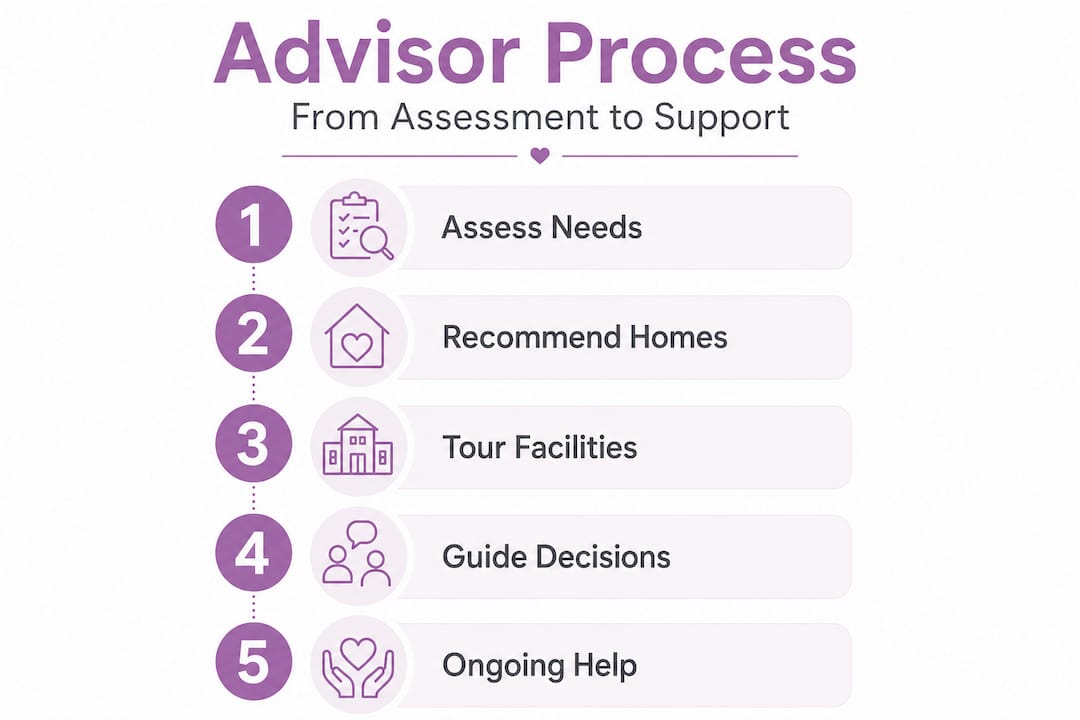
Key functions that an elder care advisor typically provides include:
- Needs assessment: Evaluating physical, cognitive, and emotional status to recommend the right level of care
- Facility matching: Connecting families to vetted communities that meet specific care, budget, and geographic preferences
- Tour coordination: Arranging and sometimes accompanying families on visits to shortlisted communities
- Move-in support: Helping manage the logistics of the actual transition
- Ongoing guidance: Answering follow-up questions as a senior’s needs evolve over time
Core services and assessment methods
Once you know who’s supporting you, understanding how they actually evaluate your senior’s needs is the next step. A good advisor does not simply hand you a list of facilities. They first invest time in getting to know your loved one through a structured assessment process.
Validated assessment tools allow advisors to measure physical function, cognitive ability, emotional wellbeing, nutritional status, and daily living skills. These are not informal conversations. They are standardized instruments with scoring systems that help advisors see clearly where a senior currently stands and where they are likely headed.
Here are the key assessment domains and the tools used:
| Assessment domain | Tool commonly used | What it measures |
|---|---|---|
| Activities of daily living (ADLs) | Katz Index | Bathing, dressing, feeding, continence |
| Instrumental ADLs (IADLs) | Lawton Scale | Managing finances, medications, transportation |
| Cognitive screening | MoCA (Montreal Cognitive Assessment) | Mild cognitive impairment, early dementia |
| Depression screening | GDS (Geriatric Depression Scale) | Emotional and psychological wellbeing |
| Nutritional risk | MNA (Mini Nutritional Assessment) | Weight loss, appetite, mobility issues |
Notably, skilled advisors prefer validated tools like the MoCA over older instruments for detecting mild cognitive impairment, which matters enormously when deciding whether assisted living or memory care is the right setting. This distinction is not subtle. A senior who scores fine on a basic screen but struggles on the MoCA may need a more structured environment with memory care-level support, even if the family believes things are “manageable” at home.
Consider this real-world scenario: a family in northern New Jersey notices their mother becoming increasingly confused about medications and missing appointments. An advisor administers the MoCA and Lawton Scale, revealing significant IADL deficits that suggest early-stage dementia. The family had been considering independent living, but the assessment results make it clear that choosing between care levels needs to involve memory care as a serious option. Without that assessment, the family might have placed their mother in a community that could not safely support her.
Pro Tip: Always ask your advisor for a written summary of assessment findings and the specific tools used. If an advisor cannot explain their evaluation methodology or declines to share results, treat that as a red flag.
Good advisors also use assessment findings to improve mental and physical health outcomes by matching seniors to communities where their specific needs will actually be addressed, not just tolerated.
How advisors support families and reduce stress
Understanding the advisor’s role is one thing. Realizing their impact on your family’s everyday wellbeing is another matter entirely.
The data on family caregiver burden in the tri-state area is striking. New Jersey caregivers alone provide 1.19 billion hours of unpaid care annually, valued at $28 billion. Nationally, caregiving has increased 45% since 2015. These are not just statistics. Behind each number is a family member missing work, sacrificing sleep, and making difficult decisions without enough information.
“The emotional cost of navigating elder care alone is real and measurable. Families who work with experienced advisors consistently report feeling less overwhelmed, better informed, and more confident about their decisions.”
Here are the top five stressors families face, and how an advisor directly addresses each:
- Not knowing what options exist. Advisors maintain active knowledge of local communities across New York, New Jersey, and Connecticut, saving families weeks of research.
- Fear of making the wrong choice. Structured assessments and advisor experience replace guesswork with evidence-based recommendations.
- Financial uncertainty. Advisors explain cost structures, explain long-term care insurance, and point families toward specialists for Medicaid guidance. Understanding how to manage eldercare costs is central to any good advisory relationship.
- Guilt and family conflict. Having a neutral, knowledgeable third party helps defuse internal disagreements about what is “best” for a parent.
- Crisis situations. When a senior is being discharged from a hospital or rehab and a decision must be made within days, an advisor who already knows the local landscape can move quickly and with precision.
Families who access good advisory support also tend to see better outcomes for their seniors, including fewer emergency readmissions and higher satisfaction with their care settings.
Pro Tip: Before hiring any advisor, ask for two or three references from families they have worked with in your specific county or metro area. A good advisor will have those available without hesitation.

Special cases and cost considerations
Not all eldercare cases are straightforward. Some involve higher needs and trickier cost structures that require specialized knowledge.
High-acuity dementia is one of the most challenging scenarios families face. Memory care communities designed for these residents include secured units to prevent wandering, highly trained staff ratios, and specialized programming. The added cost reflects that complexity. Across the tri-state area, basic assisted living typically runs $3,000 to $7,000 per month, while memory care adds another $1,000 to $2,000 on top of that. Independent living is generally less expensive, but it is not appropriate for seniors who need hands-on help with daily tasks.
Other complex scenarios advisors regularly navigate include:
- Polypharmacy management: Seniors on multiple medications need communities equipped to handle complex medication regimes, and advisors know which facilities have strong pharmacy partnerships or medication management protocols
- Rural or suburban access: Not all families are in Manhattan or Jersey City. Advisors familiar with suburban and rural New Jersey or Connecticut can identify high-quality communities that may not appear in generic online searches
- Sandwich generation caregivers: Adults simultaneously caring for aging parents and raising children face compressed timelines and emotional loads that require advisors who are both efficient and empathetic
- Rapid transitions: Seniors moving directly from a hospital or rehabilitation facility need expedited placement, which demands an advisor with strong relationships in the community network
When comparing care settings, here’s what families in the tri-state area typically encounter:
| Care type | Monthly cost range (tri-state) | Best suited for | Key features |
|---|---|---|---|
| Independent living | $2,500 to $4,500 | Active seniors, minimal care needs | Social programming, convenience, optional services |
| Assisted living | $3,000 to $7,000 | Seniors needing help with ADLs | Personal care, medication management, meals |
| Memory care | $4,500 to $9,000+ | Dementia, Alzheimer’s, cognitive decline | Secured environment, specialized programming |
Before signing any contract, families should ask specific questions about billing, fee escalation, and what services are included versus charged separately. Advisors who specialize in memory care guidance are especially valuable here because memory care contracts can be particularly complex.
Finding a trustworthy elder care advisor in the tri-state area
Now that you know what advisors do and why their support matters, choosing the right one is the final step.
Local expertise is not a luxury. It is a requirement. National referral services can connect you to a list of facilities quickly, but local advisors with personal community knowledge provide something national platforms cannot: direct, firsthand experience touring communities, knowing the staff, and understanding how a facility actually operates day to day, not just what their brochure says. Some national referral networks also have financial relationships with a limited set of contracted facilities, which can introduce bias into their recommendations even when they present themselves as neutral.
When interviewing prospective advisors, ask:
- How many communities have you personally visited in the past six months?
- Do you receive referral fees from specific communities, and if so, do you disclose that?
- Can you accommodate urgent placements, and how do you handle crisis situations?
- Do you accompany families on tours or just provide a list?
- What professional credentials or training do you hold?
- How do you stay current on care quality at the communities you recommend?
Pro Tip: Prioritize advisors who conduct in-person tours regularly and can speak candidly about both the strengths and weaknesses of specific communities. An advisor who only promotes every community they send you to is not giving you an honest picture. Learning how to find the best assisted living community for your loved one starts with knowing who is actually advocating for your family.
A hard-won perspective: What most families miss about elder care advisors
Here is what most families get wrong: they treat an elder care advisor like a search engine rather than a strategic partner. They want a quick list, a few phone numbers, and then they want to take it from there. That impulse is understandable. You feel like you should be in control of this decision. But the families who benefit most from advisor relationships are the ones who treat the advisor like a co-navigator, sharing full information about their loved one’s history, behavior, finances, and family dynamics.
The prevention value of a skilled advisor is also consistently underestimated. Most families engage advisors after a crisis: after the fall, after the dementia diagnosis, after the family argument. But advisors who are brought in earlier, before things become urgent, can help families plan gradual transitions that are far less traumatic for seniors. They can identify warning signs, suggest intermediate steps, and build a roadmap that preserves both the senior’s dignity and the family’s sanity.
There is also a transparency problem in the advisory industry that deserves honest attention. Some advisors have preferential relationships with certain facilities, which may subtly shape their recommendations. The best advisors are upfront about how they are compensated and will tell you directly if there are communities they cannot recommend in good conscience, even if those communities are in their network. If an advisor seems reluctant to discuss their financial relationships or pivots too quickly away from your questions, that is worth noting.
Finally, success in an advisor relationship requires realistic expectations. An advisor can help you find the right community. They cannot guarantee a perfect experience once your loved one is settled. The transition itself takes time, adjustment, and ongoing communication. Advisors who stay engaged after placement and help you navigate early concerns are genuinely rare and genuinely valuable. When exploring independent vs. assisted living options, the best outcomes happen when families stay involved and keep communication open with both the community and the advisor.
How Assisted Living Advisers guides tri-state families with confidence
Navigating the senior care landscape in New York, New Jersey, and Connecticut requires more than a database and a phone line.

At Assisted Living Advisers, we offer families personalized, no-cost guidance built on real local knowledge. We have toured the communities we recommend. We know the staff. We understand the differences between a facility’s marketing materials and its actual day-to-day care. Whether you are exploring assisted living near you, researching memory care communities for a loved one with dementia, or considering independent living options for an active senior, we can help you find the right fit. Schedule your free consultation today and let us bring clarity to one of the most important decisions your family will make.
Frequently asked questions
How does an elder care advisor get paid?
Elder care advisors are typically paid by the senior living communities they recommend, which means their services come at no direct cost to the family. This referral-based model is standard across the industry, though advisors should disclose their compensation arrangements transparently.
Can an advisor help with Medicaid or financial aid options?
Advisors can walk you through the general landscape of financial options, including private pay, long-term care insurance, and veterans benefits, and refer you to elder law attorneys or financial specialists for specific Medicaid planning.
Are all elder care advisors licensed?
Licensing requirements vary by state and title, so not all advisors hold the same credentials. Look for affiliations with professional organizations such as the Aging Life Care Association, along with strong references and demonstrated local experience.
What geographical areas do most advisors cover?
Coverage varies widely. Local advisors in the tri-state area offer deeper community knowledge and personal relationships than national referral networks, which may favor contracted facilities over the best individual fit.
What’s the difference between assisted living, memory care, and independent living?
Assisted living provides personal care support for seniors who need help with daily tasks. Memory care offers secured environments for dementia, costing roughly $1,000 to $2,000 more per month than standard assisted living. Independent living is designed for active seniors who want community amenities with minimal care needs.
Recommended
Let’s Work Together To Find The Ideal Senior Living Community For Your Loved One.
Assisted Living Advisers is a FREE, personalized service offering expert guidance in determining the ideal community for your loved one based on physical needs, location preferences and finances.