
Many families arrive at the care search process believing that any facility with a dementia wing automatically qualifies as memory care, only to discover months later that their loved one’s daily experience looks nothing like what they expected. That gap between assumption and reality matters deeply, because the right placement can mean the difference between a resident who is calm, engaged, and safe versus one who is confused, understimulated, or at risk. This article breaks down exactly what separates memory care from nursing homes, how each is regulated in New York, New Jersey, and Connecticut, and what questions you need to ask before signing anything.
Table of Contents
- Understanding nursing homes and skilled nursing facilities
- What is memory care and who needs it?
- Side-by-side comparison: Memory care vs. nursing home
- How families can compare facilities during tours
- The overlooked realities families must consider
- Connect with expert advisors for memory care and nursing home decisions
- Frequently asked questions
Key Takeaways
| Point | Details |
|---|---|
| Regulatory distinctions matter | Memory care and nursing homes are governed by separate regulations, especially in New York, New Jersey, and Connecticut. |
| Specialization improves outcomes | Dementia-focused memory care facilities provide routines and environments tailored for safety and engagement. |
| Not all units are equal | Families should verify that a facility’s memory care is truly specialized, not just a wing adapted for dementia needs. |
| Tour with a checklist | Comparing staff credentials, safety features, and dementia programming is critical during facility tours. |
| Consult experts for guidance | Advisors can help families navigate regulations and select the best facility for their loved one’s needs. |
Understanding nursing homes and skilled nursing facilities
A nursing home and a skilled nursing facility (SNF) are often used as interchangeable terms, but there is a meaningful distinction. A Medicare-certified SNF provides the staff and equipment necessary to treat, manage, and observe a medical condition at a skilled clinical level. That means registered nurses, licensed practical nurses, and therapists delivering ongoing medical care around the clock.
Nursing homes are the broader category. They include SNFs but also provide long-term custodial care for people who cannot safely live at home due to complex physical or cognitive conditions. The medical focus is the defining feature. Residents in nursing homes typically require wound care, IV therapy, ventilator support, post-surgical rehabilitation, or management of serious chronic illness.
In the Tri-State region, each state enforces specific regulatory frameworks. New York regulates nursing homes under Title 10, Department of Health, Article 3, Part 415, which sets minimum staffing, care planning, and safety standards. New Jersey operates under the Department of Health’s Division of Certificate of Need and Licensing. Connecticut regulates through its Department of Public Health. Understanding these care facility types before you begin touring saves enormous time and prevents costly mismatches.
Here is a quick snapshot of what nursing homes typically offer:
- 24/7 skilled nursing care with licensed clinical staff on every shift
- Rehabilitation services including physical, occupational, and speech therapy
- Complex medical management for conditions like congestive heart failure, diabetes complications, or post-stroke recovery
- Social work and discharge planning for short-term residents
- Specialized units that may include dementia wings, though quality varies widely
“The purpose of a skilled nursing facility is clinical care delivered at a skilled level, not lifestyle enrichment or dementia-specific programming. Families who expect both from one placement often feel let down.”
Some nursing homes do operate dedicated dementia units or memory care wings. But as we will explain below, the existence of a wing is not the same as a true memory care program.
| Feature | Nursing home / SNF |
|---|---|
| Primary focus | Medical and rehabilitative care |
| Staffing model | RNs, LPNs, CNAs, therapists |
| Regulatory body (NY) | DOH Title 10, Part 415 |
| Typical resident | Complex medical needs, post-acute recovery |
| Memory care available | Sometimes, in a separate unit |
What is memory care and who needs it?
Memory care is a specialized form of residential care designed specifically for people living with Alzheimer’s disease, other forms of dementia, or significant cognitive impairment. It is not simply a quieter floor in a larger building. True memory care is built around the behavioral, emotional, and safety needs of people whose cognitive function is declining in ways that create unique daily challenges.
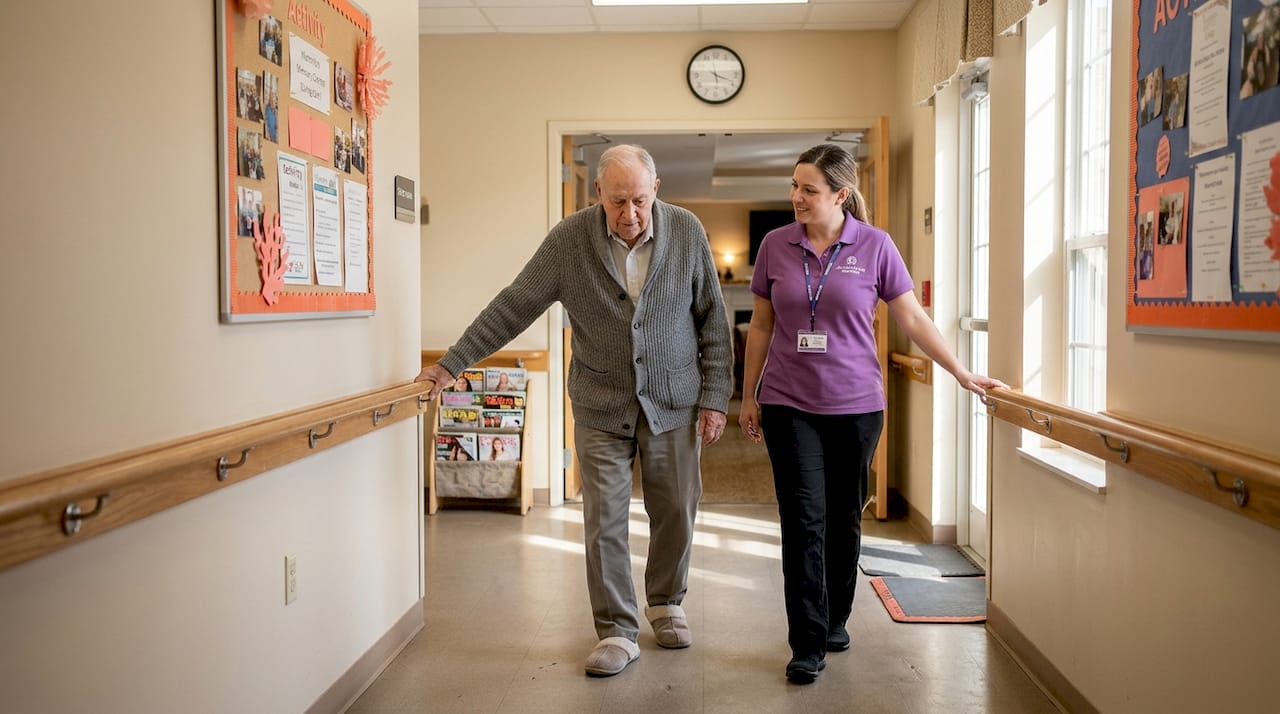
The memory care communities introduction on our site outlines the core features clearly: secured environments that prevent wandering, structured daily routines that reduce anxiety, and staff trained in dementia-specific communication techniques. These are not optional add-ons. They are the foundation of what makes memory care different from general residential care.
In New York, assisted living and memory care within assisted living fall under separate regulations and require additional certifications for enhanced or special needs assisted living. This means a community cannot simply call itself memory care without meeting state-defined standards for programming, staffing training, and physical environment. New Jersey and Connecticut have parallel oversight structures, each with their own certification criteria for dementia-specific settings.
SNFs, by contrast, can include dementia care as a component, but as Medicare guidance notes, special services like dementia care within a nursing home may simply be delivered in a separate unit rather than a purpose-built, fully specialized program. That is a critical distinction.
What does the right memory care resident profile look like?
- Diagnosed with Alzheimer’s disease or another form of dementia
- Exhibits wandering, sundowning, or agitation that requires a secured environment
- Does not have complex acute medical needs requiring daily skilled nursing intervention
- Benefits from structured programming like music therapy, reminiscence activities, or sensory engagement
- Requires staff who understand dementia behavior rather than purely clinical staff
Research shows that alcohol misuse can accelerate dementia progression, which is one reason thorough intake assessments in memory care settings gather detailed health history. The more a facility understands each resident’s background, the more personalized and effective the care becomes.
Pro Tip: Always ask whether a facility’s memory care unit is a purpose-built program with dedicated dementia-trained staff or simply a wing of a larger nursing home that has added locked doors. The difference in daily experience for your loved one is significant.
You can explore more details about what true memory care looks like across the region before you begin comparing specific facilities.
Side-by-side comparison: Memory care vs. nursing home
The clearest way to understand the differences is to place them next to each other directly. This is the comparison families in the Tri-State area most often request when they contact us.
| Category | Memory care | Nursing home / SNF |
|---|---|---|
| Primary purpose | Dementia-specific residential care | Medical and rehabilitative care |
| Environment | Secured, wandering-safe, sensory design | Clinical, medical-grade facilities |
| Daily programming | Structured dementia-focused routines | Therapy and medical treatment schedules |
| Staff training | Dementia communication and behavior management | Clinical nursing and medical protocols |
| Admission criteria | Cognitive impairment diagnosis | Complex medical or rehabilitative needs |
| Regulatory framework | Separate assisted living certification (NY) | DOH Title 10, SNF standards |
| Medicare coverage | Generally not covered | Covered for skilled care post-hospitalization |
| Physical design | Home-like, circular floor plans, sensory gardens | Institutional, clinical corridors |
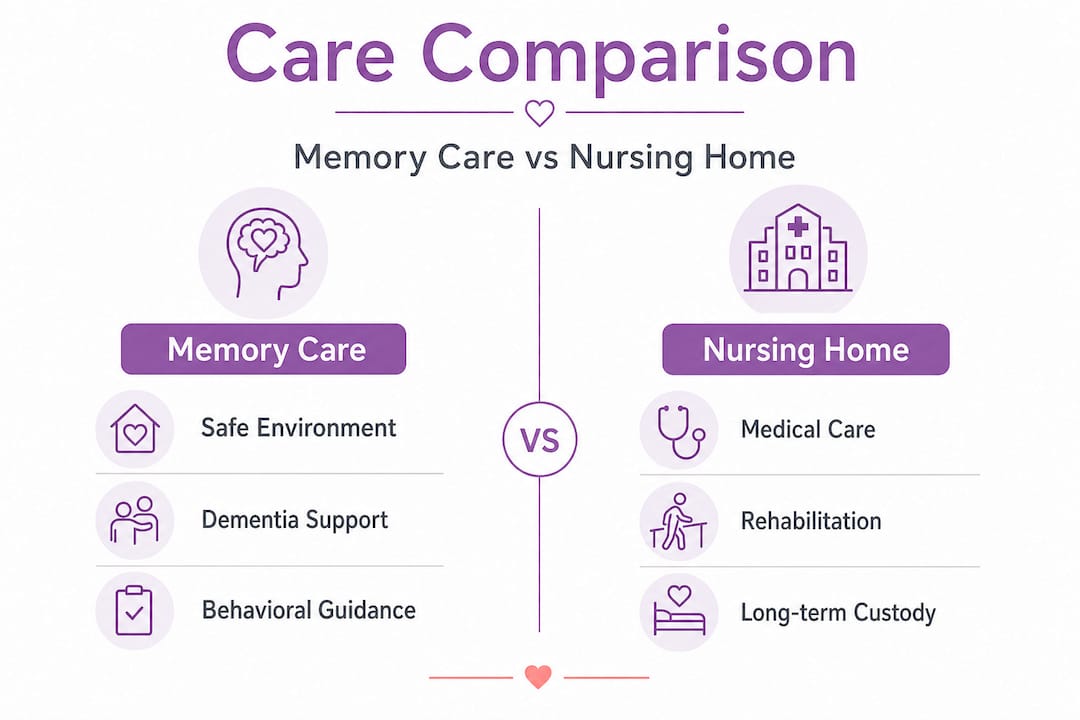
Some nursing homes have made genuine investments in dementia units. But as Medicare guidance acknowledges, families should verify whether that unit is truly memory-focused, with a secured environment, dementia-specific programming, and properly trained staff, versus a medically oriented wing that has simply been adapted for residents with dementia. The question is not just what the brochure says. It is what happens at 3 PM on a Tuesday when your loved one is anxious and the staff member on duty responds.
The Alzheimer’s Association practice recommendations provide a publicly available benchmark for what quality dementia care should include. Facilities that measure their programs against these standards are worth a much closer look. Those that are unfamiliar with the recommendations raise a red flag.
Families often find that the assisted living vs. memory care comparison is equally important to understand, since many residents move through assisted living before needing the more specialized support that memory care provides. When choosing between options, our guide on choosing memory care with confidence walks you through every major decision point.
How families can compare facilities during tours
Touring facilities is where the real information lives. Marketing materials are designed to impress. The actual unit, on an ordinary afternoon, tells the truth.
Here is a practical checklist to bring on every tour, whether you are visiting a memory care community or a nursing home with a dementia unit:
- Ask about staff-to-resident ratios during both day and evening shifts. Memory care residents need more consistent attention than general nursing home residents.
- Observe the physical environment. Is it secured? Are there circular walking paths? Is the sensory environment calm or overstimulating?
- Ask what dementia-specific training staff receive and how often. Generic caregiver certification is not the same as specialized dementia training.
- Review the activity calendar. Generic bingo and TV time are not dementia-specific programming. Look for music therapy, art therapy, reminiscence groups, and sensory activities.
- Ask about emergency protocols specific to dementia behaviors such as wandering, agitation, or refusal of care.
- Request information on how the facility measures care quality. Do they use Alzheimer’s Association benchmarks or similar standards?
- Speak with a family member of a current resident if the facility will arrange it. No marketing pitch replaces a candid conversation.
Touring is also the right time to compare what level of skilled nursing and rehabilitative services are available versus the depth of dementia programming. A facility strong on one may be weak on the other. Your loved one’s primary needs should drive which factor carries more weight.
“Quality dementia care transforms outcomes for residents. Look beyond brochures and ask about practices, not just policies.”
When you are ready to start narrowing down real options, our resource on considering memory care communities walks through the key factors to weigh. And if you are still deciding between care levels entirely, the guide on choosing between care types offers a structured framework for the decision.
Pro Tip: Ask every facility you tour to name the specific dementia care practices they follow and which external standards they reference. If they cannot answer clearly, that tells you something important.
The overlooked realities families must consider
After working with hundreds of families across New York, New Jersey, and Connecticut, we have seen the same pattern repeat itself. A family chooses a nursing home with a memory care wing because it is familiar, covered by Medicare for a short stretch, and close to home. Months later, they realize their loved one is spending most of the day in bed or at a nurses’ station, with no structured dementia programming and staff who manage behavior through redirection alone because they lack deeper training.
The problem is not bad intentions. The problem is that regulatory language and marketing language both use the phrase “memory care” to describe very different things. A locked door and a few adapted common areas do not make a dementia-specific program. Purpose-built memory care communities design every element of the physical environment, daily schedule, and staff interaction model around how dementia actually affects a person’s experience of the world.
Families also often miss a subtler issue: residents in nursing homes with dementia units are frequently housed alongside residents with purely medical needs, no cognitive impairment, and very different daily rhythms. That mix can create noise, disruption, and social mismatches that worsen anxiety for someone living with Alzheimer’s.
The distinction between adapted and purpose-built care is almost invisible until you ask the right questions. “Do your memory care staff work exclusively in that unit?” is one of the most revealing questions you can ask. Dedicated staffing signals a genuine commitment to specialized care. Floating staff who rotate through multiple units suggest the memory care label is more administrative than programmatic.
Regulations in New York do require separate certifications for memory care within assisted living settings. But families still need to verify that certifications translate into daily practice. Paperwork and lived reality do not always match. If you need a trusted local perspective on facilities in your area, resources like memory care communities in New York can help you start with vetted options rather than cold searching.
Connect with expert advisors for memory care and nursing home decisions
Sorting through the differences between memory care and nursing homes is genuinely complex, and the stakes are high. Families in the New York City, New Jersey, and Connecticut area do not need to navigate this alone.
At Assisted Living Advisers, we match families with the right communities based on each person’s specific care needs, budget, and location. Our advisors know which facilities have true dementia-specific programs and which ones are simply using the label. We offer free consultations, facility tours, and move-in coordination across the entire Tri-State region. When you are ready to explore memory care communities near you, or if you want help comparing assisted living options across the area, we are here to guide every step. Start with a free conversation by visiting our page for families considering memory care.
Frequently asked questions
Are memory care and nursing homes regulated differently in New York?
Yes, memory care within assisted living carries separate certification requirements, distinct from nursing home regulations under DOH Title 10, Part 415. Families should request documentation of both sets of certifications when comparing facilities.
Do all nursing homes offer true memory care units?
No. Some nursing home memory care units only adapt their physical environment rather than building a specialized dementia program. Always ask about dedicated staffing, secured environments, and dementia-specific daily programming before assuming the label reflects the practice.
How can families know if a memory care facility meets quality standards?
Ask about specialized training curricula, staff certification in dementia care, and whether the facility measures itself against the Alzheimer’s Association practice recommendations. Facilities that reference external benchmarks proactively are generally the stronger performers.
Who is best served by memory care versus a nursing home?
Memory care is the right fit for people with Alzheimer’s or dementia who need behavioral support, a secured environment, and structured programming. Nursing homes and SNFs are better suited for individuals who require ongoing skilled medical care, post-acute rehabilitation, or management of complex physical health conditions.
Does insurance or Medicare cover memory care or nursing home costs?
Medicare covers care in a Medicare-certified SNF following a qualifying hospital stay, but it does not typically cover routine memory care in an assisted living or standalone memory care community. Families should review their specific plan details and consult a benefits counselor to understand what is covered in their situation.
Recommended
Let’s Work Together To Find The Ideal Senior Living Community For Your Loved One.
Assisted Living Advisers is a FREE, personalized service offering expert guidance in determining the ideal community for your loved one based on physical needs, location preferences and finances.