
When your parent needs more care than you can provide at home, the process of finding the right place moves fast. Suddenly you’re buried in senior facility terminology explained by salespeople who assume you already know what “Level 3 care” or “skilled nursing” means. Most families don’t. Misreading a single term can lead to choosing a facility that doesn’t match your loved one’s actual needs or, worse, getting hit with unexpected costs. This guide breaks down the most critical elder care definitions you’ll encounter, from ADLs to care level tiers to Medicare eligibility, so you can walk into any facility conversation with confidence.
Table of Contents
- Key takeaways
- ADLs and IADLs: the foundation of senior care assessments
- Understanding assisted living levels of care
- Facility types: what the labels actually mean
- Key admission and contract terms
- My honest take on navigating this terminology
- How Assistedlivingadvisers can help your family
- FAQ
Key takeaways
| Point | Details |
|---|---|
| ADLs drive care decisions | The six Activities of Daily Living determine care eligibility and directly influence what level a resident is placed at. |
| Care levels are not standardized | Assisted living terminology like “Level 2” or “Level 4” varies by facility, so always ask what services each level actually includes. |
| Skilled vs. custodial care | Medicare covers skilled nursing care but not custodial care like bathing or dressing, a distinction that surprises many families. |
| Legal agreements protect residents | Resident and service agreements are binding contracts that spell out costs, services, and rights before move-in. |
| Ask specific questions | Generic labels tell you little. Asking about staff-to-resident ratios and ADL support gives you real answers. |
ADLs and IADLs: the foundation of senior care assessments
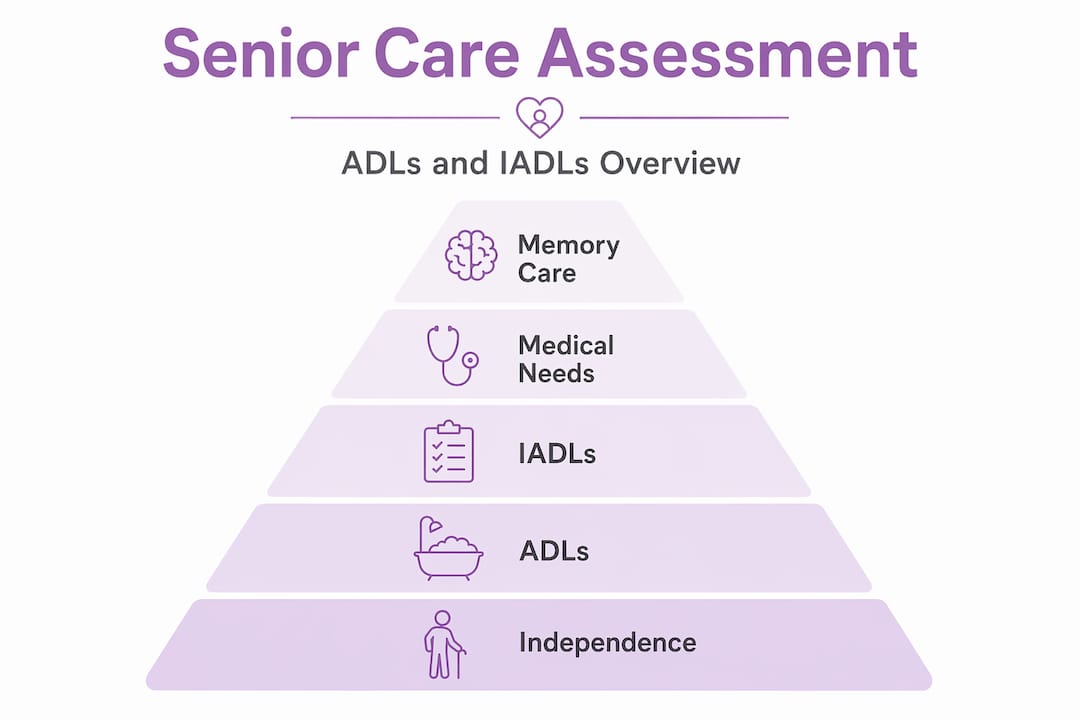
Before a facility places your parent at any care level, they run an assessment. That assessment centers almost entirely on two sets of measures: Activities of Daily Living (ADLs) and Instrumental Activities of Daily Living (IADLs). These are the backbone of nearly all senior care terminology you’ll encounter.
The six ADLs are bathing, dressing, eating, transferring (moving from bed to chair, for example), toileting, and continence. These are the basic physical tasks a person performs every day to take care of themselves. If your parent needs help with two or more of these, they typically qualify for assisted living. If they need help with four or more, a higher level of care or a nursing facility may be more appropriate.
IADLs go one step further. They measure the ability to live independently in the community. Examples include managing finances, preparing meals, handling medications, using transportation, and shopping. Someone might have all their ADLs intact but still struggle significantly with IADLs. That distinction matters when comparing independent living vs assisted living options.
In nursing homes, ADL assessments are standardized using a tool called the Minimum Data Set (MDS). Staff score each ADL on a dependence scale that guides care planning and affects Medicare reimbursement. Assisted living facilities use less formal versions of this, but the logic is the same.
Pro Tip: Before touring any facility, write out which specific ADLs your parent needs help with and how much help each one requires. Mapping real needs to ADLs leads to more accurate care placement and helps you evaluate whether a facility’s stated level of care actually matches what your parent needs.
Understanding assisted living levels of care
This is where most families hit a wall. You walk into a facility and they tell you your parent qualifies for a “Level 2” or possibly a “Level 4.” What does that mean in practice? Here’s the honest answer: it depends on which facility you’re standing in.
Assisted living levels typically run from Level 1 to Level 5, with each tier corresponding to increasing support needs and higher costs. But facilities define these levels differently. One community’s Level 3 might be another’s Level 4. There is no universal standard in the United States that dictates what each number means.
Here is a general framework for how levels tend to break down across most communities:
| Level | Care description | Typical needs |
|---|---|---|
| Level 1 | Minimal assistance | Reminders for medications, minor safety monitoring |
| Level 2 | Light ADL help | Assistance with bathing or dressing once daily |
| Level 3 | Moderate ADL support | Help with multiple ADLs, some mobility assistance |
| Level 4 | High daily assistance | Full ADL support, possible two-person transfers |
| Level 5 | Memory care | Dementia-specific support, secured environment |
Memory care sits at the top of this spectrum. It is a specialized assisted living level for residents with Alzheimer’s or other forms of dementia. Staff in these units receive specific dementia training, the environment is designed for cognitive safety, and ADL support is comprehensive. The term “memory care” describes the program, not just a room type.
Some facilities also offer what is called “enhanced assisted living,” a tier between traditional assisted living and skilled nursing that allows for medication administration by licensed nurses and more clinical oversight. This bridges a real gap for residents who need more than personal care but don’t meet skilled nursing criteria.
Pro Tip: When reviewing any care level, ask specifically which ADLs are covered, what the staff-to-resident ratio is for that level, how medication management is handled, and what happens if your parent’s needs increase beyond the stated level. Labels are shortcuts. Operational details are the truth.
Facility types: what the labels actually mean
The four main types of senior facilities each serve different populations and offer different levels of medical involvement. Confusing them can send a family in entirely the wrong direction.
Assisted living communities provide personal care support with daily activities in a residential setting. They are licensed for custodial care, meaning hands-on help with ADLs, but they do not provide ongoing medical care. You can learn more about how these communities work by reading the role of assisted living in senior care.

Skilled nursing facilities (SNFs), often called nursing homes, provide a higher level of medical care. Skilled care includes services like wound care, IV therapy, physical rehabilitation, and respiratory therapy. These services require licensed professionals, typically registered nurses or therapists, and a physician’s certification of medical necessity. This is not the same as assisted living.
Medicare’s role here trips up nearly every family. Medicare covers skilled nursing facility care only when it involves daily skilled services. It does not cover custodial care, which is the help with bathing, dressing, and eating that most assisted living residents receive. Additionally, Medicare SNF coverage requires a qualifying three-day inpatient hospital stay. Observation status days do not count. This is a detail that leads to denied coverage every day for unprepared families.
Memory care communities are either standalone facilities or secured wings within assisted living. They specialize in dementia care, with staff trained in behavioral support, communication techniques, and safety management. You can explore memory care options that may fit your family’s needs.
Board and care homes, sometimes called residential care homes, are smaller private residences licensed to care for a handful of residents, typically four to six. They offer a more intimate setting and often lower cost than large assisted living communities. The distinction between these options is worth understanding in detail, and assisted living vs board and care comparisons can help you decide.
Here is a quick reference table:
| Facility type | Medical level | Medicare coverage | Best for |
|---|---|---|---|
| Assisted living | Custodial only | Generally no | ADL help, social engagement |
| Skilled nursing facility | High medical | Yes, with criteria | Post-hospital rehab, clinical needs |
| Memory care | Custodial + dementia support | Generally no | Alzheimer’s, dementia |
| Board and care home | Custodial, limited | Generally no | Small setting, lower cost |
Key admission and contract terms
Once you select a facility, the paperwork begins. The documents you sign at move-in have real legal and financial weight, so understanding these terms is not optional.
A resident agreement (also called an accommodation agreement) is the primary contract between your family and the facility. Resident agreements specify the scope of care services, the cost of accommodation, payment schedules, and the rights and responsibilities of both parties. Read it line by line. Specifically, look for what triggers a care level reassessment and whether rates can increase without notice.
A service agreement details the specific care services being provided, often broken down by task and frequency. This document should map directly back to your parent’s ADL needs. If a facility says they support with bathing twice daily but the service agreement only lists it once, that is a discrepancy worth addressing before signing.
Several other terms you may encounter during the admissions process:
- Level of care assessment: A formal evaluation of ADL and IADN needs used to assign a care level and associated monthly fee.
- Private pay rate: The full out-of-pocket cost before any insurance, long-term care insurance, or Medicaid benefits apply.
- Long-term care insurance: Private insurance that may cover custodial care costs at assisted living, distinct from Medicare.
- Medicaid waiver programs: State-funded programs that can help low-income residents pay for assisted living or home care, with eligibility rules that vary by state.
- Advance directive / healthcare proxy: Legal documents naming a decision-maker and outlining care preferences if your parent becomes unable to communicate.
Understanding what qualifies someone for assisted living from a clinical and financial standpoint helps you prepare for the admission conversation rather than react to it.
My honest take on navigating this terminology
I’ve worked with hundreds of families going through this process, and the single biggest mistake I see is trusting labels over details. A family will hear “Level 2 care” and assume it covers what their parent needs. They sign the agreement, move in, and then discover that medication management requires an add-on fee, or that transfers require an additional aide not included at that level.
In my experience, the families who make the best decisions are the ones who treat every piece of senior community jargon as a starting point for a conversation, not a final answer. When a facility says “memory care,” I tell families to ask what the dementia-to-staff ratio is on the night shift. That one question tells you more than any brochure will.
I’ve also seen families blindsided by the Medicare skilled nursing coverage rules. Many assume that a hospital stay automatically unlocks nursing home coverage. It doesn’t. A physician must certify medical necessity and the stay must be inpatient status, not observation status. These details matter enormously when you’re planning for a post-hospital discharge.
My advice is simple: document your parent’s current ADL status in writing before any facility tour. Bring that document with you. Compare what you’ve written to what each facility’s care level actually covers. The facilities that give you clear, specific answers to specific questions are the ones worth trusting.
— Eric
How Assistedlivingadvisers can help your family
Understanding the terminology is the first step. Knowing which facilities in your area actually deliver on their promises is the next one, and that’s where most families need real support.

Assistedlivingadvisers provides free, personalized guidance to families across the New York City, New Jersey, and Connecticut area. The team helps you interpret what facilities are actually offering, matches communities to your parent’s specific ADL profile and budget, and accompanies you through tours and paperwork. Whether you’re exploring assisted living communities for the first time or trying to understand what memory care actually involves, Assistedlivingadvisers translates the jargon into decisions you can feel confident about. If you’re ready to start comparing real options, find assisted living near you and let the advisers do the heavy lifting.
FAQ
What are the six ADLs used in senior care assessments?
The six Activities of Daily Living are bathing, dressing, eating, transferring, toileting, and continence. Facilities use these to determine care level placement and insurance eligibility.
Does Medicare pay for assisted living?
No. Medicare covers skilled nursing facility care only when daily skilled medical services are required following a qualifying inpatient hospital stay. It does not cover custodial care like bathing or dressing, which is what assisted living primarily provides.
What is the difference between assisted living and a skilled nursing facility?
Assisted living provides personal care support for daily activities in a residential setting without ongoing medical services. A skilled nursing facility delivers licensed medical care such as rehabilitation, wound care, and IV therapy, and requires physician certification of medical necessity.
Are assisted living care levels the same at every facility?
No. Care level terminology varies from one community to another. A Level 3 at one facility may not include the same services as a Level 3 at another. Always ask for a written description of exactly what each level covers before committing.
What is a resident agreement in senior care?
A resident agreement is the binding contract between a family and a senior care facility. It outlines the scope of care services, accommodation costs, payment terms, and the rights of the resident, and should be reviewed carefully before signing.
Recommended
Let’s Work Together To Find The Ideal Senior Living Community For Your Loved One.
Assisted Living Advisers is a FREE, personalized service offering expert guidance in determining the ideal community for your loved one based on physical needs, location preferences and finances.