
Most families touring assisted living communities focus on nursing staff ratios, meal quality, and room size. The activities director barely makes it onto the checklist. That’s a mistake. The role of activities director in assisted living reaches far deeper than planning bingo nights or holiday parties. These professionals shape how engaged, purposeful, and socially connected your loved one feels every single day. Understanding what they actually do, and what separates a good one from a great one, gives you a real edge when evaluating any community.
Table of Contents
- Key takeaways
- The role of activities director in assisted living
- How activities directors collaborate across the community
- Adapting activities for every resident
- The administrative side no one sees
- What makes an exceptional activities director
- My perspective on what families often miss
- How Assistedlivingadvisers can help you find the right community
- FAQ
Key takeaways
| Point | Details |
|---|---|
| More than entertainment | Activities directors manage personalized programs that support physical, cognitive, and emotional health, not just fun events. |
| Collaboration is central | They coordinate with nurses, families, volunteers, and community partners to align activities with each resident’s care plan. |
| Individualization matters | The best directors adapt every program to accommodate mobility limitations, cognitive needs, and personal interests. |
| Documentation drives outcomes | Tracking attendance and engagement informs care adjustments and satisfies regulatory requirements. |
| Families play a role too | Sharing your loved one’s history and preferences directly improves the quality of programming they receive. |
The role of activities director in assisted living
The activities director does something most people underestimate. They plan, coordinate, and facilitate enrichment programs that touch every dimension of a resident’s well-being, including social connection, physical movement, creative expression, and mental stimulation. And every bit of it is tailored to individual interests and abilities.
On any given day, the responsibilities of activities director include conducting needs assessments on new residents, reviewing existing programs for engagement levels, meeting with healthcare staff about a resident’s changing condition, coordinating with outside vendors for a cultural event, and updating the weekly activity calendar. It is a management role as much as it is a care role.
Here is what a typical scope of responsibilities looks like:
- Resident assessment: Gathering information on each person’s background, hobbies, physical abilities, and cognitive status to build meaningful programming
- Calendar creation: Designing a structured yet flexible weekly schedule that balances group and individual activities across physical, social, cognitive, and creative categories
- Staff and volunteer oversight: Supervising activity aides and coordinating volunteers who help run programs
- Budget management: Allocating resources for supplies, equipment, and special events within set financial limits
- Safety compliance: Reviewing all activities against community safety standards and adjusting participation levels as residents’ needs change
- Program evaluation: Collecting feedback and attendance data to continually refine offerings
Pro Tip: When touring a community, ask the activities director how they assess a new resident’s preferences before that resident ever attends a group event. The specificity of their answer tells you everything about the quality of their process.
How activities directors collaborate across the community
Here is where many families are surprised. An activities coordinator in assisted living does not work in a silo. The role requires constant coordination across the entire care team, and that collaboration is what separates a fragmented experience from a truly integrated one.
Working directly with nurses and personal care staff, the activities director aligns program scheduling with each resident’s medication timing, therapy appointments, and energy patterns. A resident who is exhausted from morning physical therapy should not be expected to show up for a high-energy group fitness class an hour later. These conversations happen daily.
Family engagement is also built into the role. Coordination inside and outside the facility is a core expectation, and families who share detailed information about a loved one’s past career, cultural background, or longtime hobbies give the director real material to work with. A retired teacher may come alive in a reading group. Someone who spent decades gardening might find deep meaning in a container gardening program on the patio.
Volunteer coordination adds another layer. Many activities departments rely on community volunteers, student groups, and faith organizations to supplement programming, particularly for one-on-one visits with residents who rarely join group events. The director recruits, trains, and manages this pipeline.
Pro Tip: Ask the community how families can stay updated on the activity calendar and whether there’s a process for submitting suggestions. Communities that actively incorporate family input tend to have stronger programming overall.
Adapting activities for every resident
This is the hardest part of the job, and also the most important. Generic programming risks excluding residents with low mobility or cognitive impairment. A great activities director plans accommodations in advance rather than improvising them on the spot.

Consider the difference between these two approaches:
| Standard approach | Individualized approach |
|---|---|
| One-size-fits-all group fitness class | Chair-based exercise options alongside standing versions |
| Single trivia game format for all | Tiered question difficulty levels based on cognitive assessment |
| Group outing with no modifications | Transportation and mobility aid planning confirmed in advance |
| Arts and crafts with fine motor demands | Simplified versions available for residents with hand tremors |
| Fixed activity schedule weekly | Rotating options that respond to resident feedback each month |
Individualized planning includes resident assessments and careful documentation so programs can be refined as a person’s condition changes. A resident in early memory care requires a very different approach than someone who recently moved in after a hip replacement. Both deserve activities that feel purposeful, not patronizing.
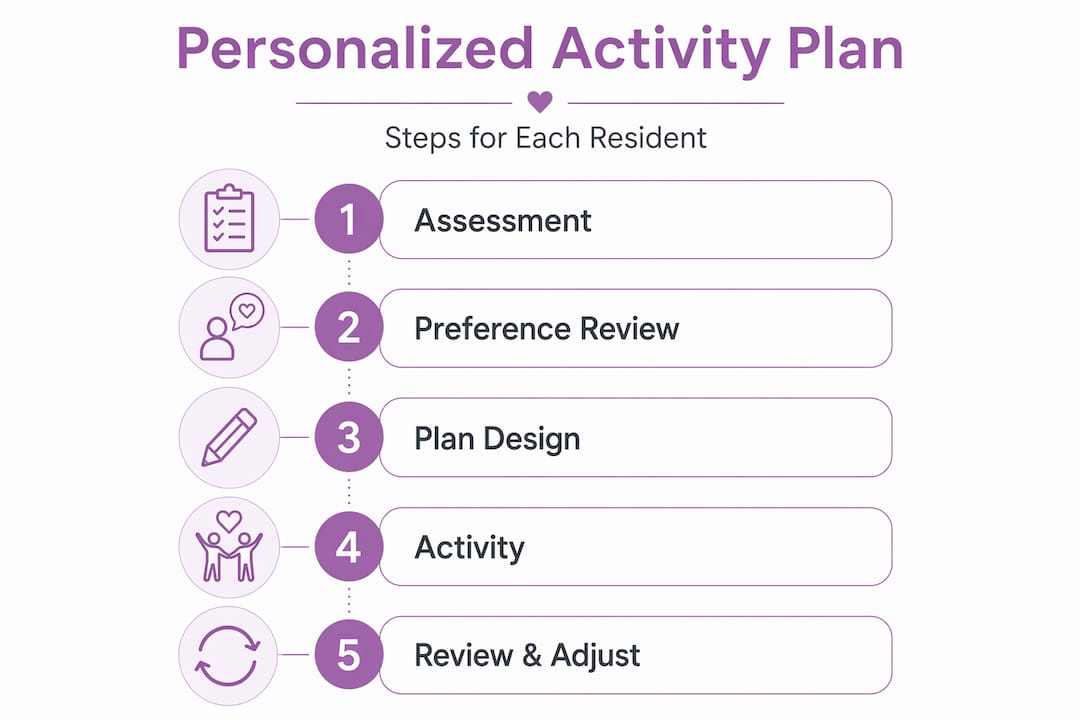
Balancing group events with one-on-one engagement is another layer of this work. Some residents thrive in social settings. Others find large groups overwhelming and benefit more from a staff member sitting with them to look through a photo album or work on a puzzle together. A skilled activities director adapts activities for residents with diverse mobility and cognitive needs rather than defaulting to the format that is easiest to run.
Pro Tip: Ask whether the community tracks one-on-one activity time separately from group attendance. If they can show you both metrics, they are almost certainly doing the deeper personalization work.
The administrative side no one sees
Most of the activities director’s most important work happens away from residents. The behind-the-scenes responsibilities of activities director are what make the visible programming sustainable and meaningful.
Documentation is essential not just for regulatory compliance, but as a feedback loop that informs care decisions. When a resident who previously attended three programs a week suddenly stops showing up, that attendance data flags a potential health or mood change that the broader care team needs to investigate.
Key administrative duties include:
- Budget oversight: Requesting and justifying resource allocation for supplies, performers, transportation, and special events
- Attendance tracking: Logging participation across all programs to identify patterns and gaps
- Care plan integration: Translating care goals set by nursing and therapy staff into scheduled activities that support those goals directly
- Compliance reporting: Demonstrating program effectiveness to management and meeting any state-specific regulatory requirements for activities in licensed facilities
- Feedback collection: Running periodic surveys or informal check-ins with residents and families to identify what is and is not working
Program evaluation and adjustment is formally embedded in the role. The best directors treat their activity calendar like a living document, not a template they recycle each month.
What makes an exceptional activities director
You can evaluate the quality of an activities director the same way you evaluate any professional: look at their skills, their credentials, and the evidence of their outcomes.
Strong communication stands at the top of the list. The role requires speaking clearly with residents who may have hearing loss or cognitive decline, presenting ideas persuasively to management, and keeping families updated in plain language. Empathy comes next. Residents in assisted living have often given up a home, a car, and much of their independence. An activities director who approaches that reality with genuine sensitivity builds trust quickly.
Creativity matters more than people realize. Tailored programs that prevent exclusion require a director who can look at a group of fifteen residents with fifteen different histories and design something that reaches most of them. That is not a logistical task. It is a creative one.
On the credentials side, look for professionals who hold or are pursuing ADC certification through the National Certification Council for Activity Professionals (NCCAP). This credential signals that the director has met formal training and regulatory standards, not just worked in the role for a few years.
Pro Tip: Review the activity calendar posted in the community during your tour. Count the number of different activity types across a two-week period. If you see mostly passive entertainment like movies or TV, that is a signal worth probing further.
My perspective on what families often miss
I’ve spent years helping families evaluate assisted living communities in the tri-state area, and I can tell you honestly: the activities director is one of the most underrated people in any facility. Families spend the tour asking about nurse-to-resident ratios and medication management, both of which matter. But what shapes your loved one’s actual day, their mood, their sense of belonging, their motivation to get out of bed, is the quality of the activities program.
What I’ve seen consistently is that communities with engaged, well-resourced activities directors produce residents who feel like members of a community rather than patients in a facility. That distinction matters enormously for long-term health outcomes. Individualized, inclusive activities calendars are directly tied to better physical and emotional wellness in seniors. That’s not a feel-good claim. It’s documented.
I’ve also noticed that families who share detailed background information about their loved one, past careers, hobbies, cultural traditions, religious practices, see noticeably better engagement from the activities team. A great director can only personalize what they know. Give them something to work with.
My advice: treat your meeting with the activities director as seriously as your meeting with the director of nursing. Ask specific questions. Ask for outcomes data. Ask to see the last three months of programming. A director who is proud of their work will welcome those questions. One who deflects them is telling you something important.
— Eric
How Assistedlivingadvisers can help you find the right community
If you’re searching for an assisted living community where your loved one will truly thrive, the activities program should be a deciding factor, not an afterthought. At Assistedlivingadvisers, we help families throughout New York City, New Jersey, and Connecticut identify communities with strong, well-resourced activities programs as part of a much larger picture of care quality.
Our consultants know which local communities have exceptional activities directors and how those programs are structured across different care levels. We match families based on your loved one’s specific interests, mobility needs, and social preferences, not just bed availability. Whether you’re exploring assisted living communities nearby or wondering whether assisted living improves quality of life for someone with your loved one’s needs, we can help you get specific answers fast, at no cost to your family. Start by finding assisted living near you through our free consultation service.
FAQ
What does an activities director do in assisted living?
An activities director plans, coordinates, and evaluates programs that support residents’ social, physical, and cognitive well-being. Their work includes resident assessments, calendar management, staff supervision, family coordination, and documentation of participation outcomes.
How do activities directors personalize programs for residents?
They conduct individual assessments to learn each resident’s history, interests, and physical or cognitive limitations, then design or modify activities accordingly. This includes offering seated alternatives, tiered difficulty levels, and one-on-one engagement for residents who do not participate in group settings.
What certifications should a good activities director have?
The Activity Director Certified (ADC) credential from NCCAP is the most recognized professional standard in the field. It reflects formal training in program planning, resident assessment, and regulatory compliance across care settings.
How can families support the activities director?
Share detailed information about your loved one’s background, hobbies, cultural traditions, and past career at the time of move-in. This information directly improves the quality of personalized programming your family member receives.
Why does the activities program matter when choosing assisted living?
Research consistently links individualized activities programs to better physical and emotional health outcomes in seniors. A well-run program affects mood, motivation, social connection, and cognitive engagement every single day, making it one of the most meaningful indicators of community quality.
Recommended
- Understanding the Role of Assisted Living Communities in Senior Care – Assisted Living Advisers
- How Assisted Living Communities Help Senior Residents Thrive – Assisted Living Advisers
- Spring Time Fun at Assisted Living Communities – Assisted Living Advisers
- Assisted Living Consulting by Assisted Living Advisers – Assisted Living Advisers
Let’s Work Together To Find The Ideal Senior Living Community For Your Loved One.
Assisted Living Advisers is a FREE, personalized service offering expert guidance in determining the ideal community for your loved one based on physical needs, location preferences and finances.