
Senior community accreditation is a voluntary, third-party validation process where independent organizations evaluate senior living communities against quality standards that exceed basic state licensing requirements. Unlike a state license, which every facility must hold to operate legally, accreditation is earned. It signals that a community has invited outside scrutiny and passed. Families searching for the right assisted living, memory care, or retirement community need to understand what is senior community accreditation before they tour a single building. The difference between a licensed community and an accredited one can directly affect the quality of care your loved one receives every day.
What is senior community accreditation vs. state licensing?
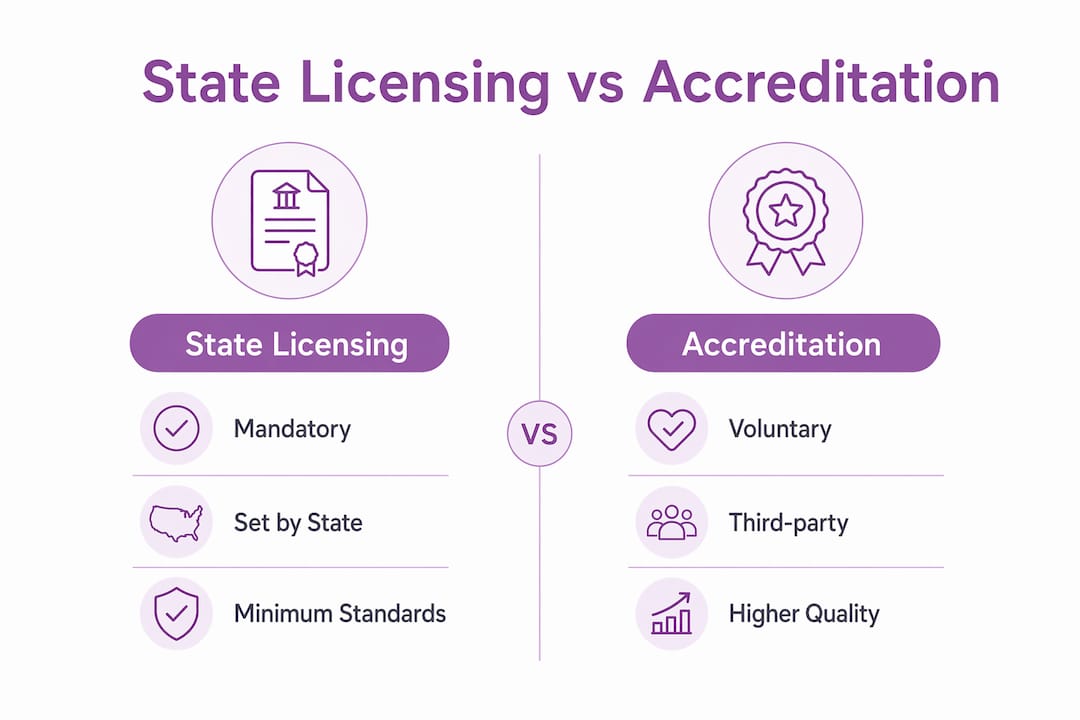
State licensing and senior living accreditation are not the same thing, and confusing them is one of the most common mistakes families make. State licensing is a legal requirement. Every senior living community must hold a valid state license to operate. That license confirms the facility meets minimum safety and health thresholds set by state regulators.
Accreditation goes further. Accreditation evaluates care delivery, safety protocols, staff training, and governance well beyond what any license requires. A community can be fully licensed but still fall short of the higher bar that accreditation demands. The reverse is also true: an accredited community always holds a valid license, but it has chosen to be measured against a tougher standard.

The table below shows the core differences at a glance.
| Factor | State licensing | Accreditation |
|---|---|---|
| Required by law | Yes | No |
| Set by | State government | Independent accrediting body |
| Focus | Minimum safety thresholds | Evidence-based quality standards |
| Evaluation method | State inspections | On-site peer surveys |
| Renewal cycle | Varies by state | Typically 1–5 years |
| Financial oversight | Limited | Required reporting of major events |
Pro Tip: When you tour a community, ask to see both the current state license and the accreditation certificate. If staff cannot produce both on request, treat that as a red flag.
Families who understand assisted living licensure are better equipped to ask the right questions. Accreditation adds a layer of trust that licensing alone cannot provide.
How do accreditation organizations evaluate senior communities?
The evaluation process is far more demanding than a routine state inspection. Accrediting bodies send teams of peer experts, often retired administrators, nurses, and care specialists, to conduct on-site surveys that can last several days. They do not just review paperwork. They observe daily operations, interview staff and residents, and check whether written policies match what actually happens on the floor.
CARF International awards accreditation terms of one, three, or five years depending on survey findings. A one-year term signals that a community needs improvement in specific areas. A five-year term is the highest recognition and reflects consistent excellence across all domains. Communities must report major financial events, such as insolvency risk or ownership changes, to the accrediting body during the active term. That reporting requirement creates accountability that state licensing does not mandate.
The domains covered in a full accreditation survey include:
- Care delivery and clinical protocols — Are residents receiving the right level of care, and is that care documented accurately?
- Staff training and qualifications — Do staff members meet training requirements, and are those requirements updated regularly?
- Governance and leadership — Does the leadership team have clear accountability structures and ethical decision-making processes?
- Financial health — Is the community financially stable enough to sustain operations and care quality long term?
- Resident rights and dignity — Are residents treated with respect, given choices, and protected from abuse or neglect?
- Safety and emergency management — Does the community have tested plans for fires, medical emergencies, and natural disasters?
Accreditation requires compliance across all of these domains simultaneously. Passing one area while failing another does not earn a community its credential.
Pro Tip: Ask any community you are considering how long they have held their current accreditation and whether they have ever had a one-year term. Sustained multi-year accreditation tells a stronger story than a recent first-time credential.
What are the top accreditation bodies for senior communities?
Two organizations dominate senior living accreditation in the United States: CARF International and The Joint Commission. They approach the work differently, and understanding those differences helps families interpret what a credential actually means.
CARF International specializes in aging services with tailored standards for assisted living, memory care, and continuing care retirement communities. CARF’s standards number over 1,200, covering everything from resident engagement to financial transparency. That breadth reflects CARF’s focus on the full resident experience, not just clinical outcomes. CARF accreditation is widely recognized as the gold standard for communities that serve older adults across multiple care levels.
The Joint Commission originated in hospital and acute care settings. It has adapted its standards for residential senior living, but its roots remain in clinical and medical quality. Communities with Joint Commission accreditation tend to emphasize their clinical protocols and health outcomes. That focus is particularly relevant for communities offering skilled nursing or post-acute rehabilitation alongside residential care.
Key points families should know about each body:
- CARF International covers assisted living, memory care, and continuing care retirement communities with aging-specific standards built from the ground up.
- The Joint Commission applies clinical rigor drawn from hospital care, making it a strong signal for medically complex residents.
- Neither body is inherently superior. The right credential depends on the type of care your loved one needs.
- Families should verify that the accreditation covers the specific care level their loved one requires. Some accreditations are level-specific, meaning a community might be accredited for assisted living but not for its memory care unit.
Verifying the scope of accreditation relative to the care level needed is a step most families skip. Do not skip it.
Why does accreditation matter when choosing a senior community?
Fewer than 10% of Continuing Care Retirement Communities achieve accreditation. That rarity makes the credential meaningful. It is not a participation award. It is evidence that a community has voluntarily subjected itself to rigorous outside review and met a high bar.
Accreditation matters for families for several concrete reasons:
- External validation: Accreditation is an independent judgment, not a self-assessment or a marketing award. A peer survey team has no financial interest in the outcome.
- Transparency culture: Communities that pursue accreditation tend to operate with greater openness. They share data, welcome scrutiny, and communicate proactively with families.
- Continuous improvement: Accreditation is not a one-time trophy but an ongoing process that keeps communities focused on quality between survey cycles.
- Financial accountability: Communities must report major financial events to their accrediting body, adding an oversight layer that protects residents from sudden disruptions in care.
- Peace of mind: Knowing that an outside organization has reviewed staffing levels, safety protocols, and resident rights gives families a credible foundation for trust.
“Accreditation signals transparency, accountability, and a culture of continuous improvement in resident safety.” — RiverWoods Retirement Communities
Some organizations have held accreditation for 25 consecutive years. That kind of sustained commitment tells you something a brochure never can. When you compare communities, check not just whether they are accredited but how long they have maintained that status and whether their credential covers the care type your loved one needs.
Accreditation is also particularly valuable for smaller or private communities that lack the brand recognition of large national chains. For those communities, independent evaluation builds trust that marketing alone cannot establish. Families evaluating assisted living communities should treat accreditation as one of the strongest quality signals available.
Key Takeaways
Senior community accreditation is a voluntary, third-party credential that confirms a community meets rigorous quality standards well beyond what state licensing requires, and fewer than 10% of Continuing Care Retirement Communities earn it.
| Point | Details |
|---|---|
| Accreditation vs. licensing | Licensing is legally required; accreditation is voluntary and sets a higher quality bar. |
| Top accrediting bodies | CARF International and The Joint Commission are the two most recognized bodies for senior communities. |
| Evaluation scope | Surveys cover care delivery, staffing, governance, financial health, and resident rights. |
| Renewal and accountability | Accreditation terms run 1–5 years, with required reporting of major financial events. |
| Rarity signals quality | Fewer than 10% of CCRCs are accredited, making the credential a meaningful differentiator. |
Accreditation is a process, not a plaque
Families often ask me whether accreditation really matters or whether it is just a marketing tool. My honest answer: it matters, but only if you know how to read it.
The most important thing I have learned working with families across the tri-state area is that accreditation is a process, not a plaque. A community that earned its CARF credential three years ago and has since changed leadership, cut staffing, or faced financial trouble is not the same community that passed the survey. Always check the current accreditation status directly with the accrediting body. Do not rely on a lobby display.
I have also seen communities promote “awards” and “recognitions” that sound impressive but involve no on-site survey, no peer review, and no accountability. Those are marketing tools. CARF International and The Joint Commission conduct real surveys with real consequences. That distinction matters enormously.
My advice to every family: use accreditation as a filter, not a final answer. An accredited community that feels wrong during your visit is still the wrong community. A non-accredited community that is transparent, well-staffed, and responsive to your questions may still be a strong choice. Accreditation narrows the field. Your eyes and instincts close the decision.
— Eric
How Assistedlivingadvisers helps families find accredited communities
Choosing a senior living community is one of the most consequential decisions a family makes. Assistedlivingadvisers specializes in helping families across New York, New Jersey, and Connecticut find communities that match their loved one’s care needs, budget, and quality expectations, at no cost to the family.

The advisers at Assistedlivingadvisers factor accreditation status directly into their community recommendations. They know which local communities hold current CARF or Joint Commission credentials, which have sustained accreditation over multiple cycles, and which rely on marketing awards rather than independent review. Families can find accredited assisted living options near them with guidance from advisers who have already done the vetting. For families weighing care levels, Assistedlivingadvisers also covers assisted living community options across the region, so you can compare with confidence.
FAQ
What is senior community accreditation in simple terms?
Senior community accreditation is a voluntary process where an independent organization evaluates a senior living community against high quality standards and confirms it meets them. It goes beyond the minimum requirements of a state license.
Is accreditation the same as a state license?
No. A state license is legally required and confirms minimum safety standards. Accreditation is voluntary and confirms the community meets a higher bar for care quality, governance, and transparency.
Which accreditation body is best for assisted living?
CARF International is the most widely recognized accrediting body for assisted living and memory care, with over 1,200 aging-specific standards. The Joint Commission is also credible, particularly for communities with strong clinical or medical care programs.
How long does accreditation last?
Accreditation terms typically run one to five years. A five-year term reflects the highest level of performance, while a one-year term indicates areas needing improvement before the next review.
How can I verify a community’s accreditation status?
Contact CARF International or The Joint Commission directly and search their online directories. Do not rely solely on what a community displays in its lobby or marketing materials, since credentials can lapse or be level-specific.
Recommended
Let’s Work Together To Find The Ideal Senior Living Community For Your Loved One.
Assisted Living Advisers is a FREE, personalized service offering expert guidance in determining the ideal community for your loved one based on physical needs, location preferences and finances.