
Supportive independent living is defined as a care model where seniors or individuals with disabilities live in their own home or apartment while receiving tailored personal support services, without giving up their legal tenancy rights. Unlike moving into a nursing home or assisted living facility, this model keeps housing and care legally separate. Support levels range from a few hours of help per week up to 24/7 assistance, adjusting as needs change over time. For families weighing options in 2026, understanding this model is the first step toward making a confident, informed decision.
What is supportive independent living and how does it work?
Supportive independent living, often called “supported living” in professional eldercare circles, is a housing and care arrangement that treats where someone lives and who provides their care as two entirely separate matters. The resident holds their own tenancy agreement with a landlord, and a separate care service agreement covers the personal support they receive. Decoupling housing and care protects the resident’s right to stay in their home even if a care provider changes or goes out of business. That legal protection is something traditional residential care facilities simply cannot offer.
The support itself is built around the individual. A senior who needs help with meal preparation and medication reminders two mornings a week gets exactly that. Another person who requires round-the-clock assistance gets a fully staffed schedule. Individualized homes rather than shared facilities are the preferred arrangement, giving residents genuine privacy and personal control over their daily routines. This is what separates supportive independent living from the more institutional feel of a nursing home or even some assisted living communities.

How does supportive independent living compare to assisted living and nursing homes?
This is the question families ask most, and the answer comes down to three factors: care intensity, housing control, and medical oversight.
| Feature | Supportive independent living | Assisted living | Nursing home |
|---|---|---|---|
| Housing arrangement | Own apartment or home with separate tenancy | Shared or private room within a licensed facility | Skilled nursing facility room |
| Care level | Flexible, from minimal to 24/7 | Moderate help with daily activities (ADLs) | Intensive, 24/7 medical and nursing care |
| Medical oversight | Limited; community health services used | Some on-site nursing support | Full-time licensed nursing staff |
| Resident control | High; tenant rights protected | Moderate; facility rules apply | Low; clinical environment |
| Best suited for | Seniors wanting independence with flexible support | Seniors needing regular personal care assistance | Seniors with complex, chronic medical conditions |
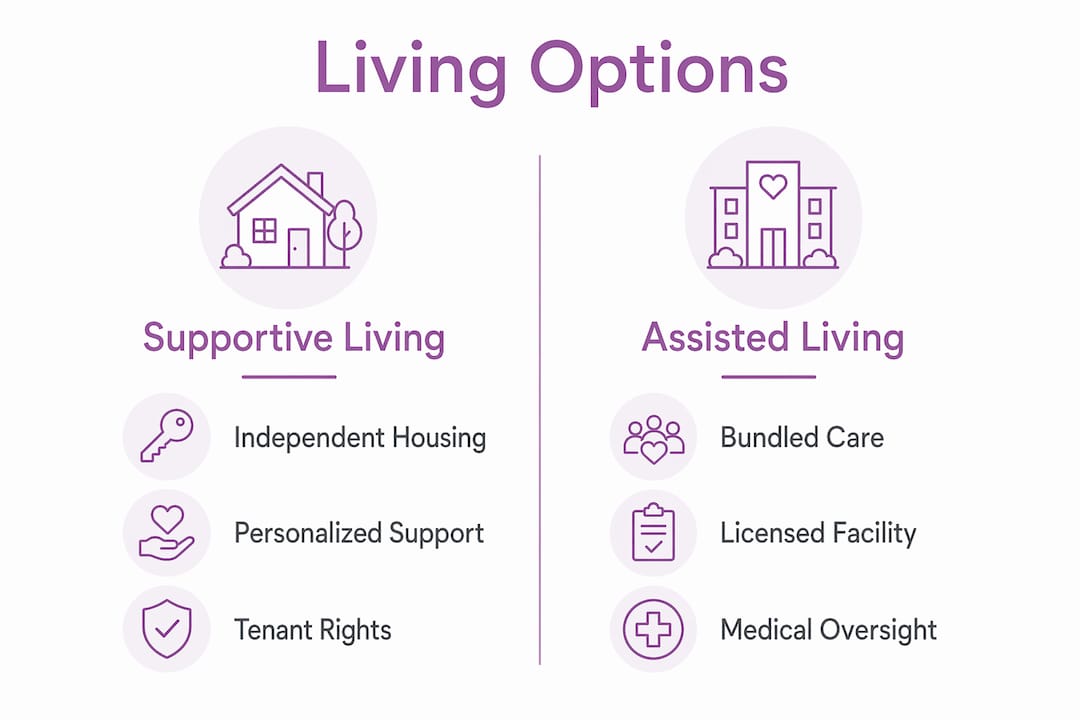
Assisted living supports ADLs like bathing, dressing, and mobility, but it lacks the intensive medical oversight found in nursing homes. Nursing homes, by contrast, are designed for seniors with chronic conditions requiring skilled nursing care around the clock. Supportive independent living sits at the other end of the spectrum, prioritizing autonomy and community integration over clinical structure.
Pro Tip: If your loved one can manage most daily tasks independently but needs help with a few specific activities, supportive independent living is worth exploring before assuming assisted living is the only option. Use the independent living vs assisted living comparison from Assistedlivingadvisers to map needs against care levels.
What are the benefits and challenges of supportive independent living?
The case for supportive independent living is strong, particularly for seniors who value their independence and want to remain part of their community. A five-year study in Denver found that supportive housing residents had fewer police contacts, fewer arrests, and significantly higher housing retention rates compared to those without structured support. That data points to something deeper than convenience: stable, personalized housing with support actively improves long-term well-being.
Key benefits of supportive independent living:
- Legal housing security. The tenant holds their own lease, so a change in care provider does not mean a change in home.
- Personalized support. Services are built around the individual, not a facility’s standard schedule.
- Community integration. Residents live in ordinary neighborhoods, maintaining social connections and routines.
- Flexibility. Support levels adjust as needs evolve, without requiring a move to a new facility.
- Cost control. Housing and care costs are paid separately, which can make it easier to apply for Medicaid Home and Community-Based Services (HCBS) waivers and housing benefits.
Common challenges families should anticipate:
- Coordination demands. Supported living requires active family involvement to manage services, schedules, and any changes in care needs.
- Provider variability. Support quality differs significantly between providers, making vetting critical.
- Planning complexity. Setting up two separate agreements (tenancy and care) takes more upfront work than signing into a single facility.
Pro Tip: Before selecting a support provider, ask for a written description of how they handle staffing changes. High staff turnover is the single biggest predictor of inconsistent care quality in supportive living arrangements.
How is supportive independent living regulated and funded?
Regulation and funding for supportive independent living vary considerably by state, which is one reason families often feel confused when researching options. The core legal principle is consistent across most jurisdictions: housing tenancy and care service agreements must remain legally separate documents. This separation is not just a best practice. It is the structural foundation that gives residents their tenant rights and protects them from displacement.
In Georgia, for example, supportive living communities are regulated with a maximum of 24 residents, creating a deliberately homelike environment that distinguishes them from larger assisted living facilities. Other states apply different caps, licensing requirements, and inspection schedules. Families researching options in New York, New Jersey, or Connecticut will find that local regulations shape what services are available and how providers are licensed.
Funding typically works through two separate channels:
| Funding source | What it covers | Who qualifies |
|---|---|---|
| Medicaid HCBS waivers | Personal care, support services, coordination | Income and care-need eligible individuals |
| Housing benefits (Section 8, HUD) | Rental assistance for the tenancy portion | Income-eligible renters |
| Private pay | Any gap in services or housing costs | Anyone |
| State-specific programs | Varies by state; may include additional support | Determined by state eligibility rules |
Care funded separately from accommodation gives families better financial control and makes it easier to retain benefits. A senior receiving Medicaid HCBS funding for personal care services can simultaneously receive housing assistance for rent, because the two are treated as distinct expenses. Families should consult a benefits counselor or eldercare advisor before signing any agreements to confirm eligibility and avoid inadvertently disqualifying a loved one from benefits.
What practical steps can families take when choosing supportive independent living?
Choosing the right supportive independent living arrangement requires methodical planning. Families who approach this process with a clear framework avoid the most common pitfalls, including signing care agreements that bundle housing and support in ways that undermine tenant rights.
- Assess care needs in writing. Document exactly what support your loved one needs today and anticipate what they may need in 12 to 24 months. Include physical, cognitive, social, and safety considerations.
- Identify housing options separately from care providers. Search for accessible apartments or homes in the target area before selecting a care provider. The two decisions are legally separate and should be treated that way from the start.
- Vet support providers thoroughly. Ask for references, staff turnover rates, and copies of standard care agreements. Confirm that the care agreement does not include any housing clauses that could compromise tenancy rights.
- Review both agreements with a legal or eldercare professional. A benefits counselor or eldercare advisor can confirm that Medicaid HCBS eligibility is preserved and that the tenancy agreement meets local housing standards.
- Plan for age-friendly home modifications. Grab bars, ramp access, and improved lighting are low-cost changes that significantly extend how long a senior can live safely in their own home.
- Build a review schedule. Set a calendar reminder every six months to reassess care needs and confirm that the current support level still matches reality. Needs change, and the support plan should change with them.
Assistedlivingadvisers offers free consultations that include needs assessments and provider matching across the tri-state area. Families who are unsure where to start benefit from working with an advisor who already knows the local provider landscape, rather than starting from scratch. You can also explore the full range of senior living facility options to understand how supportive independent living fits alongside other care models.
Key takeaways
Supportive independent living works because it legally separates housing from care, giving seniors tenant rights, flexible support, and community integration that institutional settings cannot replicate.
| Point | Details |
|---|---|
| Legal separation is foundational | Tenancy and care agreements must be separate documents to protect housing rights. |
| Support is fully flexible | Services range from a few hours weekly to 24/7 assistance, adapting as needs evolve. |
| Funding uses two channels | Medicaid HCBS waivers cover care; housing benefits cover rent, independently of each other. |
| Family coordination is required | Active involvement in managing services and reviewing care plans is not optional. |
| State regulations vary significantly | Georgia caps communities at 24 residents; other states apply different rules and licensing standards. |
Why the legal separation matters more than families realize
Most families I work with focus almost entirely on the care side of supportive independent living. They want to know who will help with meals, who handles medications, and what happens in an emergency. Those are the right questions. But the question families rarely ask until it is too late is: what happens to my parent’s home if the care provider closes or changes?
I have seen situations where a senior’s care and housing were bundled under a single provider agreement. When that provider restructured, the resident had no independent tenancy rights to fall back on. The legal separation between housing and care is not a technicality. It is the single most important protection in this entire model, and families should treat it as a non-negotiable requirement before signing anything.
The other trend worth watching in 2026 is the gradual inclusion of clinical support within supportive independent living arrangements. Telehealth visits, remote monitoring devices, and medication management apps are making it possible for seniors with more complex health needs to remain in their own homes longer than was realistic five years ago. This is genuinely expanding who can benefit from this model, but it also means families need to ask harder questions about how clinical oversight is coordinated and who is accountable when something goes wrong.
The families who navigate this best are the ones who treat the process like a project, not a single decision. They document needs, separate housing from care, vet providers rigorously, and schedule regular reviews. That discipline pays off in stability and peace of mind.
— Eric
How Assistedlivingadvisers can help you find the right fit
Finding the right supportive independent living or assisted living arrangement in the New York, New Jersey, and Connecticut tri-state area takes local knowledge that most families simply do not have. Assistedlivingadvisers provides free, personalized consultations that include a full needs assessment, provider vetting, and placement coordination at no cost to your family.

Whether your loved one is ready for supportive independent living, needs the structured care of an assisted living community, or falls somewhere in between, Assistedlivingadvisers matches families to vetted options that fit both care needs and budget. Start by searching for assisted living near you or explore the full range of independent living options available through the platform. A free consultation takes less than 30 minutes and gives families a clear path forward.
FAQ
What is supportive independent living in simple terms?
Supportive independent living is a care arrangement where a senior lives in their own home or apartment and receives personalized support services under a separate care agreement, keeping full tenant rights and control over their daily life.
How is supportive independent living different from assisted living?
Assisted living places seniors in a licensed facility where housing and care are bundled together, while supportive independent living keeps the two legally separate, giving residents stronger housing protections and greater personal autonomy.
Who qualifies for supportive independent living?
Seniors and individuals with disabilities who can live in their own home with some level of personal support typically qualify. Eligibility for funding through Medicaid HCBS waivers depends on income and assessed care needs, which vary by state.
Can Medicaid pay for supportive independent living?
Medicaid Home and Community-Based Services (HCBS) waivers can fund the personal care and support services portion of supportive independent living. Housing costs are covered separately through housing benefits or private pay.
What is the biggest risk families should watch for?
The biggest risk is signing a combined housing and care agreement that strips the resident of independent tenancy rights. Always confirm that the tenancy agreement and the care service agreement are two separate legal documents before committing to any arrangement.
Recommended
Let’s Work Together To Find The Ideal Senior Living Community For Your Loved One.
Assisted Living Advisers is a FREE, personalized service offering expert guidance in determining the ideal community for your loved one based on physical needs, location preferences and finances.