
Local senior communities are defined as residential care settings within a family’s geographic area that provide housing, health support, and social programming for older adults. The case for choosing one nearby is not just emotional. Research from the NORC study at National Church Residences and the American Journal of Managed Care (AJMC) shows that seniors in supportive local communities experience measurably better health outcomes, lower Medicare costs, and stronger family bonds. If you are weighing why consider local senior communities for a parent or loved one, the answer starts with proximity and ends with significantly better quality of life.
Why consider local senior communities first
The health benefits of local senior living are documented and specific. The NORC study found that older adults in senior living communities reduced hospital admissions and emergency room visits significantly over time, with Medicare costs lowered by about $7,200 per resident by year 3. By that same point, ER visits dropped 14%, and only 1 in 4 residents had hospital admissions compared to 1 in 3 in year 1. That shift represents real money and real relief for families managing care from nearby.
AJMC research reinforces this picture. Medicare beneficiaries in housing with supportive social services had 32% lower hospitalization rates and stayed one day fewer in the hospital compared to peers without such services. The odds of hospitalization for ambulatory-care-sensitive conditions dropped by 43%. These are not marginal improvements. They reflect what happens when a senior has consistent access to care, community, and family.
| Health Metric | With Local Supportive Services | Without Supportive Services |
|---|---|---|
| Hospitalization rate | 88.1 per 1,000 | Significantly higher |
| Hospital stay length | 1 day shorter | Baseline |
| ER visits by year 3 | Down 14% | No change |
| Medicare cost reduction | ~$7,200 per resident | None documented |
| Odds of avoidable hospitalization | 43% lower | Baseline |
“Sustained engagement over time is key to accruing health benefits from senior living, and local communities enable practical sustained family involvement.” — NORC Study, National Church Residences
The data makes one thing clear. Proximity is not a convenience. It is a clinical advantage.
How does local living support social and emotional well-being?
Social connection is one of the strongest predictors of health in older adults. Research published in MDPI’s Environments journal found that socialization and exercise in Naturally Occurring Retirement Communities (NORCs) consistently predict better well-being among older adults. Frequent social and physical activity are not optional extras. They are the mechanism through which community living improves health.

Family contact plays an equally direct role. A study published in Nature Scientific Reports found that more frequent in-person contact with children correlates with better physical and mental health outcomes for seniors. The pathway runs through exercise. Regular family visits lead to higher exercise frequency, fewer depressive symptoms, and better self-rated health. When a community is local, those visits happen more often and more spontaneously.
The daily structure of senior living also matters. Shared meals, scheduled fitness classes, and group activities address what public health researchers now call a loneliness crisis among older Americans. The NORC study found that these daily life rhythms reduce isolation, elevate mental health, and improve physical health outcomes. A local community makes it easy for family members to join those activities, which multiplies the benefit.
When evaluating community social programming, look for:
- Weekly group fitness classes and walking programs
- Scheduled family visit hours with flexible access policies
- Organized outings to local parks, restaurants, or cultural venues
- Volunteer programs that connect residents with the broader neighborhood
- On-site social workers or activity directors who track resident engagement
Pro Tip: Ask the community director for the past month’s activity calendar before your tour. A sparse or repetitive schedule is a red flag. A varied, resident-driven calendar signals a culture of genuine engagement.
What practical advantages does proximity offer caregivers?
Caregivers consistently underestimate how often acute issues arise in the first one to three years after a senior moves into a community. WesleyLife, a senior living organization, advises families to define geographic priorities before beginning their search. Clarifying a search radius and identifying preferred hospitals or physicians upfront reduces caregiver stress and produces better placement decisions. Location is a practical factor, not just an emotional one.
Being nearby shortens response times when problems occur. Medication questions, fall incidents, and appointment changes all require family input. The NORC study found that quicker family involvement during the critical early post-move period helps manage these situations before they escalate. A family that can arrive within 30 minutes resolves issues that a family three hours away cannot.
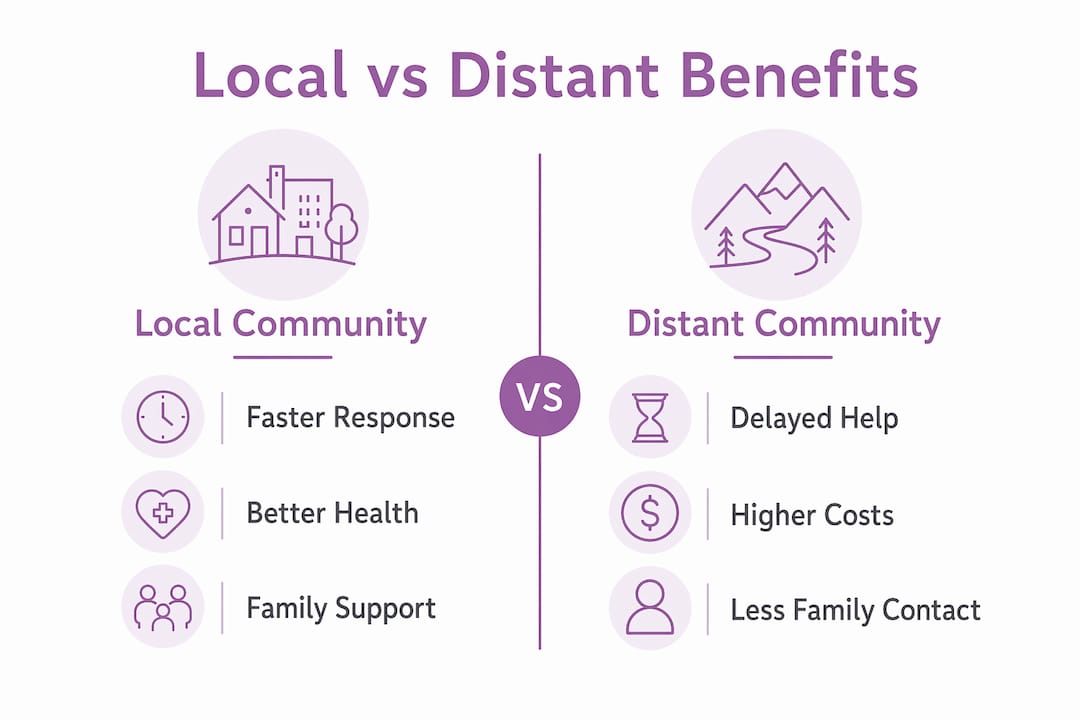
| Factor | Local Community | Distant Community |
|---|---|---|
| Response time for incidents | Under 30 minutes | Hours or a flight away |
| Family visit frequency | Weekly or more | Monthly or less |
| Familiarity with care staff | High, built over time | Limited |
| Coordination with local doctors | Direct and fast | Requires remote communication |
| Caregiver stress level | Lower | Higher |
| Ability to attend care meetings | Easy | Difficult |
Pro Tip: When touring a community, ask staff how they contact families during non-emergency situations. Communities with proactive communication protocols, not just crisis calls, are the ones that keep families genuinely informed.
Choosing a community near your loved one’s existing physicians also matters clinically. Continuity of care with a trusted primary care doctor or specialist reduces the risk of medication errors and gaps in treatment during the transition period.
What types of local senior housing options exist?
Local senior housing options span a wide range of care levels and living arrangements. Understanding the differences helps you match the right model to your loved one’s current and future needs. The main categories available in most metro areas include independent living, assisted living, memory care, and small group homes.
Independent living communities serve active seniors who do not need daily personal care but want social programming, maintenance-free living, and peer connection. Assisted living communities provide personal care support, medication management, and 24-hour staffing for seniors who need help with daily activities. Memory care communities are purpose-built for residents with Alzheimer’s disease or other forms of dementia, with secured environments and specialized programming.
Group homes represent a fourth option that many families overlook. Research published by WTOP found that group homes typically serve 5–20 residents and offer 24/7 assistance within a neighborhood model, often with better staff-to-resident ratios than larger institutions. That ratio translates to more personalized supervision and faster response to individual needs.
Common services and amenities across local senior community types include:
- Three daily meals plus snacks in a communal dining setting
- Scheduled transportation to medical appointments and errands
- On-site physical, occupational, and speech therapy
- Housekeeping, laundry, and personal care assistance
- Emergency call systems and 24-hour staffing
- Recreational programming, fitness facilities, and outdoor spaces
- Social work support and care coordination services
The right choice depends on your loved one’s current health, cognitive status, social preferences, and budget. Specialty senior communities, such as those designed for veterans, LGBTQ+ seniors, or specific cultural communities, are also available in larger metro areas and offer targeted programming that generic communities cannot replicate. Reviewing the full range of elderly housing options before committing to one type gives families a clearer picture of what is available locally.
Key takeaways
Local senior communities deliver measurable health improvements, reduce caregiver stress, and support emotional well-being through proximity, structured social programming, and faster family involvement.
| Point | Details |
|---|---|
| Health outcomes improve with proximity | Medicare costs drop by ~$7,200 per resident by year 3 in supportive local communities. |
| Social engagement is clinically significant | Regular in-person family visits reduce depressive symptoms and increase exercise frequency. |
| Define geography before searching | Setting a search radius and preferred providers upfront reduces caregiver stress and improves placement quality. |
| Community type matters as much as location | Group homes, assisted living, and memory care serve different needs; match the model to current and future care requirements. |
| Proximity shortens crisis response time | Families within 30 minutes resolve medication, fall, and appointment issues before they escalate. |
What i’ve learned after years of watching families choose
Most families I work with focus almost entirely on the facility itself: the dining room, the room size, the activity board. Those things matter. But the single factor that separates a good placement from a great one is almost always how close the family lives to the community.
Here is what I have seen repeatedly. Families who place a loved one in a community 90 minutes away with the best intentions visit less often than they planned. Life intervenes. And when visits drop off, so does the senior’s engagement, exercise, and mood. The research from Nature Scientific Reports confirms what I observe in practice. Frequent in-person contact with family members directly improves physical and mental health outcomes. Distance quietly erodes that benefit.
The other mistake I see is treating proximity as a substitute for quality. A community that is five minutes from your house but runs a thin social calendar or has high staff turnover will not deliver the outcomes the research describes. Proximity enables meaningful contact. The community still has to facilitate it through strong programming and family-friendly policies.
My honest advice: start your search with a geographic boundary you can realistically maintain for years, not just the first few months. Then evaluate communities within that boundary on the quality of their social infrastructure, staff stability, and family communication practices. That combination is what the data actually rewards.
— Eric
How Assistedlivingadvisers helps you find the right local community
Assistedlivingadvisers specializes in helping families across the New York City, New Jersey, and Connecticut tri-state area find vetted assisted living, independent living, and memory care communities close to home. The service is free to families and includes a full needs assessment, guided tours, and move-in coordination.

If you are ready to explore options near you, Assistedlivingadvisers connects you with communities that match your loved one’s care needs, social preferences, and budget within your preferred geographic area. Start by searching for assisted living near you to see what is available in your neighborhood. For families comparing care levels, the guide on retirement vs. assisted living explains the key differences clearly. Schedule a free consultation today and get expert guidance without the guesswork.
FAQ
What are the health benefits of local senior communities?
Seniors in local supportive communities see Medicare costs reduced by about $7,200 per resident by year 3, with ER visits dropping 14% and hospitalization rates falling 32% compared to peers without supportive services, according to the NORC study and AJMC research.
How does proximity help family caregivers?
Being within a short drive allows families to respond quickly to medication questions, fall incidents, and care meetings, which the NORC study links to better outcomes during the critical first one to three years after a senior’s move.
What is the difference between a group home and assisted living?
Group homes serve 5–20 residents in a neighborhood setting with high staff-to-resident ratios, while assisted living communities are larger facilities offering structured personal care, dining, and programming for seniors who need daily support.
How do i start searching for local senior housing options?
WesleyLife advises defining your geographic search radius and preferred healthcare providers before you begin. That step narrows your choices and reduces decision fatigue significantly.
Does social programming really affect senior health?
Yes. MDPI research on NORCs found that frequent socialization and physical activity consistently predict better well-being, and the NORC study links daily structured activities directly to reduced isolation and improved mental and physical health outcomes.
Recommended
- 7 Key Advantages of Senior Living Communities
- How Assisted Living Communities Can Provide Better Outcomes for Seniors – Assisted Living Advisers
- Top Benefits of Assisted Living Communities – Assisted Living Advisers
- The Top 5 Benefits of Assisted Living Communities for Seniors – Assisted Living Advisers
Let’s Work Together To Find The Ideal Senior Living Community For Your Loved One.
Assisted Living Advisers is a FREE, personalized service offering expert guidance in determining the ideal community for your loved one based on physical needs, location preferences and finances.